Israel steps up strikes on Lebanon and Hezbollah attacks continue as talks loom

 EPA
EPAIsraeli air strikes and Hezbollah rocket attacks intensified over the weekend in southern Lebanon and northern Israel, as both sides signalled the war would continue despite diplomatic efforts.
Lebanon's health ministry said that since fighting renewed on 2 March after a Hezbollah attack on Israel, Israeli attacks have killed 2,055 people, including 167 since Friday. Twelve Israeli soldiers and two civilians have been killed by Hezbollah over the same period, Israeli authorities say.
Fighting has continued despite a ceasefire between the US and Iran, which Israel says does not apply to its campaign in Lebanon.
Lebanese, Israeli and US officials are due to hold talks in Washington on Tuesday.
The Lebanese president's office told the BBC that the discussions would focus on conditions for a ceasefire, and that formal negotiations could follow if an agreement was reached.
Hezbollah, however, has rejected the initiative and has held protests in central Beirut, where supporters waved Hezbollah flags and pictures of the group's late leader, Hassan Nasrallah, who was killed by Israel in 2024.
Israel's embassy in Washington has said it has refused to discuss a ceasefire with Hezbollah and that the talks will constitute the start of formal peace negotiations.
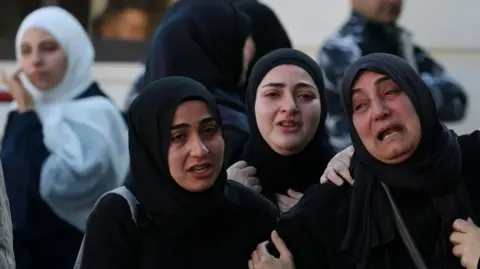
Among the latest victims of the weekend bombardment was Taleen Saeed, just under two years old.
She had survived a strike on her family home in southern Lebanon last Wednesday, but was killed when another hit during her father's funeral.
Her seven-year-old sister, Aline, was badly burned and was in hospital at the time, wrapped in layers of bloodied gauze. Their grandfather, Nasser Saeed, 63, narrowly escaped the strike.
"This isn't humanity. This is a war crime," Saeed told Reuters news agency.
"Where are the human rights? If a child - a child - is wounded in Israel, the whole world jumps up. Are we not people? Are we not humans? We're like them!" he cried.
On Sunday, Lebanon's Prime Minister Nawaf Salam said efforts to end the conflict were continuing, even as fighting intensified.
"We will work to stop this war and obtain the Israeli withdrawal from all of our territory," Salam said in a televised address.
"We are continuing our efforts... by negotiating to stop the war," he added.
Meanwhile, Israel's Prime Minister Benjamin Netanyahu struck a more defiant tone while visiting Israeli troops who have invaded southern Lebanon.
"The war continues, including in the security zone in Lebanon," he said. "We have thwarted the threat of an invasion from Lebanon thanks to this security zone."
Israel has previously announced the creation of what it described as a security buffer zone extending eight to 10km (five to six miles) inside Lebanese territory, saying the move was necessary to protect Israeli communities from Hezbollah attacks.
Heavy Israeli air strikes were reported across dozens of towns in southern Lebanon on Sunday, including in Bint Jbeil, the site of fierce fighting during the 2006 war between Israel and Hezbollah.
The Israel Defense Forces (IDF) said troops had killed more than 20 Hezbollah fighters operating from a hospital compound in Bint Jbeil.
Lebanon's health ministry denied the claim, accusing Israel of targeting civilians and medical facilities.
The weekend strikes also hit emergency responders, killing a Lebanese Red Cross rescuer.
The organisation said its team had been "directly targeted by an Israeli drone" while carrying out a humanitarian mission. The BBC has approached the IDF for comment.
The death marks the second killing of a Red Cross volunteer in recent weeks.
Lebanese authorities say more than 80 rescuers and medical personnel have been killed in Israeli strikes since the start of the war.
The United Nations Interim Force in Lebanon (Unifil) also reported confrontations with Israeli troops, saying Israeli tanks rammed two peacekeeping vehicles on two separate occasions, causing significant damage.
In response, the IDF said Unifil had not co-ordinated its movements with Israeli forces ahead of time, and that it was not working against Unifil or Lebanese civilians.
Civilian suffering continues to mount, with around 1.2 million people displaced across Lebanon, and tens of thousands in northern Israel, as the conflict enters another week of sustained fighting.