Statue of computing pioneer officially unveiled

 BBC
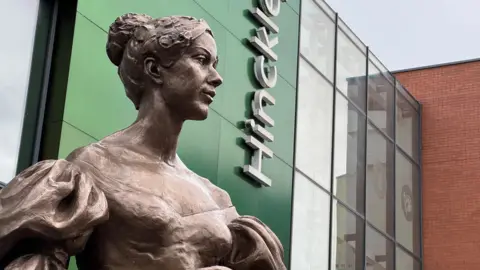
BBCA statue of pioneering 19th Century mathematician Ada Lovelace has been officially unveiled in the town near her childhood home.
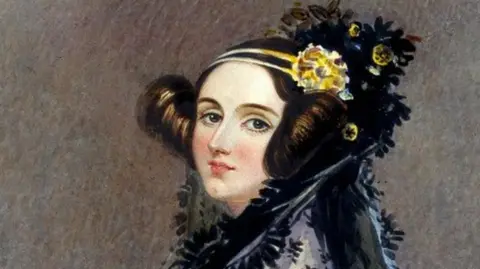
Lovelace, the daughter of romantic poet Lord Byron, has been widely described as the world's first computer programmer because of her work with inventor Charles Babbage on his idea for an "analytical engine" in the 1800s.
She was born in 1815 in London, but her childhood home was the now demolished Kirkby Mallory Hall, some five miles (8km) from Hinckley in Leicestershire.
The 2.5m (8ft 2in) bronze sculpture was unveiled by the Lord Lieutenant of Leicestershire Mike Kapur at a ceremony in Lower Bond Street on Saturday.
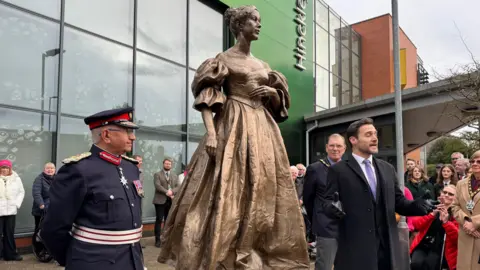
The Ada Lovelace in Hinckley Community Interest Company was behind the project, which cost £100,000 and was paid for through donations and fundraising.
The statue of Lovelace, who died in 1852 at the age of 36, stands outside the Hinckley campus of the North Warwickshire and South Leicestershire College.
Byron Richards, a distant relative of Lovelace, said he was told she was persuaded not to take art and to go into science instead.
He said: "I am pleased to be here. It was so emotional.
"The team have done a fantastic job. It's absolutely amazing."
 Science Museum
Project leader Stan Rooney said: "Ada Lovelace was remarkably ahead of her time.
"Not only did she help Charles Babbage with his conception of an early computer, but she showed that a computer could be programmed and that it had applications beyond just crunching numbers."
Rooney said "she loved Hinckley" and it was fitting to give the town its first statue and "an identity".
"You could say Hinckley has become faceless, so we're hoping that Hinckley will become known as the home of Ada Lovelace," he added.
He said the location for the sculpture was chosen to inspire girls and young women to study science, technology, engineering and mathematics (STEM).
Marion Plant, principal and chief executive of the college, said: "This statue will stand as a visible reminder to our students, staff and the wider community that ambition, curiosity and talent can change the world.
"We hope that it will particularly encourage people, especially girls and young women, to consider opportunities in science, technology, engineering and mathematics, areas that are central to Ada Lovelace's legacy."
The statue is a replica of one commissioned by a property developer for a building in Westminster, London.
The sculptors who created it, Mary and Etienne Millner, had agreed to allow the mould to be used to replicate the original statue.
Follow BBC Leicester on Facebook, on X, or on Instagram. Send your story ideas to eastmidsnews@bbc.co.uk or via WhatsApp on 0808 100 2210.