Courting capercaillies up 50% on Cairngorms reserve

 Getty Images
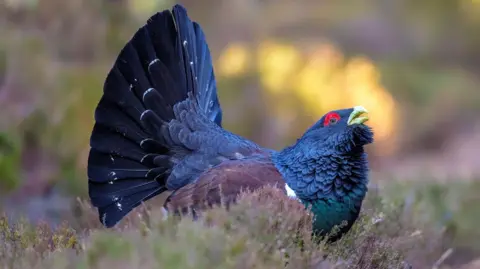
Numbers of breeding male capercaillies on a Cairngorms nature reserve have increased by 50% since 2020, according to RSPB Scotland.
The large woodland grouse were once more widespread across the UK, but the charity said only an estimated 532 birds survived in native pinewood forests in Scotland.
Habitat loss, eggs being eaten by pine martens, and badgers and capercaillie being killed flying into deer fences, have been blamed for declines in numbers.
Last year, 30 lekking males were recorded at RSPB Abernethy. A lek is a courtship ritual which sees male birds gather in the same area to compete for females' attention.
The Scottish government has announced an emergency plan to boost numbers in the Cairngorms National Park.
Increasing areas of habitat, minimising human disturbance and diverting predators to other sources of food are among the ways of helping capercaillie.
Cattle and a remotely-controlled mower have been used at RSPB Abernethy to cutback heather. This allows blaeberries - one of the birds' favourite foods - to flourish.
Conservation manager Richard Mason said: "The increase in the number of lekking male capercaillie is thanks to the huge amount of work we are undertaking to improve habitat quality.
"The combination of cutting and extensive cattle grazing has dramatically improved conditions in the forest.
"We are seeing many chicks reaching full size and whilst the future of capercaillie remains in the balance, we are hopeful that these techniques can support their recovery in Scotland."
He added: "There is still a lot of work to be done for capercaillie, not just at RSPB Abernethy, but across all capercaillie sites in Scotland."
'Horse of the forest'
The capercaillie is a native species that became extinct in Britain in the mid-18th Century.
The main cause for the extinction was thought to have been a catastrophic loss of its woodland habitat.
Birds from Sweden were reintroduced into Perthshire in 1837, followed by later reintroductions to Scottish pinewoods.
Four years ago, conservationists warned the species could be extinct within the next 30 years.
The Gaelic name for the birds is capall-coille, meaning "horse of the forest".