Heat pumps for all new homes and plug-in solar in green tech drive

 EPA/Shutterstock
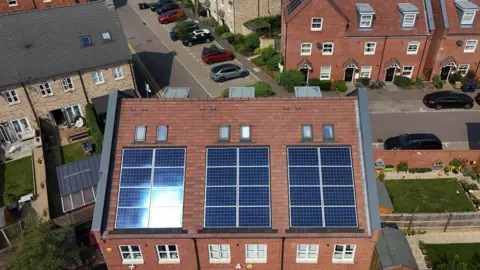
Developers will be required to install solar panels and heat pumps in all new homes in England as part of updated planning requirements published by the government.
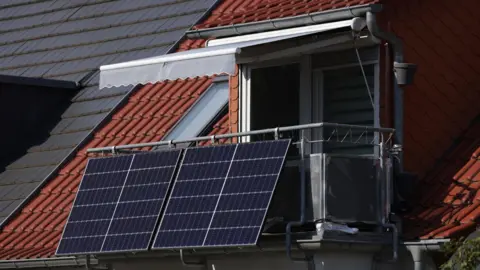
It also said plug-in panels that homeowners can self-install on balconies would be available in supermarkets in the coming months.
These small versions of the green tech are already deployed across Europe but are not currently sold in the UK due to safety regulations.
Announcing the raft of measures to ramp up solar, the energy secretary said the Iran war had shown clean power was "essential".
The move has been welcomed by some energy companies but developers have raised concerns about the scale of solar required.
For the last decade, successive governments have been trying to develop the Future Homes Standard - an update to the way that new homes have to be designed in England.
The guidance published on Tuesday means that from 2028, no new homes will be on the gas network - and will instead be on a heat network or get a heat pump - and they must have solar panels on their roofs covering an area equivalent to 40% of the ground floor space.
"The Iran war has once again shown our drive for clean power is essential for our energy security so we can escape the grip of fossil fuel markets we don't control," said Energy Secretary Ed Miliband.
The announced changes have been welcomed by the energy industry and those working in green technology for providing certainty that heat pumps and solar panels are worth investing in.
"It's going to give clarity to the UK market, installers, builders, manufacturers, that there's a significant market that's there," said Garry Felgate, CEO of MCS Foundation, which certifies installers of low carbon heating systems.
The changes in building requirements are estimated to add an additional £10,000 onto the cost of the home for developers, but over the long term will likely bring down the cost of energy bills for customers.
The savings could be significantly increased where homes have batteries, but the government opted not to include those as a requirement.
Hannah McCarthy, head of partnerships for new homes at Octopus Energy, told the BBC: "Decarbonising the new housing stock is a fantastic step - batteries would take that a step further."
Although the Home Builders Federation (HBF) said the additional cost that developers now face from the changes was "not welcome at any time", it said the industry had been given a lot of forewarning.
But Neil Jefferson, CEO of HBF, said the size of the solar panels mandated for each home was unexpected.
"The government has really pushed the number of solar panels that are required on rooftops right to the limit, we think 60% of homes can't actually reach that standard," he said.
There are exemptions to the requirement, such as when the design does not give enough space for the solar panels.
But Jefferson said: "Each home will have to be looked at individually.
"There are some challenges within the process [and] we don't want bottlenecks."
The government has a target to build 1.5m homes by 2029 - but in December the housing secretary, Steve Reed, told the BBC there would need to be a surge in building after rates of construction appeared to drop.
Both the Liberal Democrats and the Green Party welcomed the move to ensure all new homes have solar panels. But Dr Ellie Chowns, from the Green Party, added that it was "utterly ridiculous" to wait until 2028 before implementing the changes.
In Scotland, gas and oil-based heating in new build homes was banned two years ago. Housebuilders are now required to install what it classifies as 'climate-friendly' heating systems which can include wood burners as well as heat pumps or district heating.
 Sean Gallup/Getty Images
On Tuesday, the Conservatives said policy should be focused on securing domestic energy supply to lower consumer bills, calling on the government to issue licences for new oil and gas fields in the North Sea and to scrap green subsidies.
This was echoed by Richard Tice, Reform shadow business secretary, who called on the government to scrap its 'net zero' policies
"All these measures will cost the taxpayer vast sums," he said.
Speaking on R4 Today programme, the Energy Minister Michael Shanks said he did not accept that drilling more in the North Sea was the answer to lowering energy bills.
"For 60 years [the North Sea] has been a hugely important asset powering the country, but for the last 20 years it has been in decline.
"The North Sea will remain hugely important...but our long term future doesn't lie in fossil fuels," he said.
As well as changes to requirements for new-builds, the government wants to make it easier for those in existing homes in the UK, particularly those in flats, to access renewable energy.
The government said it was working with major retailers like Lidl and Amazon to make plug-in solar available on the high street.
These DIY solar panels do not have upfront installation costs and are designed for balconies and small garden spaces.
They have been successful in Germany, where it is estimated that more than 1.5m homes have them.
But currently the panels are not sold in the UK as they do not meet safety regulations for electrical installations. The government said it was working to review and update these in the coming months.
Mark Coles, head of technical regulations at the IET, said that because of the UK's ageing housing stock and "poorly maintained electrical installations" introducing plug-in solar could pose risks to homeowners.
"Before purchasing any off-the-shelf generation product, householders should have their electrical installation checked by a competent electrician. What may be safe in one home may pose a significant risk in another," he said.

Sign up for our Future Earth newsletter to get exclusive insight on the latest climate and environment news from the BBC's Climate Editor Justin Rowlatt, delivered to your inbox every week. Outside the UK? Sign up to our international newsletter here.