Tourist finds rare chunk of oldest sea crocodile

 BBC
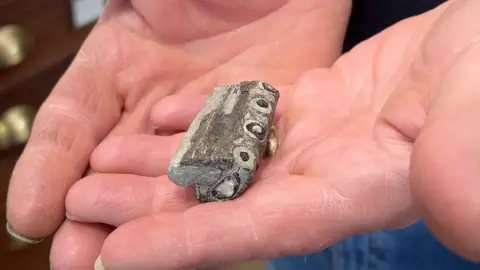
BBCAn amateur fossil hunter who found a rare fragment from the world's oldest marine crocodile said she thought it was a piece of wood with nails driven through it.
The upper jawbone fossil, found during a guided walk along the Lyme Regis shore in Dorset, is thought to be one of only 11 found from the animal.
Dr Paul Davis, palaeontologist and geology curator at Lyme Regis Museum, said that it will help researchers understand how the Jurassic croc hunted in the world's early oceans.
It went on display to the public last week, as part of the museum's exhibit on the "Charmouth Crocodile" - first discovered in 2017 in nearby Charmouth.
 Lyme Regis Museum/Heather Steed
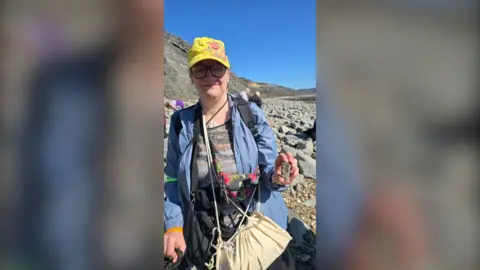
Heather Salt, an amateur fossil hunter from Solihull near Birmingham, said she travelled down to Lyme Regis in hopes of finding something for her own collection.
"I really just wanted to find a little ammonite," she said.
"It was by where there's an old dump eroding onto the beach, and there's lots of bits of metal, so I looked down and thought it was nails stuck into something."
But when she picked it up and realised it was stone, she started to become suspicious.
"I went and showed it to Casey [the guide] and he got so excited and he just said - 'are you kidding me!' and he was calling everyone over to have a look."
"After, I said to Casey: 'Well, I just wanted to find a little ammonite."
"He said: 'I would trade you my entire collection of ammonites for that.'"
Before leaving, she was found by the museum's geology curator, Dr Paul Davis.
"He came rushing over and he got so excited and he said, 'that's croc!'"
She said after she learned how important the find was, she was happy to donate it to the museum.
"I did find my own little ammonite in the end which was what I really wanted."
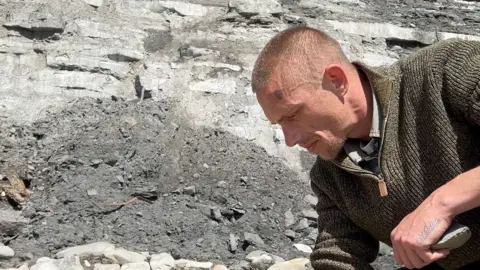
Casey Rich, a fossil walk guide with Lyme Regis Museum, said when he was handed the rock he immediately knew it was something special.
His first thoughts were that it might be another marine reptile like an ichthyosaur or plesiosaur.
"Bits of ichthyosaur are rare enough, so even if it was a piece of ichthyosaur it would have been a fantastic day," he said.
His colleague then looked over his shoulder at what he was holding and said, "either plesiosaur or croc."
"When you hear 'croc', you instantly think of the rarity," said Rich. "How special that find potentially is really started to hit home."
It was later sent into a group chat and the importance of the 200 million year old fossil began to become apparent.
"I'm just grateful it was on one of my walks," he said.
What was the Charmouth Crocodile?
 Júlia d'Oliveira/Lyme Regis Museum
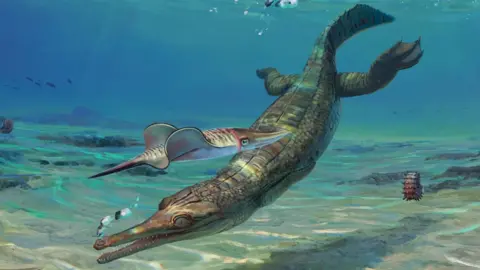
The "Charmouth crocodile" spent most of its life in the sea, only coming ashore to lay eggs and raise young.
It was slender, about 2 metres long, and it had a thin long snout specifically adapted for eating fish.
It's known as a marine crocodile, but it's more accurately a thalattosuchian rather than a true crocodilian.
Both modern crocodiles and Thalattosuchia are part of the wider group Crocodylomorpha.
That group has an evolutionary history stretching back around 230 million years to the early Jurassic.
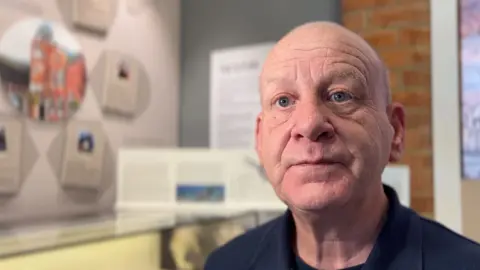
And the 11 known fossils of this animal are the first good evidence for the early evolution of the crocodylomorpha, said Dr Paul Davis, geology curator at Lyme Regis Museum.
"We've got a critical period of time where the crocodylomorph group were rapidly evolving, but we have no fossils. These are some of those critical fossils," he said.
"It shows that even 200 million years ago, they were already highly evolved and adapted for a marine habitat."
Dr Davis said this find will help researchers understand how the animals jaws worked, and how it caught fish.
"We're getting these tantalising fragments," he said. "What we would love to find eventually would be a complete skull...that would help us to solve some of the issues we have about their evolution and biology."