Canada accused of cheating again in curling row
Tensions rise in the curling after Sweden accuse Canada of double-tapping their stones
- Published
For the second time in two matches, Canadian curler Marc Kennedy has been accused of cheating by an opponent at the Winter Olympics.
The 44-year-old - who won gold in 2010 and bronze four years ago - became involved in a heated verbal exchange with Sweden opponent Oskar Eriksson towards the end of his side's 8-6 win on Friday.
The Swedes believed Kennedy was repeatedly double-touching some of his stones - releasing the handle at the appropriate time but then giving the stone another little prod with his finger to correct its course - with TV pictures appearing to show that he did indeed touch the stone on occasion.
That led World Curling to announce that they would deploy extra officials for the remainder of the Games to check for such infractions - a departure for a sport that is self-governed by the players.
However, when the Canadians returned to the ice on Saturday to face Switzerland, controversy flared around Kennedy again, with the Swiss reporting him to the umpire for the same offence in their 9-5 win.
"I saw [Kennedy do it] when the referee was next to me," Swiss lead Pablo Lachat-Couchepin told BBC Sport.
"I really believe it does nothing - it doesn't change the stone - but when you have a referee looking at it, they should see it.
"I was a bit annoyed and said to the chief umpire if they send an email they have to follow what it says. It's nothing against Marc but you have to follow the rule."
After the initial accusation, Kennedy - who was later given a warning for using foul language - said: "I don't like being accused of cheating after 25 years on tour and four Olympic Games So I told him [Eriksson] where to stick it.
"He might have been upset that he was losing..."
What did Kennedy do? And is it allowed?
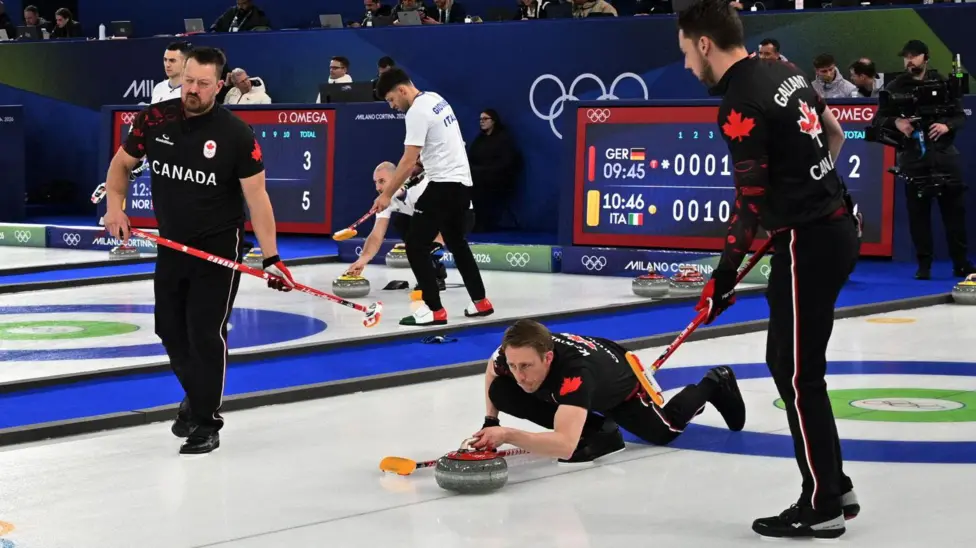
Canada's Marc Kennedy was accused of double-touching stones when he released them
Each stone has a sensor on it to ensure players release their grip on the handle before the thick green line that runs across the ice, known as the hog line.
If they do, the sensor flashes green. If not, a red light shows.
In both matches Kennedy's stone showed green, but his opponents thought they saw the Canadian give his throw an extra push with his finger on the stone after letting the handle go - and the video evidence seems to back that up from the Sweden game.
But, as BBC Sport curling commentator Steve Cram asked former world champion Jackie Lockhart, is it actually cheating and does it make a difference?
"You should not be touching the stone after you've released it," Lockhart said. "If you touch it with a broom, it's burned and removed.
"He's released that stone, then poked it with his finger - I'm not sure why. Is it to push it a little bit harder because he felt he didn't give it enough?"
Fellow pundit Logan Gray suggested it was perhaps "muscle memory rather than active cheating", and after their win over the Czech Republic on Saturday, Team GB's Grant Hardie said that to call it cheating "would be a stretch".
Skip Bruce Mouat added: "I'm sure Marc didn't mean anything by it, it is just that he was caught doing it on TV. Now it's out there, it should be regulated pretty well, and hopefully by the athletes."
'They have to follow the rules' - curling controversy reaction
What happens next?
But will anything come of it? It appears not.
When the teams come off the ice after a game, they are required to sign a declaration saying they are happy with the result.
After the first incident, World Curling confirmed that "decisions made during a game are final" and that they do not use video replays "to re-umpire" decisions.
They added that "touching the granite of the stone" is not allowed and that once the issue was brought to the umpire's attention in the game with Sweden, officials were positioned at the hog line to monitor throws for three ends - as per protocol.
No violations were observed, so no action was taken.
It remains unclear what the fallout will be to the second allegation by Switzerland but it does leave a cloud over the Canadians, who are considered medal contenders and seem well placed to reach the semi-finals.
"The question we should be asking is if Oskar is challenging him, has he [Kennedy] done it before?" Lockhart added. "Have they been doing it at other Championships and now they're being called out on it?
"I'm a bit disappointed with the Canadians if that's what they're doing. We'll all be looking now."
Winter Olympics 2026
6-22 February
Milan-Cortina
Watch two live streams and highlights on BBC iPlayer (UK only), updates on BBC Radio 5 Live and live text commentary and video highlights on the BBC Sport website and app.