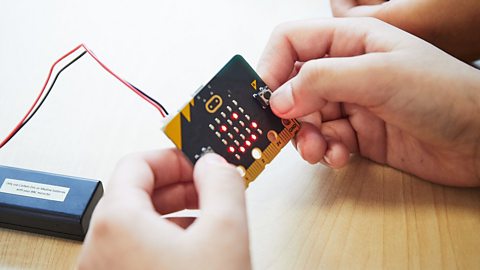
Sometimes an opportunity or new experience early can open a door that might impact your whole life – for Spencer Kelly it was learning to code at school.
“Being able to get your hands on a bit of technology that's not too complicated really gives you a passion for being creative. I loved it when I was at school.”

Who is Spencer Kelly?
Spencer Kelly is a technology journalist and presenter, notable for presenting the BBC’s technology programme Click. Spencer has a huge passion for technology and all things innovation. His job as a presenter has taken him all over the world with highlights of his career including interviewing Bill Gates and James Cameron, flying a jet pack and testing satellite broadband in the Namib Desert amid red sand dunes, hundreds of miles away from any technology.
We caught up with Spencer to find out what inspired him to his career path and why he has been involved with promoting the BBC micro:bit - the next gen camapign, a campaign to inspire design and innovation through improving technology skills in primary school children.
Spencer's early experience with technology
So where did it all begin? Spencer told us that he started his technology journey at school in the '80s when he was 8 years old. His school had taken delivery of a BBC micro, a home computer made for schools. “My teacher, Mr. Simmons was working on it. I just looked over his shoulder and thought, what’s that? And I just fell in love with this computer and started programming it.”
Spencer used the BBC micro whenever he got a chance, writing computer programs and quizzes on his lunch breaks, he feels that really set him on a path. Spencer explains “When you’re writing computer programs, I think it helps you solve problems in a particular way and I fell in love with that way of thinking. If you are faced with a really complicated challenge, if you break it down into smaller steps, you can pretty much achieve anything and it set me onto the path that led me to where I am today.”

It's about giving kids access to technology, helping them to just think really creatively about how it can be used
Spencer went from writing computer programs at break, to being the head of his computing club at school, to doing computer science at university. “I went into radio and now presenting Click on the TV is a mixture of the two (technology and broadcast). It shaped my entire life and that’s why I’m passionate about doing the same for kids these days”.
Spencer has had a long relationship with the BBC. It was a BBC Scheme that provided the computer he fell in love with, a pre-cursor to the BBC micro:bit (a tiny pocket sized computer) which was first distributed to secondary schools in 2015. Spencer explains “The BBC micro:bit – the next gen campaign is the latest scheme by the BBC to get coding into schools. It’s about giving kids access to technology and helping them to just think really creatively about how it can be used.”
The micro:bit - the next gen campaign launched in September 2023 with the aim of making technology and computing accessible. Targeted at primary school children, the campaign has given away almost 700,000 micro:bits to schools across the UK.
Why does Spencer support the campaign?
We asked Spencer why he has been involved with the BBC micro:bit - the next gen campaign.
“It takes me back, being able to get your hands on a bit of technology that’s not too complicated and really gives you a passion for being creative. I mean, I loved it at school.
For better or for worse, more kids have phones these days. Those are super computers in their pockets. Everything uses technology now so it’s really important that the next generation are not scared of technology.
They’re open to what it can do and also open to using it to solve the world’s problems. I think this is a great start, just to get your hands on something and understand that the world is your lobster.”

More from BBC micro:bit - the next gen
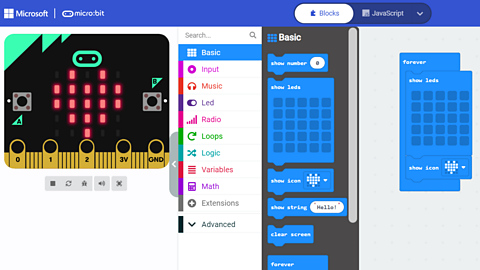
Coding made easy with the MakeCode platform
Find out more about using MakeCode and the training resources available to get you started.

Our partners
Find out more about the organisations supporting our micro:bit initiative.