Key points
Overview
The poem is a first person reflection on guilt, violence, and the struggle to reconcile beliefs with actions. The speaker questions his own maturity and morality, expressing regret for violence and a sense of being trapped in one place. The title Here suggests a fixed, uncertain position, both physically and emotionally.
Main themes
The poem explores guilt, growth, faith and doubt, existence and meaning, violence, and suffering. It considers the burden of inherited and personal guilt, the search for meaning, and the difficulty of moving on from past actions.
Tone and voice
The tone is frank, bleak, raw, questioning, and resigned. The speaker’s voice is direct and confessional, shifting from declarative statements to desperate questions, revealing uncertainty and inner conflict.
Context
RS Thomas was a Welsh poet and clergyman, known for his religious faith, pacifism, and concern with the harshness of rural life. He wrote in a post-war context, reflecting widespread disillusionment and questioning of authority. His poetry often uses simple language to address complex spiritual and moral issues, and Here reflects his lifelong pacifism and suspicion of modernity.
Form and structure
The poem is made up of seven tercets (three-line stanzas), each expressing a single idea. The rhyme scheme is mostly AAA, but often uses slant rhymes, creating a sense of unease. The metre is irregular, with short lines and varying syllable counts, adding to the discomfort. The poem moves from statements to questions, ending with the speaker accepting he must "stay here with my hurt".
Poetic devices to spot
- Declarative and imperative statements – "I am a man now" and "pass your hand over my brow".
- Simile – "I am like a tree" suggests growth and rootedness.
- Metaphor – "footprints that led up to me", "stain", "clock of my whole being".
- Imagery of the body – "brow", "brains", "blood", "veins", "loins", "hands", "heart".
- Questions – "Why, then, are my hands red with the blood of so many dead?", "Does no God hear when I pray?".
- Enjambment – ideas flow across lines, reflecting uncertainty.
- Repetition – the word "here", and references to the body, emphasise the speaker’s struggle.
- Allusion – references to ‘Original Sin’ and inherited guilt.
- Irony – the speaker’s uncertainty contrasts with the opening statement.
Here
by RS Thomas
A link to this poem is available in the CCEA Poetry Anthology which can be downloaded from the CCEA website.
The BBC is not responsible for the contents of any other sites listed.
Summary
A speaker grapples with the guilt of violence he has committed and the gulf between beliefs and actions. First published in 1961.

Title: A terse, one-word title which seems to place the speaker (and reader) in a location but does not specify where; the speaker occupies a space, ‘here’, but does not indicate where it really is or where else they can go. The word "here" can variously be a A noun is the name of a thing, such as an object, a place, or a person., an A word used to describe a noun., or even an A word that describes a verb (an action or a doing word). For example, 'he ran quickly' - 'ran' is the verb and 'quickly' is the adverb. in different contexts – the title gives away nothing other than a sense of existing in a single spot.
Themes: Guilt, growth, faith and doubt, existence and meaning, violence, suffering.
Tone: Frank, bleak, raw, questioning, uncertain, angry, desperate, resigned.
Speaker: A first person male speaker, sometimes assumed to be the persona of a soldier regretting his commitment to war.
Applicable context
- Ronald Stuart Thomas was a Welsh poet and clergyman born in 1913. Religion was important to him, and he wanted others to be in touch with their spirituality. His biographer Daniel Westover noted that Thomas tried to write “spiritually minded poems relevant within, and relevant to, a science-minded, post-industrial world”.
- Thomas was known as a fierce Welsh nationalist. He learned the Welsh language when he was around thirty; he wrote his biography in Welsh but noted it was learned “too late” for it to serve his poetry. This, along with the fact he felt poetry was often written in ways that made it inaccessible to ordinary people, may explain the simple language he uses in poems like Here.
- He was suspicious of technology and commercialism, and while he loved Wales and wrote about its beauty, he also focused on the harshness of the rural life that his parishioners experienced. His lifelong pacifism seems relevant to Here, in which the “the blood of so many dead” could suggest war casualties. Many poets of the 1950s and 1960s were deeply disillusioned in the wake of World War Two, and wrote works which questioned the political establishment and expressed uncertainty about the modern world; Thomas reflects some of these values in his wider work.
Only a little context is needed for each poem; where used, it should be applied to the point you're making.
Form and structure
- The poem is divided into seven A tercet is a group of three lines in a poem. It is a type of stanza. (three line A grouped set of lines within a poem.), each of which is short, even terse, and expresses one key idea or thought. Some have noted that seven is a spiritually and religiously significant number, and that this could have influenced the religious poet’s choice of structure.
- The rhyme scheme of each tercet is AAA, although some rhymes are slant rhymes or half-rhymes rather than perfect matches for the other sounds with which they’re paired. Stanza one rhymes “now” and “brow” before its third line ends in “grow”, spelled the same as the others but differently pronounced; stanza three rhymes “loins” with “veins” and “stain”, while the final stanza rhymes “start” and “heart” with “hurt”. These incomplete, imperfect rhymes, particularly the one at the very end of the poem, create a slight discord throughout and give a sense of unease that echoes the moral unease of the speaker.
There is blood in my veins
That has run clear of the stain
Contracted in so many loins.
- The The rhythm of a line of poetry based on how many syllables it has and where they are stressed or emphasised – likes beats in music. varies but has some metrical consistencies in each tercet: each first line is five or six syllables, while the second and third lines stay within a range of seven to nine syllables. This gives the stanzas a basic sense of overall consistency, but lacks the steadiness and evenness of exact metre, which again leaves the reader feeling slightly uncomfortable and uneasy as the speaker’s thoughts unfold.
Language and poetic methods
Declarative and imperative: Thomas opens the poem with a simple declarative statement – “I am a man now”. It announces to the reader who the speaker is and at first it seems factual and certain in its simplicity. We can read this more than one way, however. Perhaps the speaker is indeed as assertive and sure of himself as the statement suggests – or perhaps the statement is Happening in the opposite way to what is expected and maybe causing amusement because of it., and the speaker is stating it so openly because he himself isn’t sure that it’s true. Or isn’t sure that being a man is what he expected it to be. “Now” proposes he has only recently ‘become’ a man; the simple language of the poem may further suggest the speaker is young, and less convinced of his own maturity than his opening statement initially sounds.
The Verbs that give commands, instructions, or requests directly to the reader or a specific character which follows, in which the speaker tells us to “pass your hand over my brow”, seems like an attempt to engage the reader and make us agree with him. Is this a sign he is happy to prove how mature he really is, or is he simply trying to convince us? These lines may seem straightforward but in the wider context of the poem and its questioning, disillusioned tone, the declarative opening could either be underpinning the speaker’s uncertainty or providing a contrast for the questions that begin in A grouped set of lines within a poem. four.Simile: “I am like a tree” opens the second stanza with a fairly simple A simile is a word or phrase used to make a comparison for dramatic effect, using 'like' or 'as'.. The connotations of the tree here could be suggested by the rest of the stanza – being able to “see” from the “top boughs” suggests the tree is tall. The speaker is illustrating his own stature as a fully grown man, perhaps meaning intellectual growth as well as physical size. There could also be a link to Thomas’ belief in humanity being connected to nature, and even an allusion to a ‘family tree’. This fits with the idea of the “footprints that led up to me” – a sense of being connected to his ancestors by family lineage.
In the wider sense of the poem Here, it may be worth remembering that a tree, though it may be tall and strong, is rooted in one place and cannot move. By the last line of the poem, staying stuck in one place seems to illustrate the speaker’s plight.Metaphors: The second stanza’s image of “footprints that led up to me” is a metaphor for what has been and gone before him. This most likely means the previous generations of his familial ancestors, given the references to “blood” (like a bloodline) and “loins” in the following stanza, but it could also be hinting at his own past beliefs, choices, and actions. The A metaphor is a word or a phrase used for dramatic effect, to describe something as if it were something else. of the “stain” in stanza three suggests the idea of ‘Original Sin’ – the ideas in some religions that all people are born bad and must strive to be good, and that sin causes a ‘stain’ on one’s soul. This is akin to the metaphor of his “red” hands in stanza four, displaying his metaphorical guilt for the deaths of others.
The “clock of my whole being” metaphorically implies several things. A clock is finely tuned machine made of many working parts (such as the body parts he names in the poem) and carefully put together. Clocks symbolise time passing, which may coincide with him growing up and being “a man now”. However, he says his clock is “slow”, suggesting he is out of sync with the world as it races on with scientific discoveries and technological advances like the “swift satellites”. Thomas’s speaker is a functioning person, but he feels disconnected from the world he lives in, partly because of how he has been “misled” and called upon to use violence against others.
Why, then, are my hands red
With the blood of so many dead?
Imagery of the body: The poem contains many references to the body. It starts with the speaker’s “brow”, suggesting thought, and goes on to discuss his “hands”, implying action – the fact he questions what his hands have done suggests his thoughts and actions do not match. “Loins” are referred to in a hereditary sense, alluding to sexual reproduction in previous generations that has led to the speaker existing. Other references concern the internal body: “brains”, “blood”, “veins”, and lastly the “heart” in the final stanza, which is of course an internal organ but also used here as a metaphor for the speaker’s true desires and beliefs.
These references to the physicality of the body, including its more visceral and possibly squeamish elements, help further portray the speaker’s dilemma as someone whose existence is uncomfortable and uncertain. He cannot reconcile his physical actions with his moral and spiritual beliefs. The images of “blood” and “brains” help create an atmosphere in which the reader can feel the speaker’s revulsion at “so many dead”.Questions: The centre of the poem has two stanzas that are full of questions, providing a contrast with the declarative certainty suggested in the first stanza. This highlights the moral struggle the speaker is undergoing as he tries to reconcile his values and actions. Stanza four in particular leads some readers to believe the speaker may be a soldier or former soldier who questions his involvement in a war: “Why, then, are my hands red / With the blood of so many dead? / Is this where I was misled?”. This may or may not be the case; we can be sure that whatever the speaker’s specific situation, he feels tremendous guilt over his actions and is struggling to cope with what he has done, and the questions show his great uncertainty and unease. These are not rhetorical questions; he is genuinely asking for answers, but there are no easy answers to what troubles him and in the final stanza he simply accepts he must “stay here with my hurt”.
“Does no God hear when I pray?” is a significant line from a poet as concerned with religion as Thomas was. He may be illustrating the depth of the young man’s isolation and disillusionment. Or even commenting on how, in the wake of World War Two, the very foundations of human society had been shaken by the overwhelming extent of the destruction and violence wrought. This led many to doubt or question whether any God could exist if such dreadful acts had been allowed to happen.
Why are my hands this way
That they will not do as I say?
Does no God hear when I pray?
This is not a list of every method or notable use of language and structure in Here.
Look at the poem again. Can you find any of the following?
A poetic device where a sentence continues beyond the end of the line or verse.
The use of enjambment helps to develop the speaker’s sense of guilt; he starts stanza one with short end-stopped sentences. But, as he develops the images of his self in stanzas two and three, he uses more expanded ideas that spill onto the next line, helping to give each stanza a sense of internal continuity. By stanza four the enjambment highlights his horror at what he has done. In stanza five a sense of his bleak realisation is shown in the way the three lines blur together overwhelmingly, without punctuation to delineate them from each other. The enjambment suggests his actions and situation are too terrible to fit neatly on one line, and instead overflow and overwhelm him.
Repetition
There are a few repeated words in the poem that help focus on the speaker’s dilemma. He mentions his own “blood” in stanza three that “runs”, giving a sense of both his living being and his inherited traits; the “blood” in the following stanza is that of death and horror, using the repeated word to create a contrast between the two. Repetition of “I am” in the first two stanzas works as a kind of anchor point, show him trying to assert who he is before he descends into questions and uncertainty. He never repeats the phrase again, as he is no longer sure of who he is.
Imagery of journeys
There is a sense of things moving around the speaker in the poem – the “footprints that led up to me” are evidence of a kind of journey. The final stanza uses “destinations” as a metaphorical reference to actions or pursued goals, showing life as a kind of journey in a broader sense. In contrast to these, the speaker is stuck; he is “like a tree” and cannot move, eventually concluding “it is too late to start / For destinations” and he must “stay here” in a static position. Thomas’s decision to call the poem Here reflects the sense of being trapped by one’s past actions and unable to move forward from them on the journey of life.
If you have found these methods, consider what you know about the poem and the poet already.
What effects do these methods create? Why has he used them?
What other poems could I compare with Here?
Dover Beach – a poem in which the speaker also struggles with uncertainty and loss of faith, while observing the beauty of a natural setting.
Invictus – a contrasting poem in which the speaker displays unerring self-belief, and purports to be in charge of his own destiny and actions, unlike Thomas’s “misled” speaker in Here.
Belfast Confetti – a poem concerning the confusion and fear of a young man caught up in a stand-off between soldiers and rioters; perhaps more apt for comparison with Here if considering Thomas’s speaker a soldier.
Practice questions
Use these questions to hone your knowledge of Here, and to practise using your notes and analysis in organised paragraphs that focus on how particular themes or ideas are shown in the poem. There is an example answer in the following section to demonstrate how you can do this.
- How does Thomas illustrate the character of the speaker in Here?
- How does Thomas show the sense that the speaker is suffering in Here?
- What does Here show us about Thomas’s attitude to life in the modern world?
- What poetic methods does Thomas use to show his beliefs and feelings about responsibility for one’s own actions in Here?
Example answer
Below is a demonstration of how to use the material in this section to answer an example essay question. The answer below is not a full essay, but only an extract of a longer answer, showing some of the points that could be made.
Q: How does Thomas illustrate the character of the speaker in Here?
A: The speaker in RS Thomas’s poem Here is a nameless man who is struggling with guilt over his actions. Many interpret the persona of the speaker as a soldier who believed he was fighting for a ‘just cause’ before realising the destruction and death he had caused and questioning the ethics of this. Thomas was a clergyman and held strong beliefs about pacifism, so an anti-war reading fits well; however, the speaker could be anyone who feels guilt for having used violence. It is clear that the speaker is male from the opening declarative statement: “I am a man now”; it is also probable that he is young. The poem is brief – seven tercet with short lines – and its brevity and relatively simple language suggest someone not used to fully explaining themselves or expressing their feelings. The “now” in the opening line implies that the speaker has only recently ‘become a man’, also suggesting youth. The opening announcement is end-stopped and stands alone for emphasis, and so the declarative could at first seem factual and certain in its simplicity. However, it is possible that the statement is ironic and the speaker is stating it so openly because he himself isn’t sure that it’s true. Or isn’t sure that being a man is what he expected it to be. The imperative which follows, in which the speaker tells us to “pass your hand over my brow”, seems like an attempt to engage the reader and make us agree with him. Maybe a sign he is trying to convince both the reader and himself that he is mature. Thomas’s speaker, whether he is a soldier or not, is almost certainly a young man questioning how he got to ‘here’.
The character of the speaker uses the simile “I am like a tree” to symbolise how he has grown – he is connected to nature, and has got tall enough that he can “see” his past from the “top boughs”. This could show both physical height and also intellectual understanding. The symbol of the tree could also represent his family tree, which is also implied in the metaphor of the “footprints that led up to me” and the references to “blood” (like a bloodline) and “loins” in the following stanza. He says his blood has “run clear of the stain / Contracted in so many loins” – the reference to a “stain” may be a metaphor for the supposed ‘stain’ on the soul left by ‘Original Sin’ in many religions. If so, the fact his blood is “clear” of this implies that the speaker does not consider himself to have been born a bad person or to have inherited bad traits from his familial ancestors. As such, the imagery used in stanzas two and three implies he is a fully grown, healthy young man who has nothing in his past or bloodline that should have contaminated his conscience; when he wonders why his hands are metaphorically “red / With the blood of so may dead?” he is struggling to understand how his actions have created such terrible consequences. This shows the speaker is characterised as a ‘normal’ person, a sort of everyman character who did not see himself becoming a killer; Thomas may be using the speaker as a stand-in for the many young men who were swept up in wartime recruitment and did not realise the toll conflict would take on them.
This essay could go on to make the following points, backed up by evidence from the poem and detailed analysis of that evidence:
- Thomas uses the metaphors of a clock and “swift satellites” to emphasise how the character of the speaker feels out of sync with the wider world.
- Thomas uses questions to show the uncertainty and even anger of the character of the speaker, showing that he feels troubled by his actions, and that his world-view and sense of self is shaken.
- The character of the speaker shows some moral courage at the end when he decides to “stay here with my hurt”, showing he is taking responsibility and maybe implying he will remain stagnant and left behind to stop the “hurt” from travelling on to the next generation.
Test your knowledge of Here
More RS Thomas
RS Thomas: Centenary since his birth
On the centenary of the birth of one of Wales' best known poets, RS Thomas, Phil Carradice takes a look at the man and his work.
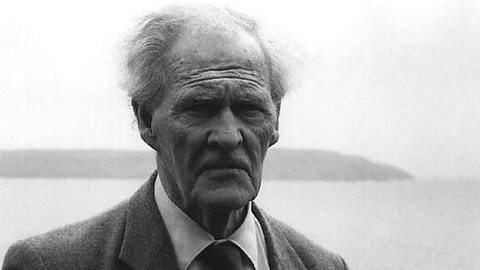
RS Thomas - Always Seeking Greater Silence Sunday Feature. audio
Jon Gower explores poet RS Thomas's life and work through the prism of birdwatching.
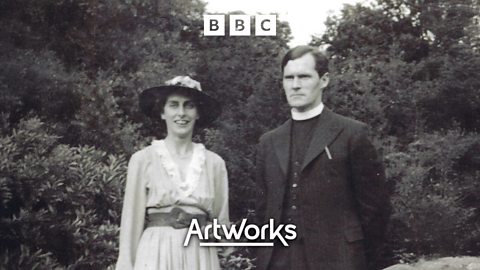
Love’s Moment: RS Thomas and Mildred Eldridge. audio
Often portrayed as a hostile and difficult figure, RS Thomas was also a poet of deep sensitivity. Gwyneth Lewis explores his unusual marriage to the painter Mildred Elsie Eldridge.
More on Anthology One: Identity
Find out more by working through a topic
- count8 of 11

- count9 of 11

- count10 of 11
- count11 of 11