Key points
Overview
A woman reflects on her forgotten past lovers, feeling haunted by memories she can no longer access. The poem explores themes of loss, regret, and the loneliness of ageing. It presents love not as romantic or joyful, but as something that fades and leaves emotional scars.
Main themes
Love, loss, memory, regret, loneliness.
Tone and voice
Reflective, melancholic, bleak. Uses first person voice to express personal thoughts and feelings. The speaker is likely an older woman, not necessarily Millay herself, looking back on her youth with sorrow and detachment.
Context
First published in 1920 in Vanity Fair. Millay was a feminist icon and outspoken in her rejection of social norms. She had relationships with both men and women and often wrote openly about female desire and emotional complexity. The poem reflects the cultural shift in post-World War One America, where women were challenging traditional roles and expectations. Millay won the Pulitzer Prize for Poetry in 1923 and was known for her pacifist views and controversial work.
Form and structure
The poem is an Italian (Petrarchan) sonnet, with 14 lines split into an octet and a sestet. It follows iambic pentameter, with some variation, such as the stressed opening of line nine: “Thus in the winter stands the lonely tree”. The volta occurs at line nine, marked by “Thus”, shifting the focus from forgotten lovers to symbolic imagery of isolation. Unlike traditional sonnets, the sestet offers no resolution – the speaker remains lost in memory and regret.
Poetic devices to spot
- Synecdoche – lovers are referred to as “lips” and “arms”, reducing them to fragments and showing how memory has depersonalised them.
- Polysyndeton – repetition of “and” in the opening lines emphasises the extent of what the speaker has forgotten.
- Metaphor – rain becomes “ghosts” tapping at the glass, symbolising haunting memories.
- Symbolism – the “lonely tree” in “winter” represents the speaker’s isolation and emotional barrenness.
- Alliteration – “What lips my lips have kissed, and where, and why” uses repeated “wh” sounds to highlight questioning and loss.
- Assonance – “lips”, “kissed”, “before” and “more” create a soft, mournful tone.
- Consonance – “unremembered lads” uses soft “d” sounds to evoke youth and innocence.
- Volta – “Thus” marks the shift in tone and focus at line nine.
- Enjambment – lines flow into each other, reflecting the speaker’s emotional overwhelm.
- Tone – regretful, sorrowful, introspective, helpless.
What Lips My Lips Have Kissed, and Where, and Why (Sonnet ⅩⅬⅢ)
by Edna St Vincent Millay
What lips my lips have kissed, and where, and why,
I have forgotten, and what arms have lain
Under my head till morning; but the rain
Is full of ghosts tonight, that tap and sigh
Upon the glass and listen for reply,
And in my heart there stirs a quiet pain
For unremembered lads that not again
Will turn to me at midnight with a cry.
Thus in the winter stands the lonely tree,
Nor knows what birds have vanished one by one,
Yet knows its boughs more silent than before:
I cannot say what loves have come and gone,
I only know that summer sang in me
A little while, that in me sings no more.
The text of this poem is available in the CCEA Poetry Anthology, which can be downloaded from the CCEA website.
The BBC is not responsible for the contents of any other sites listed.
Summary
A woman whose memory is failing struggles to remember those she has loved in the past. First published in the November 1920 issue of Vanity Fair magazine.
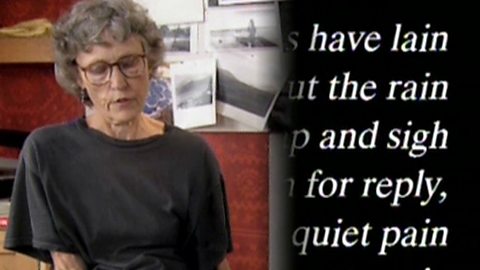
A reading of the sonnet 'What Lips My Lips Have Kissed...', by Edna St Vincent Millay, followed by analysis of the sonnet’s sense of form and voice by Fay Godwin
Title: Many sonnets are known only by their first line or by a number; this one follows that pattern.
Themes: Love, loss, memory, regret, loneliness.
Tone: Reflective, regretful, helpless, melancholic, bleak.
Speaker: Uses first person to give insight into personal thoughts and feelings. It is unclear whether the speaker is intended to be Millay herself; many suggest the speaker is actually an older woman looking back on her youth and experiencing loneliness, regret, and memory loss linked to her old age.
Applicable context
- Edna St Vincent Millay was born in the USA in 1892. Her parents divorced when she was six, and her mother raised her and her two sisters alone. She read classic literature to the children, and Millay showed an early talent for poetry. She and her sisters were outspoken and liberal, often clashing with teachers and authority figures and behaving in ways considered ‘unfeminine’: drinking, smoking, playing cards and having romantic relationships – in Millay’s case, with both men and women. This early rebelliousness contributed to Millay’s defiance of social norms throughout life, and her later status as a feminist icon.
- After college (from which she was almost suspended for behaviour they deemed inappropriate), Millay moved to New York and continued to write poetry and plays. Her work was frequently considered controversial, but nevertheless impressed and inspired people, and she won the Pulitzer Prize for Poetry in 1923 for the collection including ‘What Lips My Lips Have Kissed…’. She also wrote Aria da Capo, an anti-war play starring her sister Norma, in 1919; she held strong and active pacifist views around World War One.
- In 1920, after long and sometimes violent campaigning, women in America won the right to vote. Many like Millay were opposed to conforming to past standards of how women should behave and be seen, and there was much social debate over what women’s empowerment meant and would look like. ‘What Lips My Lips Have Kissed…’ is the monologue of a woman who openly admits she has had many love affairs; Millay’s use of female voices, exploration of women’s real thoughts and feelings and her unashamed references to sexuality made her poetry controversial to some, but have helped ensure its enduring importance. The conflict arising from the speaker’s struggle over her emotions in the poem shows a fragment of the larger societal conflict between women who wanted more freedom and a culture that couldn’t agree how to grant this.
Form and structure
‘What Lips My Lips Have Kissed…’ is an Italian sonnet (also known as a Used by the Italian poet Petrarch it's a 14-line poem split in two parts: the first 8 lines (octave) use the rhyme scheme ABBAABBA and show a problem or idea. The last 6 lines (sestet) often use CDECDE or CDCDCD and give a response.), whose 14 lines are arranged in one octet (an eight line set with a regular rhyme scheme of ABBA ABBA) and one sestet (six lines with the rhyme pattern CDEDCE). A fourteen-line poem, usually with ten syllables in each line. were a classic form for love poetry, and Millay may have chosen the form for this reason; her speaker is talking about love in a way, but it is slightly unconventional because the love she had in the past has been forgotten, causing the speaker discomfort and regret.
Another typical feature of an Italian sonnet in this poem is that the A change in focus within a poem, perhaps revealing a ‘twist’ with further information, new detail or emotion that may make us feel differently about the first part. occurs in line nine, with the word “Thus”, showing that the last six lines will be a bit different in focus or emotion than the first octet. Usually in this kind of sonnet, a problem or question would be set up in the first eight lines and resolved in the last six lines, after the volta. However, in ‘What Lips My Lips Have Kissed…’ no solution is offered – the speaker cannot remember her loves, she is pained by this, and there is no way to change it, ending the poem on a sad and hopeless note.
What is a sonnet? revision-guide
Learn about the conventions of a sonnet, Shakespearean sonnets and Petrarchan sonnets, iambic pentameter and rhyme in this KS3 English BBC Bitesize article.
- The The rhythm of a line of poetry based on how many syllables it has and where they are stressed or emphasised – likes beats in music. is One ‘iamb’ is a two-beat combination: an unstressed syllable followed by a stressed (emphasised) syllable, making a ‘da-DUM’ pattern, like a heartbeat. Pentameter means five of these two-beat units per line, making ten syllables altogether, the standard metre of a classic sonnet. One ‘iamb’ is a two-beat combination: an unstressed syllable followed by a stressed (emphasised) syllable, making a ‘da-DUM’ pattern, like a heartbeat. Pentameter means five of these two-beat units per line, making ten syllables altogether:
| What lips | my lips | have kissed| and where | and why |
| da-DUM |da-DUM | da-DUM | da-DUM | da-DUM |
There are small variations from this – in line nine there is a stressed syllable at the start rather than an unstressed one: “Thus in the winter stands the lonely tree”. This emphasises the “Thus”, and the turn or volta that begins here.
Language and poetic methods
- A figure of speech where a part of something is used to represent the whole thing, such as calling a car ‘wheels’: The poem’s speaker initially refers to her former lovers not as individual people, but to “lips” and “arms”; this is Check your connection, refresh the page and try again. in which the fragmented body parts represent the whole person. The speaker cannot remember the names or personalities of the people she was with, only recalling “lips” that kissed her and “arms” that held her. These body parts highlight the actions of kissing and holding that she experienced, but not the feelings behind them. She mentions the disconnected body parts because her memories of the people are partial, disembodied and depersonalised, showing she cannot remember what may have made these lovers special to her.
What lips my lips have kissed, and where, and why,
I have forgotten, and what arms have lain…
A writing technique where a lot of conjunctions like 'and', 'or', or 'but' are used close together. It slows down the rhythm and can make ideas feel more dramatic or emotional.: Check your connection, refresh the page and try again. is the addition of many conjunctions like ‘so’ or ‘and’ between words and phrases that might usually only have one (a single ‘and’ at the end of a list of items separated by commas, for example). It is used in the first two lines to emphasise the halting nature of her memory and the extent of the things she has forgotten about the lovers she once had. The repetition of ‘and’ highlights each aspect she has forgotten, showing the reader in greater detail each of the important memories she has lost.
Metaphor: In her melancholic state, the speaker hears rain tapping at the glass as “ghosts” who demand her attention, as though all the people she has forgotten are outside her window and demanding to be let in. The A metaphor is a word or a phrase used for dramatic effect, to describe something as if it were something else. ghosts represent her being haunted by what she has forgotten; they seemingly tap at the window to get her attention and be remembered, but they are Very light, delicate, or graceful, often in a way that feels otherworldly, like something from a dream or not quite real. and unreal, offering no information that will help her recall them and no sense of comfort either. Their presence is painful to her, and yet she can do nothing about it, other than bear the disruption and sorrow that they bring her.
A literary device where an object, person, place, or event represents something beyond its literal meaning. : Aside from the ghosts, which could be said to symbolise the forgotten lovers of her past, Millay employs a “lonely tree” in “winter” as a symbol of the speaker herself. A tree is often used to represent life, but the bare branches of a lone tree in winter evoke something cold, harsh and barren, particularly since no “birds” (a metaphor for her lovers) perch or nest there as they used to. Her life now feels cold and empty, not only of the lovers themselves, but of the memories of them.
The idea of the speaker being an older woman comes partly from the use of “winter” here, which symbolises the end of life in a mirroring of the natural seasons – birth in spring, blooming youth and beauty in summer. So on. She notes that “summer sang in me”, symbolising her past vibrancy as being like a song and the period of her youth as being warm and full of life and love, in contrast to her current state. This symbolism of the tree and the seasonal imagery helps the reader connect with the feelings of loss and sadness the speaker experiences, and allows them to visualise how bereft and alone she feels as a result.Alliteration, assonance, and consonance: Because this poem relies heavily on conveying the speaker’s feelings and mood, Millay uses sounds with care to enhance the speaker’s voice. The poem’s first line has Marked by alliteration - the repetition of a sound at the beginning of consecutive words, such as ‘the big, bold, blue sea' of “wh-“ sounds in “What”, “where” and “why”, emphasising the gentle sound of the questioning words to show they are pointless to her, emphasising how much she has forgotten and how little hope she has of remembering. Alliteration of Alliteration or repetition of s sounds, producing a hissing sound like that of 's' or 'sh'. ‘s’ sounds in “summer sang in me /… sings no more” are gentle rather than hissing, but still sound more alive than some softer sounds in the poem.
The repetition of similar consonant sounds in nearby words.is shown in the soft ‘d’ sounds at the end of “unremembered lads”, working alongside the simple, familiar word “lads” to enhance the idea that they were young, decent to her and innocent; it is also used in the harsher, repeated ‘t’ sounds in lines six to nine – “heart”, “quiet”, “that”, “midnight” and so on – which give a gentle but insistent sense of the pain she feels.
When a vowel sound is repeated in words close together. repeats pockets of vowel sounds throughout – short ‘i’ sounds in “lips” and “kissed”, for example, or the ‘o’ sounds in lines 10 and 11 like “nor”, “knows”, “more” and “before” – to enhance the soft, sad tone of the poem, making it sound wistful in its sadness and quiet in its acceptance that nothing can be done to heal the speaker’s pain.
I only know that summer sang in me
A little while, that in me sings no more.
This is not a list of every method or notable use of language and structure in What Lips My Lips Have Kissed, and Where, and Why.
Look at the poem again. Can you find any of the following?
Repetition
Repetition enhances some of the poem’s more important imagery throughout, starting with “lips” in line one – the impersonal nature of the “what lips” is immediately followed by “my lips” to emphasise her participation and give the sense that there were numerous lovers in her past. The repetition of “knows”/“only know” emphasises both what she has forgotten – the past loves – and what she still recalls: that they were once with her but are not there any more, and that the life and beauty of her youth “sings no more”.
Personification
The symbolic tree is personified as ‘knowing’ that its branches are “more silent than before”, although it cannot identify the birds/lovers that have left it. The A type of imagery in which non-human objects, animals or ideas are given human characteristics. of the tree is tragic because it is aware of its abandonment and yet can do nothing to alter its lonely state, just like the speaker. Summer “sang in me” is another example of personification, which illustrates the idea that her past was full of life, warmth and joy, in direct contrast to the “winter” in which the tree that symbolises the speaker now stands.
Enjambment
A poetic device where a sentence continues beyond the end of the line or verse. is used in conjunction with caesurae in the poem to give a sense of the unreliable and unsteady state of the speaker’s emotions and memories. At times Check your connection, refresh the page and try again. lets the speaker’s thoughts flow on, showing strong emotion; at times A break in poetic rhythm in the middle of the line, a momentary pause., such as the commas in line one or the semicolon in line three, force a pause in the speaker’s thoughts, showing hesitation or difficulty in collecting fragments of memory. Enjambment also serves to highlight certain words at the ends of lines – “sigh”, “pain” and “cry”, for example, occur at the ends of lines, leaving the reader mid-thought on a word that enhances the idea of the speaker’s sorrow and loss.
If you have found these methods, consider what you know about the poem and the poet already.
What effects do these methods create? Why has she used them?
Other poems I could compare with ‘What Lips My Lips Have Kissed…’
Last Post – Duffy’s tribute to the veterans of World War One has some interesting comparison points with Millay; students could explore, among other things, historical remembrance and personal memory, reliving or reversing the past, or even how “ghosts” could be said to appear in both poems and how/why.
Easter Monday – in contrast to Millay’s many “unremembered lads”, Farjeon offers a personal account of her friend at war, and understates the pain of his loss with irony in a way that provides another useful contrast with Millay’s poetic methods.
Poppies – a poem also written to highlight a female voice, Poppies focuses on the remembrance of an individual, unnamed but not “unremembered”; the sensory nature of the mother’s memories of him may offer some interesting comparisons and contrasts with Millay.
Practice questions
Use these questions to hone your knowledge of ‘What Lips My Lips Have Kissed…’, and to practise using your notes and analysis in organised paragraphs that focus on how particular themes or ideas are shown in the poem. There is an example answer in the following section to demonstrate how you can do this.
- How does Millay create a sense of sympathy for the speaker in ‘What Lips My Lips Have Kissed…’?
- What does ‘What Lips My Lips Have Kissed…’ show us about Millay’s attitude to love?
- What poetic methods does Millay use to show a sense of loss in ‘What Lips My Lips Have Kissed…’?
- How does Millay create a melancholic tone in ‘What Lips My Lips Have Kissed…’?
Example answer
Below is a demonstration of how to use the material in this section to answer an example essay question. The answer below is not a full essay, but only an extract of a longer answer, showing some of the points that could be made.
Q: How does Millay create a sense of sympathy for the speaker in ‘What Lips My Lips Have Kissed…’?
A: Millay’s Italian sonnet ‘What Lips My Lips Have Kissed…’ is a first person account of the heartache and sadness felt by a speaker who appears to be not Millay herself, but the persona of an older woman. She can no longer remember the lovers of her past. Her forgotten loves as well as the symbolic references in the poem to “winter” (given in present tense, “thus in winter stands the lonely tree”) and “summer” (past tense references, “summer sang in me”) support the idea she could be in her old age; summer is associated with blooming youth and beauty, while winter is cold, barren, and bleak, suggesting she was young and vibrant in the past but is coming to the end of her life. Sonnets are commonly love poems, and the speaker has known love in her past, but because she cannot remember who she loved, she feels bereft and alone. Italian sonnets often set up a ‘problem’ in the first octet which is then resolved in the final sestet; this sonnet has its volta in the right place, marked by the “Thus” at the start of line nine, but this ‘turn’ in the poem offers only further imagery of the speaker’s helplessness in the face of her isolation and memory loss. Nothing is resolved for her and no hope is offered, meaning that her situation at the end remains lonely and sad, creating sympathy for her in the reader.
In her melancholic state, the speaker hears rain tapping at the glass as “ghosts” who demand her attention, as though all the people she has forgotten are outside her window and demanding to be let in. The metaphorical ghosts represent her being haunted by what she has forgotten; they seemingly tap at the window to get her attention and be remembered, but they are ethereal and unreal, offering no information that will help her recall them and no sense of comfort either. Their presence is painful to her, and yet she can do nothing about it, other than bear the disruption and sorrow that they bring her. The metaphor of being haunted by memories she cannot properly access nor free herself from makes the reader aware of her suffering and creates sympathy for the speaker.
This essay could go on to make the following points, backed up by evidence from the poem and detailed analysis of that evidence:
- Millay uses symbolism to liken the speaker to a “lonely tree” in “winter” and the metaphor of birds abandoning her “one by one”, showing a sense of her bleak isolation and creating sympathy for her.
- Millay shows sympathy through personification of the tree that symbolises the speaker, showing she is tragically aware of her neglect and loneliness but cannot act to change it.
- Millay uses enjambment to show the speaker’s uncontrollable sadness and to emphasise negative words like “pain” and “cry” at the ends of lines.
Test your knowledge of 'What Lips My Lips Have Kissed…'
More Edna St Vincent Millay
Poetry Extra. audio
Daljit Nagra selects Adventures in Poetry, featuring Edna St Vincent Millay's short poem, First Fig.

English File. video
A dramatisation of the sonnet 'Time Does Not Bring Relief...', by Edna St Vincent Millay.
English File. video
A reading of ‘What Lips My Lips Have Kissed...’, by Edna St Vincent Millay, followed by Fay Godwin's analysis of the sonnet’s sense of form and voice.
More on Anthology Three: Conflict
Find out more by working through a topic
- count7 of 11
- count8 of 11

- count9 of 11

- count10 of 11