What is the history of St George's College?
With a history stretching back centuries, Windsor Castle has seen thousands pass through its doors and has famously been home to many British monarchs throughout time. The Royal connection to Windsor Castle continues to this day and behind the castle walls, you’ll also find St George’s Chapel.
The 15th century chapel has hosted many royal services, weddings and burials. Today, visitors can visit to not only see the magnificent architecture and worship there - but can also learn about the royals who have been laid to rest there.
But who are these royals and what was their connection to St George’s Chapel? Here, BBC Bitesize talks to archivist and chapter librarian Kate McQuillian to find out more.
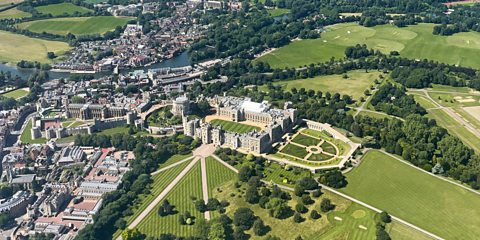
What is Windsor Castle?
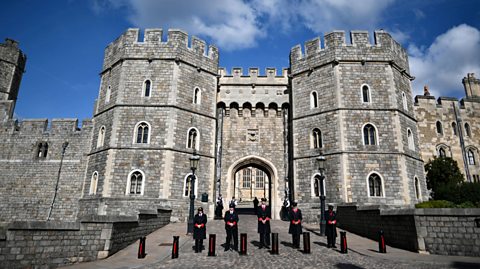
The oldest and largest occupied castle in the world, Windsor Castle is located in Berkshire, England, and was founded by William the Conqueror in the 11th century. Through the generations, it has been home to 40 monarchs and is still used by the British Royal Family today for numerous investitures, audiences, receptions and more.
Inside the castle walls, you’ll find a 15th century chapel, St George’s Chapel, which remains an active centre for worship. It is a Royal Peculiar, meaning it owes its allegiance directly to the Sovereign, as opposed to a bishop or archbishop.
Together, with the remainder of the College of St George, the chapel is governed by the Dean and Canons of Windsor. Alongside their officers and staff, they are independent of the Royal Household.
The chapel has been the scene of many royal services, wedding and burials through time. In more recent years, Prince Harry and Meghan Markle married there in 2018 and the late Queen Elizabeth II and former Duke of Edinburgh, Prince Philip, had their funerals there and are among those buried in the chapel.
When was St George’s College founded?
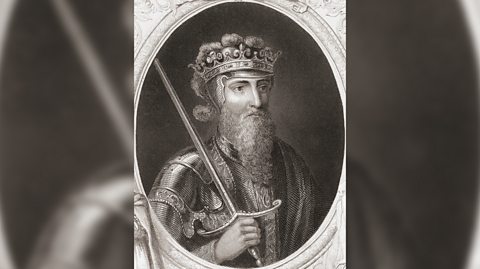
St George’s College and the Order of the Garter was founded in 1348 by King Edward III and today consists of St George’s School, St George’s House, the Military Knights of Windsor, the Chapter Library and Archives and the Choir, as well as St George’s Chapel. Today, the term college is usually associated with sixth form or universities, but generations ago, college referred to a community who lived and worked together to support a church.
Within Windsor Castle, there was an existing church building built in the 1240s under Henry III - and this is where King Edward III was baptised decades later. As an adult, following the success in his wars in France, Edward III began thinking of the spiritual health of himself and those fighting and founded the college and the Order of the Garter – the highest order of knighthood in Britain.
Archivist and chapter librarian Kate McQuillian told BBC Bitesize: “This institution was to be a college of one dean, 24 chaplains, 24 other ministers and 24 poor knights - who were to be military veterans fallen on hard times following Edward III’s campaigns in France - who were to be given alms here and to live here. That was described by Edward III and by the Pope who was involved in authorising the establishment of this church as an exchange of things temporal for things spiritual, so things earthly for things heavenly.
"The establishment of St George’s was very much in line with the prevailing theology of the time, which was that by making sacrifices from your wealth and your power in life, you could gain spiritual benefits in the afterlife. That was part of Edward III’s vision for this new establishment – that he and his ancestors and his descendants and his Knights of the Garter would be prayed for here daily, forever, and that that would assist him and them in the long term.
"He makes the College of St George, the chapel of St George, the spiritual home of the Order of the Garter and places the responsibility on the chapel of praying every day for him and for his knights. That was something done then and is still done every day now.
"It always has been throughout the college’s history.” When it comes to St George's Chapel specifically, it was in 1475 that Edward IV began building the site and it was completed by Henry VIII in 1528.
How was the Royal connection established?
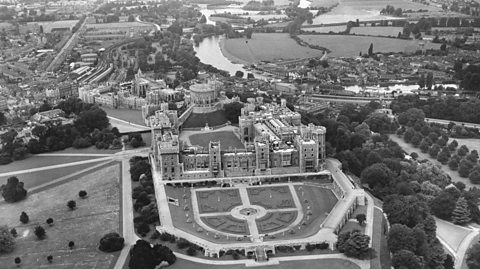
For hundreds of years, St George’s has had a Royal connection. But how has that continued throughout the generations?
Kate said: “The Royal connection can be expressed in three ways, one being from our foundation. We were founded by the King and St. George's is called a Royal peculiar.
"The royal part of that is it was founded by the King and the peculiar part is that it's exempt from the usual structure of the church. St. George's isn't responsible for managing a parish and it isn't answerable to a diocese - it's answerable as such just to the King as the head of the Church of England, and so that's the peculiar part.”
The Royal connection has also continued through the Order of the Garter, founded by King Edward III. Originally intended for his senior knights, then knights who accompanied him in battle and led his army. It has continued as the senior most Order of Chivalry in Britain throughout every reign.
Kate said: “Each monarch, each sovereign, has been able to adapt it to suit their time and their political and chivalric interests. If you look at someone like Queen Victoria - she was not leading troops into battle, but she was still able to use this order as a place for appointment for people who'd given great personal service to her and to the nation.
“As St George's is the spiritual home of the Order, we continue to have this close relationship with the sovereign, the monarch, through that, and to host the knights and now ladies of the Order of the Garter when they come to pray and to give thanks for the Order and to commemorate it here.” Another element of the strong royal connection is through royal burial, which began with Edward IV, who first had an idea of St. George's becoming a mausoleum for his family, but which didn’t come to fruition.
Kate said: “What we get in the sort of mediaeval and early modern period is a few attempts at beginning a royal mausoleum at St. George's and we end up with some kings buried here. It's really George III who finally achieves what several generations of monarchs had attempted.
“He has a vault constructed under St George's and begins then to use it as a family mausoleum. Almost every monarch since George III has then been buried at St George's - the exception of course being Queen Victoria whose funeral was held here but then she is physically interred in Frogmore, part of the Crown Estate here in Windsor.”
Who is buried in St George’s Chapel?
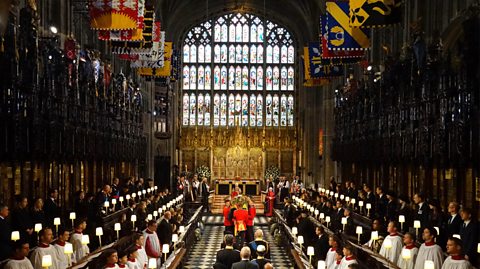
As mentioned earlier, St George’s Chapel has seen many royal services, weddings and burials. Through history, several royal figures have been moved from the chapel to rest at other locations such as the Royal Burial Ground, Frogmore, or have been moved to St George’s Chapel from their initial place of rest.
Today, nearly 50 royals spanning generations – from the 15th century to the 21st century - are still in various areas and vaults within St George’s Chapel. Within the Quire is Henry VIII and his third wife, Jane Seymour, as well as Charles I and an infant child of Queen Anne who died in 1696.
In the King George VI Memorial Chapel is King George VI, Queen Elizabeth – The Queen Mother and the ashes of Princess Margaret – Countess of Snowdon. In more recent years, Queen Elizabeth II and HRH Prince Philip, The Duke of Edinburgh, were also laid to rest there.
In the Royal Vault lies King George III and his wife, Queen Charlotte, as well as several of their children, including King George IV, and many other notable royal figures from the late 1800s and early 1900s.
In the North Quire Aisle lies King Edward IV, who died in 1483 and his wife, Queen Elizabeth Woodville, who died in 1492. In the South Quire Aisle is King Henry VI, King Edward VII and Queen Alexandra, who died in 1925.
In the North Nave Aisle is King George V, who died in 1936 but was placed there in 1939 and Queen Mary, who died in 1953. There is also The Gloucester Vault, where Princess Sophia of Gloucester lies, as well as a number of Duke and Duchesses of Gloucester from the 19th century.
Henry VIII and Jane Seymour
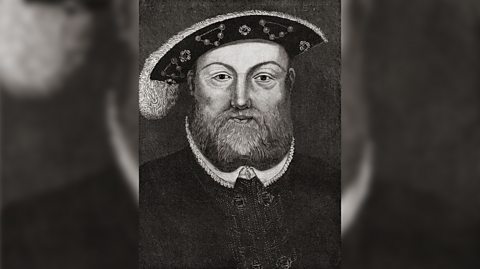
Within the Quire lies Henry VIII and his third wife, Jane Seymour, as well as Charles I - and there are many interesting facts about these royal figures relating to St George’s Chapel. Henry VIII was a Tudor king who became monarch in 1509.
During his reign, one significant event was his decision to establish the Church of England and to break with the Catholic Church. He is also remembered for his six wives – two he divorced, two he beheaded, one who died – Jane Seymour - and one who survived him.
In his life, Henry VIII was responsible for overseeing the completion of the building of St George’s Chapel. His time in the Quire was only supposed to be temporary while a big, elaborate tomb was built in the chapel, but that never happened.
Kate said: “I think not surprisingly to anyone, he was very interested in the Order of the Garter. He revised the statutes of the Order quite extensively and updated the rules partly in a functional sense and partly to suit his interests.
“One of the things that he included was that knights would sit by seniority - the more senior they got in the order, the closer they would sit to him - whereas previously they'd been given a stall, a seat on installation, and that was then their seat for the duration. Now we've reverted that and the stall you get is your stall.
"He also commissioned what's called the Black Book of the Garter, the first register of the Order of the Garter, and that's in our collection here as well. When Jane Seymour dies, she is buried in Windsor and Henry VIII writes in his will that at his death he wishes also to be buried at Windsor beside Queen Jane.”
King Charles I
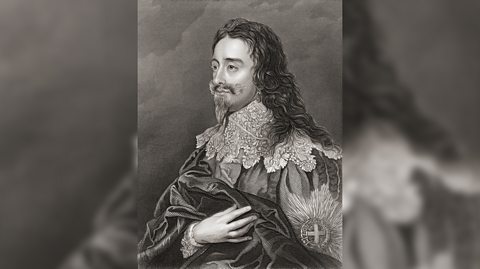
In 1625, Charles I became King of England, but had several disputes with Parliament which escalated into a civil war in 1642. In 1649, Charles was defeated and put on trial for treason, where he was found guilty and sentenced to death.
Kate said in his life, Charles I was also particularly interested in the Order of the Garter. She said: “He was holding court in exile, and he continued to appoint people to be members of the Order of the Garter and people to be clergy of St George's Chapel.
“But St George's had the unfortunate experience during the Civil War that Windsor town itself was for Parliament and then Windsor Castle was invaded by Parliament forces in 1642. At that point, the Dean and Canons were evicted, and St George's Chapel was effectively closed down.
“Now we say that we have a continued existence through that period because Parliament determined that the poor knights, these military veterans who are still living and receiving alms here, they were a worthy cause that they should still be supported. As members of the College of St. George, they continued to live on site here and so, we have this continued existence.”
When Charles I was executed, it was decided there would be no burial service or grave prepared and as a result, the Quire was opened as there was already known to be a vault there, that of Henry VIII and Jane Seymour. Kate said the burial was not recorded in their burial registers because there was nobody at the time keeping it, but that it was recorded elsewhere.
For some time, there was uncertainty of if Charles I was indeed buried there and in the 19th century, before DNA testing and analysis we know today, there was an investigation. Kate said: “In 1813, the vault was found, the floor was lifted, and a team of people went down and investigated the coffins there.
"It was Charles I that they were particularly interested in and there’s this, depending on your attitude, fantastically or horrendously gory account written by the Royal surgeon at the time, Henry Halford, who was the president of the Royal College of Surgeons. He takes away the vertebra, the one that's severed, and a tooth and a sample of the king's hair.
"They're confident that this is Charles and they describe sort of the pointed shape of the beard as well as the signs of the execution.
Then it's some years later in 1837 that William IV commissions a black marble stone, which is what you'll see now if you walk through the Quire.
"It says 'in a vault beneath this marble slab, the deposited remains of Jane Seymour, Henry VIII, Charles I, and an infant child of Queen Anne.' It's 1649 that Charles I is executed - but the stone says 1648 because it's using the old dating system.”
Can you visit St George’s Chapel and Windsor Castle?
The Chapel is open to public visitors on Monday, Thursday, Friday and Saturday but all are welcome to attend services every day. Kate said in terms of tourists and pilgrims, they get a million visitors every year – not counting those who attend their services twice daily and three or four times on Sundays, depending on the occasion.
She added: “It's a place that has a real identity in the national consciousness and a real draw to people. It was founded nearly 700 years ago as a religious institution to worship God, to pray for the Sovereign and to serve society and it continues to do that throughout the centuries against a background of turbulent times, sometimes of huge controversy, of national disaster.
“In that time, on a grand scale, it's played a role on the national stage in shaping politics and shaping religion, but it's also had that smaller scale, an enormous importance to individuals from all walks of life, like any place of worship. It's really important to be able to hold up these great national institutions and say some things endure, they adapt to time - to be suitable and to serve the time that they're in - but they do continue, and I think that’s the great significance of St. George's."
Tourists from across the globe also tour Windsor Castle every year, when it is open to the public on a number of days in the week. However, it does close to the public for special occasions, such as Christmas Day.
This article was written in January 2026