Key points
Overview
The poem is spoken by a person reflecting on a choice they made in the past. They stood at a fork in a forest path and had to choose, and now wonder how life might have been different if they had made another choice.
Themes
The poem explores choice, regret, and uncertainty. It shows how decisions shape our lives, even when the options seem similar. It also looks at how people rewrite their past to make their choices seem more meaningful.
Tone and voice
The tone is calm and thoughtful. The speaker sounds like someone looking back on an important choice and trying to understand it. Their voice is personal and honest, showing mixed feelings: they want to sound confident, but their earlier comments hint that they are still unsure. The speaker is not Frost himself, but an unnamed person thinking about how one decision might have changed their life.
Context
Robert Frost wrote this poem partly as a joke about his friend, who was always indecisive. Frost often explored nature and human emotions in his poetry. This poem is set in a quiet forest, but its meaning is much deeper.
Form and structure
The poem is a dramatic monologue with four stanzas of five lines each. It uses a regular rhyme scheme and mostly follows iambic tetrameter. The steady rhythm reflects the calm setting, while changes in pace show the speaker’s shifting thoughts.
Poetic devices to spot
- Metaphor – the roads represent life choices.
- Repetition – the repetition of “I” and “and” show the speaker’s focus and hesitation.
- Enjambment – lines run on to show flowing thoughts.
- Irony – the speaker says the choice “made all the difference,” but earlier said both paths were the same.
- Symbolism – the forest paths symbolise different futures.
- Caesura – pauses show the speaker’s uncertainty.
The Road Not Taken
by Robert Frost
A link to this poem is available in the CCEA Poetry Anthology which can be downloaded from the CCEA website.
The BBC is not responsible for the contents of any other sites listed.
Summary
A commonly misunderstood poem in which the speaker considers choices, uncertainty and how we conjure stories about these things to tell ourselves and others. Written in 1915 and published in a collection Frost released the following year.
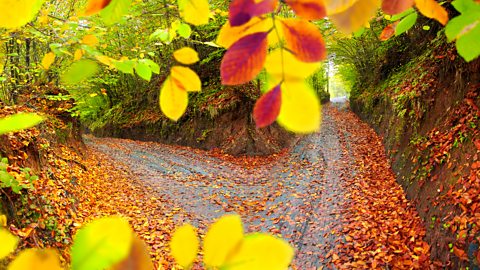
- Title: Focuses on the negative or ‘other’, not the thing chosen; it can never be experienced or understood because it wasn’t selected.
- Themes: Choices, uncertainty, regret, discontent, self-deception.
- Tone: Indecisive, reflective, confident, ironic, self-satisfied.
- Speaker: First person, not commonly thought to be Frost himself for several reasons, including the fact he wrote it for/about a friend; an anonymous speaker about whom we know nothing personal.
Only a little context is needed for each poem; where used, it should be applied to the point you're making.
Applicable context
- Robert Frost grew up in American city environments but later inherited a farm which he worked on while writing his early poetry. Like this one, his poems often take place in a rural setting, and his work became known for its links with the countryside. Frost moved his family to England in 1912 and his first poetry collections were published in London before he returned to the US in 1915.
- Frost wrote at a time when modernist poets were playing with form and disregarding established poetic ‘rules’, but he tended to stick to conventional The pattern of stresses in a line of poetry, which make up the rhythm of the line. and maintain a sense of the traditional rather than experimental. His use of Everyday language. language made his poems seem new and modern, though his choices of subject were more influenced by classic 19th century Romantic poets like Keats.
- The Road Not Taken was initially written as a joke for his friend Edward Thomas, an English poet. On country walks together, Thomas would frequently hesitate to choose a path and then obsess about whatever they would now miss on the other, unchosen route. Frost intended the poem to be melodramatic and funny, but Thomas was slightly hurt by the mocking of his own indecision; he warned Frost that the poem was not obviously humorous and was likely to be taken seriously – a prediction that turned out to be true. Frost himself described the poem as “tricky”, given that readers often misunderstood its meaning; people frequently quoted the last three lines in isolation and assumed they are the poet’s attempt to urge readers to make individual decisions rather than follow the crowd.
Only a little context is needed for each poem; where used, it should be applied to the point you're making.
Form and structure
- The Road Not Taken is an example of formal verse – this means it follows a regular rhyme scheme and rhythm but does not conform to the rules of any specific type of poem, such as a A fourteen-line poem, usually with ten syllables in each line. orA nineteen-line poem consisting of five tercets and a quatrain, with a very specific rhyme scheme.. It is divided into four quintains (or five-line stanzas), with each one generally representing a different stage in the speaker’s decision-making process.
- Frost sticks strictly to a regular rhyme scheme of ABAAB throughout the poem; perhaps this is done as a way of showing how hard the speaker tries to impose order on their flawed decision-making process and the aspects of life that they can’t know or control.
- The A nineteen-line poem consisting of five tercets and a quatrain, with a very specific rhyme scheme. of The Road Not Taken is mostly based around iambic tetrameter. One ‘iamb’ is a two-beat combination: an unstressed syllable followed by a stressed (emphasised) syllable, making a ‘da-DUM’ pattern, like a heartbeat. Tetrameter means four of these two-beat units per line, making eight syllables altogether:
| I took | the one | less trav-|-eled by |
|da-DUM | da-DUM | da-DUM |da-DUM|
Where the metre is regular, it gives the sense of regular footsteps as the poet walks. However, many of the lines disrupt this regular rhythm, particularly in the first A grouped set of lines within a poem., and this gives a looseness that makes it seem reflective and informal, more like a conversation than a strictly rhythmic line of poetry. It also echoes the imperfection of the subject matter and the uncertainty of the poet, stressing his choice was not as easy or decisive as he will later tell people it was.
Language and poetic methods
- Metaphor: The Road Not Taken is an extended metaphor, in which the act of choosing between two paths represents all choices made in life. Each time we pick one thing, we are rejecting others and the possibilities they might bring us, whether we’re fully aware of this or not. It’s the possibilities of the ‘other’ choice that give the poem its title and lie at its heart. The speaker cannot see what the path holds because it is “bent in the undergrowth”, just as we cannot see the future our choices will bring us, and he notes that they were worn “really about the same” and “both that morning equally lay/ in leaves no step had trodden black”. He can’t actually tell which is “less travelled by” and both look more or less the same before taking one. Just as our choices can only truly be evaluated in hindsight and not in advance.
- Repetition: The most notable repetition in the poem is when most of the opening line, “Two roads diverged in a yellow wood”, is brought back in the final stanza to remind us of what happened. This helps us note that the poet’s tone is much more confident as he is “telling this” later. As though he chose with purpose and intent and not on a whim. This is reinforced when he repeats “I” for emphasis in lines 18 and 19, giving an almost grandiose sense of his personal power to make good choices and disregarding all his earlier uncertainties and prevaricating. There is repetition of the word “and” throughout the single sentence that makes up all of stanzas one and two and part of stanza three. This serves to show the speaker’s conflicting thoughts and indecision as he tires to weight up which is the better option. He will recount the story “ages and ages hence” – repetition of “ages” emphasises the distance, which could show how our decisions can reach far into the future; it could also be his way of dismissing the moments of indecision and imposing a narrative of self-belief and self-determinism on his random choice.
Two roads diverged in a wood, and I—
I took the one less traveled by,
- Enjambment: Stanza one contains A poetic device where a sentence continues beyond the end of the line or verse. across three different lines, with the poet’s thoughts tumbling onto the next line. The effect is one of making the choice seem bigger than it is, as though it is a dilemma that cannot be easily contained within one line. This contrasts with the speaker’s momentary powerlessness and hesitation as he debates what choice to make.
And sorry I could not travel both
And be one traveler, long I stood
And looked down one as far as I could
- Irony: Since the poem was originally intended as a joke about his friend’s indecisiveness, it’s safe to assume that what Frost says in the guise of the speaker in this poem isn’t what he wants us to fully believe. The speaker chooses between two seemingly similar things that seem to have little or no importance to his overall life, yet he not only falters to make a decision. He also has to later imagine or pretend (to himself and others when “telling this”) that he was fully in control and made the best possible choice. He truly has no way of knowing whether his choice was good, bad, or neutral, but he claims it “made all the difference”; this statement is Happening in the opposite way to what is expected and maybe causing amusement because of it. as the poet likely doesn’t mean us to believe it is true. In stanza three the speaker exclaims “Oh, I kept the first for another day!” in a confident, knowing tone, but then acknowledges immediately that he would probably never be walking past that fork in the road ever again, showing his momentary confidence and sense of control is misplaced. The speaker even tells others he “took the one less travelled by”, like a brave nonconformist, but the poem earlier shows that both roads seem extremely similar in the amount of wear they have received from other walkers. The choice was nowhere near as clear-cut or well-informed as he later pretends it was.
- Colloquial language: Frost’s use of every day or Everyday language. language was part of what made his poems accessible and well-loved, though it could also contribute to people misunderstanding his intentions, as with The Road Not Taken. The last line of the poem, “And that has made all the difference”, is an A series of words together or phrase that convey a certain meaning that does not reflect the meanings of the words separately. An example is "kicked the bucket". (or expression) which makes the speaker sound chatty and relatable, but also adds irony to the poem since the speaker is confidently declaring something he cannot know to be true. This ending can be taken at face value, and often is by those who read the poem as a call to be intrepid and go against the grain rather than following the crowd. However, in light of the rest of the poem, it seems like the speaker is self-satisfied, telling himself everything turned out well because of the great choice he made. He forgets how he was haunted at the time by the prospect of what he might miss on the other road. In this wider context, “made all the difference” is slightly Over-the-top exaggeration for effect., exaggerating his choice’s importance; this attempt to make himself sound wise and in control may be his response to the suspicion that all humans are actually powerless to know what choices are best or what we may miss in life by rejecting other options.
This is not a list of every method or notable use of language and structure in The Road Not Taken.
Look at the poem again. Can you find any of the following?
A break in poetic rhythm in the middle of the line, a momentary pause.
The speaker makes himself and his choice sound a lot grander by the end of the poem, when “telling this… ages hence” to others. He sums up the whole experience of the poem in three lines, making it seem like a quick and wise decision rather than a long moment of agonising to choose. He prefaces his edited narrative with a caesura in the form of a colon, giving a short pause before the tale in order to reinforce its supposed importance.
When a vowel sound is repeated in words close together.
Frost uses assonance, or repeated vowel sounds, at certain points in the poem. In the first stanza, the “oo” sounds in “stood” and “looked” create an idea of the speaker pursing their lips in thought, while the second stanza repeats the “ah” sounds in “as”, “perhaps”, “passing”, “grassy” and “about”, as well as the repeated “and”. This internal coherence of sound might be a nod to ‘um-ing and ah-ing’ as he tries to decide, or could just be a way of distracting from the contradictory thoughts the speaker entertains and then dismisses later in the poem.
Symbolism
People might refer to a big life decision as ‘being at a crossroads’ to metaphorically suggest they have to choose an option from the ‘roads’ before them. In the same vein, “Two roads diverged in a yellow wood” becomes a symbol for any of life’s choices – the split path means you cannot continue without choosing one or the other, and whichever you choose, you will be rejecting the other and anything it might offer. The poem is about a country walk, but symbolically represents any choice a person makes, and the unknowable experiences they miss by selecting one thing over another.
If you have found these methods, consider what you know about the poem and the poet already.
What effects do these methods create? Why has he used them?
What other poems could I compare with The Road Not Taken?
- Invictus – a poem in which the speaker is convinced of his ability to self-determine in any circumstance, which might be contrasted with the doubt and uncertainty of The Road Not Taken.
- I Remember, I Remember – the poet’s visions of an alternative, ideal childhood that wasn’t his own could be compared with Frost’s hints about possible lives we do not end up choosing
- Effacé – the poet’s address to a woman who represents to him the now-gone chance of an alternative life, and who as such could be seen to embody a ‘road not taken’.
Practice questions
Use these questions to hone your knowledge of The Road Not Taken, and to practise using your notes and analysis in organised paragraphs that focus on how particular themes or ideas are shown in the poem. There is an example answer in the following section to demonstrate how you can do this.
- What does The Road Not Taken show us about the speaker’s attitude to choices and decision-making?
- How does Frost show the sense that the speaker’s words may be unreliable in The Road Not Taken?
- What poetic methods does Frost use to show the speaker’s conflicted feelings about his choice in The Road Not Taken?
- How does Frost create a sense of irony in The Road Not Taken?
Example answer
Below is a demonstration of how to use the material in this section to answer an example essay question. The answer below is not a full essay, but only an extract of a longer answer showing some of the points that could be made.
Q: What does The Road Not Taken show us about the speaker’s attitude to choices and decision-making?
A: The Road Not Taken is commonly misunderstood - people frequently quoted the last three lines in isolation and assumed they are the poet’s attempt to urge readers to make individual and nonconformist decisions rather than follow the crowd. Frost actually intended it as a joke about his friend’s indecisiveness, but even this friend, the poet Edward Thomas, felt it lacked humour and was likely to be taken seriously. The poem is an extended metaphor, in which the act of choosing between two paths represents all choices made in life – each time we choose one thing, we are rejecting others and the possibilities they might bring us. The possibilities of the ‘other’ choice were what would torment Thomas when walking with Frost, and these are what come to haunt the speaker in the first part of the poem. Even the title of the poem is focused on this idea – it highlights the negative or ‘other’, the choice “not taken”, not the one selected. This shows the speaker is sorely aware that every choice made represents the loss of other possibilities as well as the supposed gain of what we’ve decided.
The poem is divided into four quintains, with each one generally representing a different stage in the speaker’s decision-making process – the dilemma presented, the choice made, the contradictory reasons and doubts surrounding the decision and the very different narrative the speaker claims he will tell people about it later. Frost sticks strictly to a regular rhyme scheme of ABAAB throughout the poem; perhaps this is done as a way of showing how hard the speaker tries to impose order on their flawed decision-making process and the aspects of life that they can’t know or control. This suggests the speaker is aware that the idea he has made the best choice is an illusion, as no one can know in advance what lies ahead. It also implies that he doesn’t want to think too much about this, perhaps because the idea of choosing our own destiny is much more comforting than knowing we are always at the mercy of random luck. Good or bad.
This essay could go on to make the following points, backed up by evidence from the poem and detailed analysis of that evidence:
- Frost uses enjambment and repetition of “and” to show the speaker is initially slightly thrown off their stride by the choice presented, showing it becomes a bigger deal to him than it might really be. This suggests he feels the choice represents or symbolises something more.
- Frost uses colloquial language and small variations in metre to give an unrehearsed, conversational tone. This shows that the speaker is reflecting on what happened and showing their conflicting thoughts and considerations honestly before they turn it into a neat story later.
- Frost uses caesura and repetition of “I” to give a sense of grandeur; he uses assonance and creates a sense of irony, showing the speaker intends to mythologise the moment later and make it seem like an important decision and one he made wisely and with confidence.
Test your knowledge of 'The Road Not Taken'
More Robert Frost
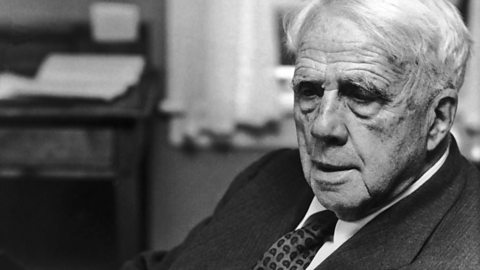
Proms Plus Literary - Robert Frost. podcast
Matthew Hollis is joined by Frost's biographer Jay Parini to discuss the poet.
The Essay. podcast
Five Poems I Wish I Had Written - Robert Frost's 'Design'
More on Anthology One: Identity
Find out more by working through a topic
- count2 of 11

- count3 of 11

- count4 of 11
- count5 of 11