Key points
Overview
The poem is a nostalgic reflection on childhood and the experience of being in a primary school classroom. The speaker recalls the safety, warmth and excitement of learning, and how this gradually gave way to the confusion and discomfort of adolescence. The classroom is a comforting space, but by the end, the child is ready to move on.
Main themes
The poem explores childhood, learning, safety, change and growing up. It shows how school can be a place of wonder and discovery, but also captures the moment when a child begins to outgrow it and becomes aware of the wider, more complicated world.
Tone and voice
The tone is warm, descriptive and nostalgic. Duffy uses vivid sensory details to recreate the classroom experience. As the poem progresses, the tone shifts gently from comfort to unease, reflecting the child’s emotional development.
Context
Carol Ann Duffy grew up in the 1950s and credits her teachers with inspiring her love of learning. The poem is based on her real experience in Mrs Tilscher’s class. References to free school milk and the Moors Murders place the poem in a specific historical moment, showing how external events shaped the atmosphere of childhood.
Form and structure
The poem is written in free verse and divided into four stanzas, each representing a stage in the school year and the child’s development. The lines grow longer and more detailed as the child matures. Enjambment reflects the flow of memory and emotion, while end-stopped lines mark key moments of change.
Poetic devices to spot
- Metaphor – "inky tadpoles changed from commas into exclamation marks" shows growth and learning.
- Simile – "the classroom glowed like a sweetshop" conveys excitement and wonder.
- Sensory imagery – sights, sounds and smells bring the classroom vividly to life.
- Enjambment – reflects the fluidity of memory and the child’s emotional journey.
- Personification – "the laugh of a bell" adds warmth and character to the setting.
- Asyndeton – lists without conjunctions show careful observation or emotional overload.
- Alliteration and consonance – repeated sounds add rhythm and texture.
- Shift in tone – from safety to discomfort as the child enters adolescence.
In Mrs Tilscher’s Class
by Carol Ann Duffy
The text of this poem is available in the CCEA Poetry Anthology, which can be downloaded from the CCEA website.
The BBC is not responsible for the contents of any other sites listed.
Summary
A nostalgic poem about the pleasure and safety the poet felt in her childhood classroom, and how she outgrew it as she got older and more knowledgeable. First published in 1990.
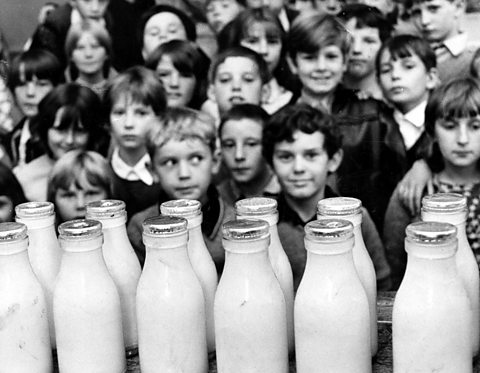
- Title: Doesn’t just name the class, but adds the preposition “in” to give a sense of present tense, situating the reader there alongside the speaker and making the place seem close and vivid.
- Themes: Childhood, safety, learning, change, growing up.
- Tone: Descriptive, positive, anecdotal, conversational, reminiscent, nostalgic.
- Speaker: Despite the fact that this is an autobiographical poem based on Carol Ann Duffy’s own real experience, it uses second person – “you” – rather than first – “I”. The effect of this is conversational, and more inclusive for the reader – it projects them into the class with the speaker.
Applicable context
- Carol Ann Duffy spent the first six years of her life in a Glasgow A building that has several flats inside it. They are usually found in cities and often built to house working-class families. In places like Scotland, tenements are common and can be old stone buildings with shared staircases and entrances. in the 1950s, before her family moved to Staffordshire in the West Midlands of England. The poem is based on her real experience of being in the primary school class of Mrs Tilscher. Duffy wrote from an early age and had poems published while still in her early teens; she credits her school teachers (like Mrs Tilscher) with encouraging her love of learning and literature.
- Concern about the health of impoverished children, especially in the postwar years, led the first female Education Minister, Ellen Wilkinson, to bring the Free Milk Act into law in 1946. This provided every schoolchild in Britain with a free bottle of milk each day in class. Duffy would have been one of those who experienced this and its intended benefits for children of improving their nourishment and ability to concentrate in school.
- The poem’s reference to “Brady and Hindley” concerns the Moors Murderers, Ian Brady and Myra Hindley. As a couple, Brady and Hindley committed a series of child abductions and murders, burying their victims on the moors near Manchester between 1963 and 1965. The shocking nature of the crimes created international notoriety for the pair; news coverage was ongoing, and fear about children’s safety was pervasive.
Only a little context is needed for each poem; where used, it should be applied to the point you're making.
Form and structure
- In Mrs Tilscher’s Class is written in free verse, having no regular rhyme scheme or The rhythm of a line of poetry based on how many syllables it has and where they are stressed or emphasised – likes beats in music. – this lack of a set form or structure perhaps mirrors the freedom of childhood or mirrors the fact that the growing children are not yet moulded into one particular shape or manner, but are constantly changing with each new experience.
- The poem is divided into four A grouped set of lines within a poem., each representing a different stage of the experience of being at school. The stanzas aren’t regular; the first two are eight lines each and the last two are seven lines. With each new stanza, the sentence structure lengthens, and the vocabulary becomes more extensive and descriptive, reflecting how the child’s communication skills improve over the course of their time at school.
- Each stanza finishes with an end-stopped line, symbolising a discrete and separate stage of development over time. But A poetic device where a sentence continues beyond the end of the line or verse. is used within the structure of each stanza – perhaps to reflect the effect of this flood of memories coming back to the speaker. Or maybe to show the overpowering nature of the changing emotions and sensory details as the child learns more.
Language and poetic methods
Metaphor: Many of the poem’s small details refer to changes; Duffy starts the third stanza with one such reference, using A metaphor is a word or a phrase used for dramatic effect, to describe something as if it were something else. to note the change in state of the “inky” class tadpoles, “from commas into exclamation marks”. These not only evoke how the tadpoles look, but show the child now has awareness of types of punctuation – another thing learned in their time at school. Some of these tadpoles then become the “three frogs… freed by a dunce” that escape into the playground – the tadpoles change, grow up and wish to escape the confines of what they know already, just as the child will in the course of the poem.
There are other examples of metaphors in the poem – the “skittle of milk” being a playful A quick reference - often to an image, character or place - from a work of literature or music or mythology. to the shape of the bottle, consistent with reference points a child might have (such as a recognisable toy); or the metaphorical journey in which “You could travel up the Nile” representing the possibility and potential of the world the children are learning about.Similes: “The classroom glowed like a sweetshop” is a A simile is a word or phrase used to make a comparison for dramatic effect, using 'like' or 'as'. that details how inviting the classroom was – brightly coloured, brightly lit and seemingly full of treasures, just as a sweetshop would be. Another, less pleasant simile - “like the faint, uneasy smudge of a mistake” – refers to “Brady and Hindley”, the infamous child murderers; in the safety of the classroom, the children could focus on their learning and rub out any mistakes they made in pencil. A mark would still remain, but it was faded – just as the fear left by the Moors Murderers remained with children who heard about them, but could be diminished in a safe, pleasantly distracting environment. Mrs Tilscher’s class cannot eradicate the evil of the outside world, but it can keep the children safe within it, making fear and threats seem distant.
Sensory imagery: Duffy accentuates the vividness and power of the child’s learning experiences with sensory imagery that enhances the details of everyday life at school. Visual images like the “Blue Nile”, the “coloured shapes” and the way the classroom “glowed” give a sense of things being bright and enticing; there is the Means related to touch or how something feels. sense of how “You could travel… with your finger, / Tracing the route”, evoking a sense of immediacy and contact. “[T]he scent of a pencil” is Related to the sense of smell. It’s used to describe anything involving scen., appealing to the sense of smell, and various noises – how they “chanted” the names of faraway places, or the “nonsense” of the xylophone heard at a distance – are Related to hearing or sound.imagery. They create the sense of the place being alive with sound, but not overpowering or noisy.
Later, the senses become mixed up – “the air tasted of electricity” – and uncomfortable – “feverish”, “hot”, “fractious”; even the sky feels “heavy” – as the child moves into adolescence, their body changing as well as their mind; the sensory language here reflects how this can feel awkward and difficult.
The classroom glowed like a sweet shop.
Personification: As well as the sensory imagery, the pleasant environment of the classroom is brought subtly to life with use of A type of imagery in which non-human objects, animals or ideas are given human characteristics. – “the laugh of a bell”. The bell signals an end to playtime and a return to the classroom, but it isn’t an unpleasant or threatening sound, because the classroom atmosphere is pleasing to the speaker.
Asyndeton: There are a few instances of The lack of conjunctions between phrases, like and, or, so, since, for, because, as, but, yet, still, while, as soon as, therefore etc, in which conjunctions like ‘and’ are left out between words and phrases they might usually connect, in In Mrs Tilscher’s Class. In stanza one, the list of place names – “Tana. Ethiopia. Khartoum. Aswân.” – is given as four separate sentence fragments with no Words that join clauses. They include words such as but, and, because, although, yet, since, unless, or, nor, while, where., giving the sense of the child carefully taking care over the pronunciation of each word.
The same thing happens with slightly more detailed sentences in the next stanza: “Enthralling books… Sugar paper. Coloured shapes.” – this shows the child’s observations, while emphasising the separate importance of each thing. Towards the end, asyndeton describes the messy, uncomfortable sensations of the older child, listing “untidy, hot, / Fractious” with no conjunctions to emphasise the overwhelming oppressiveness of these new feelings.Alliteration, assonance and consonance: A sense of playfulness is brought out with various repeated sounds within the lines of the poem. Some examples of this include the Marked by alliteration - the repetition of a sound at the beginning of consecutive words, such as ‘the big, bold, blue sea'of “good gold star”, emphasising the feeling of being special and valued; the many small instances of When a vowel sound is repeated in words close together. (repeated vowel sounds) used to emphasise phrases like “stared / At your parents” or “scent of a pencil”; and the The repetition of similar consonant sounds in nearby words. that appears in the repetition of prickly ‘t’ sounds in the final stanza: “the air tasted of electricity. / A tangible alarm made you always untidy, hot…” – this evokes an itchy, uncomfortable feeling that supports the point the poet makes.
The scent of a pencil slowly, carefully, shaved.
A xylophone’s nonsense heard from another form.
This is not a list of every method or notable use of language and structure in In Mrs Tilscher’s Class.
Look at the poem again. Can you find any of the following?
Allusion
The A quick reference - often to an image, character or place - from a work of literature or music or mythology. to “Brady and Hindley” is a literal reference to the child murderers Ian Brady and Myra Hindley, who kidnapped and killed at least five children in the 1960s. This allusion works both as a literal reference to Duffy’s own experience (as this would have been in the news when she was at school). It also shows the notorious pair became almost like a ‘bogeyman’ or ever-present fear for children in general – a symbol of the evil in the outside world that adults try to protect children from. Mrs Tilscher’s bright, safe classroom can help diminish this so it seems “faded”, but it can never fully take the threat of evil away.
Euphemism
As the child grows, they learn not just from the teacher but from other children, including the “rough boy” in stanza three. The adjective “rough” implies that he is probably more streetwise and less protected than the other children; he tells the speaker “how you were born”, which is a Polite or neutral words or expressions used to refer to things which people may find upsetting or embarrassing to talk about. (a more polite phrase used for something unpleasant or offensive) about sex and babies. This is something the speaker appears to have no knowledge of already; when they get home, they look at their parents, “appalled” by the idea. The euphemism shows the children cannot yet deal with the realities of adulthood, but such adult information is starting to find them anyway as they grow older and try to understand more of the world.
Pathetic fallacy
The thunderstorm in the final A grouped set of lines within a poem. is an example of pathetic fallacy, where the emotion of the speaker is reflected in something inhuman – in this case, the weather (this differs from personification, which gives something inhuman any human trait, not just emotions). The line in which “the sky split open” shows the overwhelming nature of the new adolescent emotions that the once-content child is now experiencing, while the “thunderstorm” represents the turbulent times ahead now the child has left school and is becoming a teenager.
You ran through the gates, impatient to be grown,
as the sky split open into a thunderstorm.
If you have found these methods, consider what you know about the poem and the poet already.
What effects do these methods create? Why has she used them?
What other poems could I compare with In Mrs Tilscher’s Class?
- I Remember, I Remember – A comparison of the childhoods depicted in both poems would contrast Duffy’s sense of security and fulfilment with Larkin’s discontent.
- Kid – A poem which contains a similar theme of growing up, and the difficulties involved in it, albeit in different circumstances.
- Prayer Before Birth – The pleas of the unborn infant to be protected and nurtured provide some points of comparison with the childhood Duffy depicts in In Mrs Tilscher’s Class.
Practice questions
Use these questions to hone your knowledge of In Mrs Tilscher’s Class, and to practise using your notes and analysis in organised paragraphs that focus on how particular themes or ideas are shown in the poem. There is an example answer in the following section to demonstrate how you can do this.
- How does Duffy create the sense that the child is growing up throughout In Mrs Tilscher’s Class?
- What does In Mrs Tilscher’s Class show us about Duffy’s attitude to her childhood and early schooling?
- What poetic methods does Duffy use to create a sense of what the classroom was like in In Mrs Tilscher’s Class?
- How does Duffy characterise her teacher in In Mrs Tilscher’s Class?
Example answer
Below is a demonstration of how to use the material in this section to answer an example essay question. The answer below is not a full essay, but only an extract of a longer answer showing some of the points that could be made.
Q: How does Duffy create the sense that the child is growing up throughout In Mrs Tilscher’s Class?
A: Duffy’s autobiographical poem In Mrs Tilscher’s Class depicts scenes from her own time in primary school – Mrs Tilscher was her real teacher. It is clear that Duffy’s time in school was both important to her and beneficial to her life. The poem is divided into four stanzas, the first starting in early primary school and the final stanza covering the speaker’s last ever summer term, when they are “impatient to be grown” and feeling the start of the awkwardness and discomfort of adolescence. The whole poem is in free verse, perhaps to reflect the freedom of childhood and the way that learning and growing up don’t follow one set path. However, Duffy also uses the structure of the poem to reflect the child’s growth. As the poem progresses, the vocabulary becomes more developed and the sentence structure grows in length and sophistication, mirroring the way the child has learned and become better at communicating. This gives a sense of the child changing and growing up throughout the poem.
A further sense of the changes involved in the child growing up is shown in the use of sensory language in the poem. Duffy accentuates the vividness and power of the child’s learning experiences with sensory imagery that enhances the details of everyday life at school. Visual images like the “Blue Nile”, the “coloured shapes” and the way the classroom “glowed” give a sense of things being bright and enticing. There is the tactile sense of how “You could travel… with your finger, / Tracing the route”, evoking a sense of immediacy and contact. “[T]he scent of a pencil” is olfactory, appealing to the sense of smell, and various noises – how they “chanted” the names of faraway places, or the “nonsense” of the xylophone heard at a distance – are aural imagery, creating the sense of the place being alive with sound but not overpowering or noisy. Later, the senses become mixed up – “the air tasted of electricity” – and uncomfortable – “feverish”, “hot”, “fractious”; even the sky feels “heavy” – as the child moves into adolescence. Their body changing as well as their mind; the sensory language here reflects how this can feel awkward and difficult. These vivid but changing details give a sense of how the child is growing up throughout the course of the poem.
This essay could go on to make the following points, backed up by evidence from the poem and detailed analysis of that evidence:
- The poet uses asyndeton at several points in the poem – initially it shows careful learning, then positive observations about the class, all separated by full stops; later, it describes the sensory overload of approaching adolescence, using commas to emphasise the relentless nature of the feelings, showing the child is growing up.
- The poet uses the metaphor of the tadpoles changing into frogs to show change and growing up. The escape of the fully grown frogs that are “freed” echoes the feelings of the child wanting to escape the school they have outgrown at the end.
- The poet uses the characterisation of Mrs Tilscher to show the child growing up – early in the poem Mrs Tilscher is a positive figure who teaches new information; later she “smiled, / then turned away” instead of answering the child’s question about sex – this shows Mrs Tilscher is a suitable teacher for the younger, more innocent child, but the speaker has now outgrown her, they are growing up'
Test your knowledge of In Mrs Tilscher’s Class
More Carol Ann Duffy
Meet the Author: Carol Ann Duffy. video
In a series of special Meet the Author interviews, Nick Higham meets the winners 2012's Costa Book Awards.
Intermediate English: Poetry. collection
Students get a chance to question, interpret and evaluate poems by Carol Ann Duffy and Liz Lochhead.

The Echo Chamber. audio
Paul Farley presents a series showcasing the best of the latest poetry: Carol Ann Duffy.

More on Anthology One: Identity
Find out more by working through a topic
- count6 of 11
- count7 of 11

- count8 of 11

- count9 of 11