Key points
Overview
The poem is a sonnet written from the perspective of a dying speaker, asking their loved one to remember them after death. As the poem develops, the speaker accepts that being forgotten is better than causing pain, showing selfless love.
Main themes
The poem explores love, loss, death, grief, mourning, memory and remembrance. It shows how grief can be softened by selfless love, as the speaker puts the mourner’s feelings first.
Tone and voice
The tone is intimate, loving, frank and direct, but also accepting and selfless. The speaker implores their loved one to remember them, but ultimately prioritises the loved one’s happiness over their own desire to be remembered.
Context
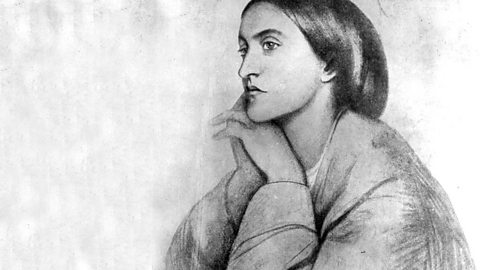
Rossetti lived in Victorian England, a time when death and mourning were common themes. Her religious beliefs and personal struggles influenced her writing. She was exposed to loss from an early age, and her poetry often reflects both intimate love and spiritual concerns.
Form and structure
The poem is a Petrarchan sonnet, divided into an octave and sestet, with a clear turning point (volta) in line nine. It is written in iambic pentameter, giving it a steady, heartbeat-like rhythm. The structure helps show the shift from wanting to be remembered to accepting being forgotten.
Poetic devices to spot
- Apostrophe – the speaker addresses a loved one directly.
- Euphemism and metaphor – death is described as "gone away" and "the silent land".
- Enjambment – sentences flow across lines, showing emotion.
- Repetition – "remember me" is repeated to emphasise the theme.
- Paradox – the speaker wants to be remembered but accepts being forgotten.
- Alliteration and caesura – add emphasis and pause.
- Symbolism – images like "silent land" deepen the meaning.
Remember
by Christina Rossetti
Remember me when I am gone away,
Gone far away into the silent land;
When you can no more hold me by the hand,
Nor I half turn to go yet turning stay.
Remember me when no more day by day
You tell me of our future that you plann'd:
Only remember me; you understand
It will be late to counsel then or pray.
Yet if you should forget me for a while
And afterwards remember, do not grieve:
For if the darkness and corruption leave
A vestige of the thoughts that once I had,
Better by far you should forget and smile
Than that you should remember and be sad.
The text of this poem is available in the CCEA Poetry Anthology, which can be downloaded from the CCEA website.
The BBC is not responsible for the contents of any other sites listed.
Summary
A sonnet written from the perspective of a dying speaker, asking their loved one to remember them. Written in 1849, when Rossetti was still a teenager.

- Title: A single word title, simple and memorable, but also an Verbs that give commands, instructions, or requests directly to the reader or a specific character; the speaker is making a significant request.
- Themes: Love, loss, death, grief/mourning, memory and remembrance.
- Tone: Intimate and loving, frank, direct, imploring, accepting, selfless.
- Speaker: A first person speaker who is not the poet herself but a persona or character created to explore the themes.
Applicable context
- Rossetti was born in England into a family of artists and scholars, gaining a love of literature at an early age. Her mother was an educator and her father was an Italian nobleman but was forced into political exile, which ultimately left him ill, depressed and in financial difficulty until he died.
- Her brother, painter Dante Gabriel Rossetti, praised his sister’s poetry as 'artless art', admiring how she could convey great meaning in simple language. Her association through him with the Artists and writers in the 1800s who wanted to return to a more emotional and detailed style, inspired by art before Raphael. They thought art became too focused on looking perfect. art movement also informed the Art focused on strong emotions, imagination, and the beauty of nature. It often showed dramatic scenes and personal feelings, rather than realistic or scientific ideas. elements in her work, focusing on feeling and emotion rather than realism or logic.
- Rossetti was religious and sensitive; she suffered a nervous breakdown at 14 and bouts of depression thereafter. She refused to marry all her life, most probably for reasons of her religious faith. Her concern with the spiritual is evident in the poem, which shows both a sense of intimate love between two people and a sense of the universal and divine.
- The Victorian era in which Rossetti lived had high mortality rates and a society well accustomed to mourning. Rossetti herself was exposed to death and suffering from an early age, perhaps explaining her concern with – and understanding of – loss and bereavement in this poem, although she was only 19 when she wrote it.
Only a little context is needed for each poem; where used, it should be applied to the point you're making.
Form and structure
- Remember is a Used by the Italian poet Petrarch it's a 14-line poem split in two parts: the first 8 lines (octave) use the rhyme scheme ABBAABBA and show a problem or idea. The last 6 lines (sestet) often use CDECDE or CDCDCD and give a response. (also known as an Italian sonnet), meaning that its rhyming structure is divided into an octet (eight lines which rhyme ABBA ABBA) and sestet (six lines with a rhyming pattern of alternating lines: CDCDCD). The Italian heritage of Rossetti’s father and his own past as a poet and scholar influenced her use of the form, which was widespread in classic Italian literature and often used in love poetry.
- The poem is written mostly in One ‘iamb’ is a two-beat combination: an unstressed syllable followed by a stressed (emphasised) syllable, making a ‘da-DUM’ pattern, like a heartbeat. Pentameter means five of these two-beat units per line, making ten syllables altogether, which was the traditional poetic metre used in most A fourteen-line poem, usually with ten syllables in each line.. One ‘iamb’ is a two-beat combination: an unstressed syllable followed by a stressed (emphasised) syllable, making a ‘da-DUM’ pattern, like a heartbeat. Pentameter means five of these two-beat units per line, making 10 syllables altogether:
| Re-mem | ber me | when I | am gone | a way |
| da-DUM | da-DUM | da-DUM | da-DUM | da-DUM |
- Conventionally for a classic sonnet, Remember has a A change in focus within a poem, perhaps revealing a ‘twist’ with further information, new detail or emotion that may make us feel differently about the first part. occurring between the octet and sestet, beginning with “Yet”; Rossetti changes her focus from remembering to instead forgetting, ultimately renouncing her own need to be memorialised in favour of her lover’s potential ongoing happiness.
It will be late to counsel then or pray.
Yet if you should forget me for a while
Language and poetic methods
- Apostrophe: Remember uses apostrophe – not the punctuation mark, but a figure of speech where the poet directly addresses someone who cannot or does not answer back. This could be someone who has departed for another place, or even an inanimate object; in this case, she may be leaving a final letter for her loved one or issuing her pleas in one go without them interrupting.
Remember me when no more day by day
You tell me of our future that you plann'd:
- Metaphor: Typically for Romantic poetry, Rossetti does not use the term ‘death’ but favours Polite or neutral words or expressions used to refer to things which people may find upsetting or embarrassing to talk about. and symbolic or A metaphor is a word or a phrase used for dramatic effect, to describe something as if it were something else. language. She does not say she will be dead, but instead that she will have “gone away”; likewise, there is no mention of an afterlife or Heaven, but rather “the silent land”, a place from where she can no longer be heard or reached. These euphemisms may work in several ways – perhaps she's avoiding upsetting her loved one with overly blunt terms; perhaps she is forewarning of the loneliness and separation the loved one will experience and the fearful unknown the speaker herself faces. Rossetti may mean to make death sound more like a journey, minimising its permanence; the euphemisms also help create a more reflective and romantic tone.
- A poetic device where a sentence continues beyond the end of the line or verse.: The flowing of a sentence onto the next line, such as in “no more day by day / You tell me” or “you understand / It will be late”, is mainly used by Rossetti to give a sense of feeling that cannot be constrained to one simple row. She is experiencing complex thoughts and feelings regarding her demise, and these emotions spill over. Maybe there is even a sense of urgency in them, suggesting she hasn’t much time left to share these thoughts with her loved one.
- Repetition: There are several uses of repetition in the poem, which ties in with the theme of memory. Rossetti uses many repetitions of “you” and “I” but no references to “we” or “us”, suggesting that separation is imminent. The phrase “remember me” is used three times in the first octet, repeating the Verbs that give commands, instructions, or requests directly to the reader or a specific character to emphasise her desire to be remembered. She states “when I am gone away / Gone far away”, again placing emphasis on what she’s saying – this time, to note the distance there will soon be between them.
- Paradox: The poem contains a paradox – a seemingly contradictory set of ideas which still contain some emotional truth for the reader – which is embodied by the shift in focus that takes place at the volta. The speaker’s desire to be remembered is detailed and repeated in the first octet, but at the volta she considers an alternative scenario in which her beloved may forget her “for a while” and urges him not to be sad about this. This shows she doesn’t want him to suffer. The final lines reveal that she is willing to sacrifice her personal desire to be remembered as an expression of her love for him, putting his happiness above him clinging sadly to memories of her. This creates a little Presenting an idea in a way that is interesting or strange because of being very different from what you would expect. in the context of the poem’s Verbs that give commands, instructions, or requests directly to the reader or a specific character title, but also shows her love to be true and selfless.
This is not a list of every method or notable use of language and structure in Remember.
Look at the poem again. Can you find any of the following?
A literary device where an object, person, place, or event represents something beyond its literal meaning.
“Darkness and corruption” in line 11 symbolises death and decay; she again does not mention death directly, but hopes its influence will not erase hers on her beloved. “Hold me by the hand” is a symbol of physical presence, reassurance and connection between people; two people holding hands with each other can be a symbol of their partnership. She tells her lover he will no longer be able to do this, again emphasising they will soon be parted forever.
Marked by alliteration - the repetition of a sound at the beginning of consecutive words, such as ‘the big, bold, blue sea'
The repeated ‘h’ sounds in lines three and four have a halting, hesitant sound that mirrors the sentiment she’s expressing: “you can no longer hold me by the hand / Nor I half turn…”. The A fricative is a sound made by squeezing air through a narrow space, like in f, v, s, z, or th in think and this. ‘f’ sounds in “Better by far you should forget” are gentle, softening the message and showing the sentiment is loving, not bitter.
A break in poetic rhythm in the middle of the line, a momentary pause.
The Check your connection, refresh the page and try again. achieved by the semicolon in line seven – “Only remember me; you understand” – seems to have two effects. Firstly, the pause it creates emphasises the phrase before it, which itself could have two meanings: is she asking him to just make sure he remembers her, or asking that he remember nobody else but her? Secondly, the caesura creates a split between “me” and “you”, further emphasising how they are soon to be parted forever.
If you have found these methods, consider what you know about the poem and the poet already.
What effects do these methods create? Why has she used them?
What other poems could I compare with Remember?
- How Do I Love Thee? (Sonnet 43) – another Victorian sonnet composed by a female poet and concerned with the spiritual elements of a loving relationship.
- Long Distance II – an illustration of one concept of remembering someone after death, inviting speculation as to what degree of remembrance is considered healthy or acceptable.
- Funeral Blues – another poem concerned with ways of remembering a deceased loved one and examining how those left behind might want to memorialise their loss.
Practice questions
Use these questions to hone your knowledge of Remember, and to practise using your notes and analysis in organised paragraphs that focus on how particular themes or ideas are shown in the poem. There is an example answer in the following section to demonstrate how you can do this.
- How does Rossetti show the sense that her love for the person she addresses is real and true in Remember?
- What does Remember show us about Rossetti’s attitude to remembering the dead when they’ve passed?
- What poetic methods does Rossetti use to show her feelings about death in Remember?
- How does Rossetti create a tone of acceptance in Remember?
Example answer
Below is a demonstration of how to use the material in this section to answer an example essay question. The answer below is not a full essay, but only an extract of a longer answer showing some of the points that could be made.
Q: How does Rossetti show the sense that her love for the person she addresses is real and true in Remember?
A: Rossetti first gives the sense of her love being true with her choice of form for the poem Remember – she chooses a sonnet, traditionally a form for love poetry. Rossetti’s father was Italian and she was familiar with Italian literature from an early age, which may inform her use of a Petrarchan sonnet for Remember. The iambic pentameter gives a heartbeat rhythm that reinforces the idea of the topic being close to her heart. And she uses apostrophe to address her loved one directly, creating a sense of the closeness and love between them and showing the true love she feels towards him.
Although a love poem at heart, Remember is more concerned with death, separation and mourning, since the speaker seems to be facing her demise and is counselling her lover to prepare him. The speaker implores her beloved to remember her after death, and emphasises they will be separated forever. She tells him he can no longer “hold me by the hand”, using this simple imagery to illustrate their loving relationship; two people holding hands is a symbol of partnership and physical closeness. Her repetition of the imperative “remember me” in the first octet of the sonnet indicates how strongly she holds the desire to be remembered, suggesting she feels strong love for him and his memories of her are important to her.
This essay could go on to make the following points, backed up by evidence from the poem and detailed analysis of that evidence:
- Rossetti uses euphemism and metaphor instead of mentioning death, to create emotional resonance and a romantic tone but also perhaps to protect her lover from the harshness of that reality, showing her love for him
- Rossetti employs a paradox at the volta, implying her loved one shouldn’t feel guilty if he forgets her. She ultimately shows her true love for him by selflessly sacrificing her desire to be remembered for the sake of his future happiness.
Test your knowledge of Remember
More Christina Rossetti
Adventures in Poetry – Remember Christina Rossetti. audio
Why we remember still the poem Remember by Christina Rossetti (1830-1894).

In Our Time - Christina Rossetti. audio
Melvyn Bragg and guests discuss the life and work of the Victorian poet Christina Rossetti.
More on Anthology Two: Relationships
Find out more by working through a topic
- count10 of 12
- count11 of 12

- count12 of 12

- count1 of 12