Nerve cells
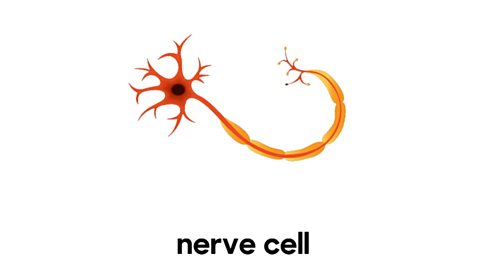
An illustration of a nerve cell
Nerve cells transmit electrical signals. They are well suited to their function because:
- They are thin, and can be more than 1 metre long. This means they can carry messages up and down the body over large distances.
- Nerve cells have branched connections at each end. These join to other nerve cells, allowing them to pass messages around the body.
- They have a fatty (myelin) sheath that surrounds them. The fatty sheath increases the speed at which the message can travel.
Muscle cells
Muscle cells bring parts of the body closer together. They are well suited to this function because:
- Muscle cells are held together in bundles, which pull together to make muscles contract (get shorter and fatter).
There are different types of muscle cell, each perfectly adapted to its function:
Cardiac muscle cells
Cardiac (heart) muscle cells are branched, and they join together to make a net. Cardiac muscle cells contract rhythmically, even outside the body. They never get tired.
Skeletal muscle cells
Skeletal muscle is joined to bones. Its cells contract to make bones move and joints bend.
Smooth muscle cells
Smooth muscle cells make up thin sheets of muscle, such as the stomach lining. They can also be arranged in bundles, or rings, like that in the anus.