Why does the body need food?
There are a number of reasons why food is essential for life. In the human body, energy produced from food is essential for:
- cell growth and repair
- respiration
- blood flow
- maintaining body temperature
- movement
- work
- exercise
Energy from food keeps a plant or animal alive and allows it to carry out all its activities.Food is very important socially too. Most of us celebrate special events like birthdays and holidays with food. There is an important connection between food, family, friends and fun!

Nutrients
A nutrient is a substance needed by organisms to stay alive and healthy. A healthy human diet involves seven different kinds of nutrient:

- carbohydrates
- proteins
- lipids (fats and oils)
- minerals
- vitamins
- dietary fibre
- water
Energy needs

Each person needs a different amount of energy depending on factors such as:
- gender (male or female)
- age
- amount of daily activity
If you look on the side of food packets you will see the food's energy content. (Link to section in Healthy mind and body) This is usually measured in kilojoules, kJ.

For example, a one-year-old baby needs 3 850 kJ each day to continue to grow, whereas an Ulster rugby player needs 15 600 kJ each day. Someone who sits at a desk all day will need less food than their twin who climbs ladders all day to wash windows.
Underweight, overweight
If the amount of energy you get from your food is different from the amount of energy you need, your diet will be imbalanced:
- too little food may lead to too little energy a person being underweight
- too much food may lead to too much energy and a person being overweight
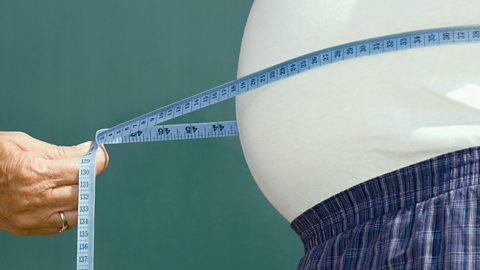

For a given height, there is a range of body weight that is thought to be healthy.
Starvation happens if you eat so little food that your body becomes very underweight. This can eventually cause serious illness.
Obesity happens when you eat so much food that your body becomes very overweight. This can also cause serious illness, for example an increased chance of heart disease.
Energy calculations
The average man needs about 10 470 kJ per day, and the average woman needs about 8 370 kJ per day. Food labels show how much energy the food provides. The table shows three examples:
| Food | Energy |
|---|---|
| Baked beans | 1395 kJ per can |
| Bread | 364 kJ per slice |
| Grated cheese | 17.45 kJ per g |
Using these numbers, the daily energy needs for a woman could be met from 6 cans of baked beans (8370 ÷ 1395 = 6) or from 23 slices of bread (8370 ÷ 364 = 23). The daily energy needs for a man could be met from 600 g of cheese (10470 ÷ 17.45 = 600).
However, we need to eat a mixture of different foods in the correct proportions to achieve a balanced diet. The amount we need to eat will vary from person to person.
What is a healthy diet?
To keep healthy, it is vital to eat a balanced diet. This means eating foods that contain nutrients in the correct amount.
Find out what makes a balanced plate of food from a catering supervisor.
My name is Tracy Healey and I am the Catering Supervisor at Ravensthorpe Junior School.
We try to get the children to eat a balanced diet. Obviously, it helps them getting all the nutrients they need on a daily basis.
Healthy diet, to me, is a balance of what we call an eat well plate. There's your carbohydrates, which is your breads, your starches, rice, potatoes, etcetera. You've got your oils, which is obviously fats. You've got your proteins, which is your meats, your pulses, beans. And then you've got your fruit and vegetables.
We do try and incorporate a lot of fruit and vegetables into our meals. If you think about homemade pizza, which you would traditionally think as being healthy, the pizza bases actually have grated carrot and courgette in there, then there's the homemade tomato sauce, which has the tomatoes, peppers, onions, carrots, and then, obviously, on top of the pizza, we put sweetcorn and peppers.
And they come back and say "Miss! Miss! I've really enjoyed that. Can we have that again?"
That, to me, you know, puts a smile on my face.
Nutrients are essential substances that the body needs. There are different types of nutrient, each with its own purpose.
The table shows why we need each nutrient, and some good sources of each one:
| Nutrient | Use in body | Good sources |
|---|---|---|
| Carbohydrate | To provide energy | Cereals, bread, pasta, rice and potatoes |
| Protein | For growth and repair | Fish, meat, eggs, beans, pulses and dairy products |
| Lipids (fats and oils) | To provide energy. Also to store energy in the body and insulate it against the cold. | Butter, oil and nuts |
| Minerals | There are 16 essential minerals needed in small amounts to maintain health. These include iron, used to transport oxygen in the blood, and calcium, used in making bones and teeth | Salt, milk (for calcium) and liver (for iron) |
| Vitamins | Needed in small amounts to maintain health | Fruit, vegetables, dairy foods |
| Dietary fibre | To provide roughage to help to keep the food moving through the gut | Vegetables, bran |
| Water | Around 70% of your body mass is water. It’s needed for cells and body fluids. Chemical reactions in cells take place in water and the blood transports substances dissolved in water | Water, fruit juice, milk |
How much?
It is important to eat nutrients in the correct amounts – too much may cause obesity and too little may cause malnutrition.
The World Health Organisation recommends getting at least half of your energy intake from carbohydrates and no more than 30% from fats. The organisation also recommends 400 g of fruit and vegetables daily.
Diet quizTest your knowledge with this quick quiz.
Effects of a poor diet
A balanced diet is one that contains the correct amounts of all the necessary nutrients needed for healthy growth and activity.
An imbalanced or poor diet can contain too much or too little of a particular nutrient. If you have too little of a particular nutrient, we say that you have a deficiency in that nutrient. For example, fibre is needed to keep food moving through the intestines easily, and people who have a fibre deficiency in their diet may get constipation.
Mineral deficiencies
You only need small amounts of the different minerals in your diet to stay healthy, but mineral deficiencies can make you ill. For example:
- iron deficiency can cause anaemia,where there are too few red blood cell
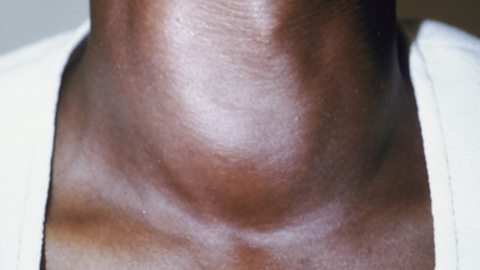
- iodine deficiency can cause a swelling in the neck called goitre
Vitamin deficiencies
Like minerals, you only need small amounts of the different vitamins in your diet to stay healthy, but you become ill if you do not get enough. For example:
- vitamin A deficiency can cause blindness
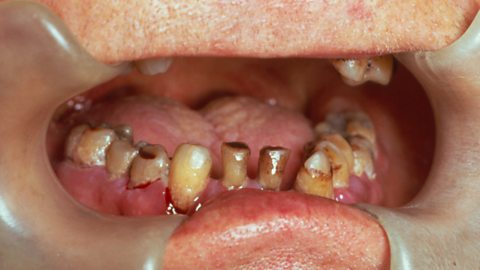
- vitamin C deficiency causes scurvy, which makes the gums bleed
- vitamin D deficiency causes rickets, which makes the legs bow outwards in growing children
Protein deficiency
Protein deficiency can affect many body functions, often resulting in swollen, puffy skin and muscle wasting.
Hunger, malnutrition and starvation
Hunger is the way the body signals that it needs to eat.
Malnutrition
Malnutrition is the lack of a balanced diet and can lead to being underweight, overweight, or obese.
Malnutrition is a serious health problem. It happens when people do not eat the right amounts of nutrients.
Too little food, or a lack of particular nutrients, can cause deficiency, diseases or death.
Too much food results in obesity. This may cause heart disease or type-2 diabetes.
Find out about the effects and treatment of malnutrition from a charity worker
Malnutrition is a condition that you get when you don't get the right kind of food in your diet.
My name is Dan Walden. I'm the Senior Programmes Specialist for Emergencies here at UNICEF UK.
Malnutrition can be broken down into kind of two areas. First one is acute malnutrition. That's the immediate risk to a child's life. There's not enough nutrients in the food that the kid is getting, their immune system is going to drop massively. On the other side of the coin, you've got chronic malnutrition which can result in stunting, where your body and your brain haven't developed into their full potential.
To identify malnutrition in children, remember, we're thinking about undernourishment, not getting enough nutrients, we use one of these, it's a MUAC band. Basically, we wrap it around the upper arm of the kid and we can see how small that's become. Sometimes, it's like right down to the size of a two pound coin.
In order to treat severe acute malnutrition, that's when the MUAC band has gone right around to red, we have something called ready-to-use therapeutic food and it is in a little sachet, ready to use, and it can really, really save a life.
It's about understanding the value of the nutrients, it's awareness, it's access to the food. This is an issue for everyone. It's not just an issue in developing countries.
What is malnutrition?
Malnutrition happens when people do not eat the right amounts of nutrients. Malnutrition can occur all over the world - it is not just a problem in developing countries.
Eating too little food can cause two types of malnutrition:
Acute malnutrition - when a person is at immediate risk of dying.
Chronic malnutrition - when a person does not grow or develop fully.
Malnutrition can also occur when people eat too much food or large amounts of foods that are high in fat or sugar.
These people may become overweight or even obese. Obesity can lead to life-threatening conditions, including type-2 diabetes, heart disease and some types of cancer.
Tackling malnutrition
Health and overseas charity workers need to understand nutrition. They use their knowledge to decide whether a person is malnourished. For example, they might use a MUAC band to measure the circumference of a child’s arm. If the arm is too small, the child may have acute malnutrition.
A person with acute malnutrition needs immediate help. This might include giving them life-saving food powder, called ready-to-use therapeutic food, which can be eaten straight from the packet. Ready-to-use therapeutic food is high in energy. It contains large amounts of lipids and carbohydrates.
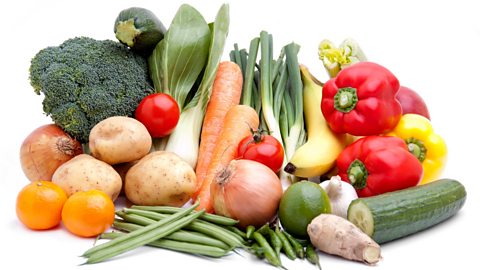
People with chronic malnutrition also need support. Teachers and health and community workers can teach families how to cook nutritious food. Governments can help to make sure that nutritious food is available, and that people are able to grow or buy it.
Starvation
Starvation is the lack of food. In humans, prolonged starvation can cause permanent organ damage and eventually, death.
Obesity
A school fitness adviser explains what obesity is and the steps that can be taken to avoid it. Where diabetes is referred to in this video, it specifically relates to Type-2 diabetes.
The role of diet in reducing obesity is vitally important to make sure that we don't consume more calories than we actually burn off.
Obesity is where someone is overweight and has excess of body fat. Balanced diet is equally important as daily exercise. They both play a fundamental part in maintaining a healthy weight.
Exercise is so important because it's great for everybody's physical and mental wellbeing. We need to be walking, we need to be trying to get our heart rate up which is the most important part about being active. The heart is a muscle, and we need to work that on a daily basis.
Some daily examples are walking to school, really fun but walking at a brisk pace. Taking the stairs instead of the lift. Drop a stop earlier from the bus stop and walk home.
Well, how you can tell if someone is obese is you perform a BMI test which is a body mass index test. BMI is calculated using a person's height and weight. If you're above 25, you are overweight. If you are between 30 and 40, you're considered obese. And anybody above 40 is very obese.
Someone at an obese stage in their life is more at risk of heart attack, strokes, and diabetes and associated illnesses.
The science I learned at school was really important to understand how the body works and what's needed to lead a healthy lifestyle.
My top three tips would be daily activities which are fun that you're gonna be want to doing again, a balanced healthy diet, and my third tip is to make sure you commit to this as a family.
What is obesity?
A person is said to be obese if they have such a high excess of body fat that their health might be affected.
Health workers use body mass index (BMI) to assess obesity. They measure the height and mass of a person and then use the equation below to calculate their BMI:

BMI = mass (kg) ÷ height² (m²)
For example, if a person has a mass of 60 kg and a height of 1.65 m:
BMI = 60 kg ÷ 1.65²
BMI = 22 kg/m²
- A person is overweight if their BMI is between 25 kg/m² and 30 kg/m².
- A person with a BMI over 30 kg/m² is said to be obese.
Therefore, the person in our example is not overweight or obese.
For children and young people aged 2 to 18, a BMI calculation takes into account age and gender as well as height and weight.
How does a person become obese?
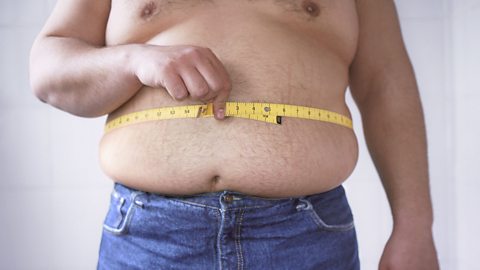
A person becomes obese by eating food that supplies more energy than they use up. The excess energy gets stored in the body as fat.
A 13-year old girl needs about 9,000 kilojoules (KJ) of energy each day. Boys of the same age need around 10,000 KJ/day.Adult women need roughly 8,400 KJ/day and adult men need roughly 10,500 KJ/day.If people consistently eat food that supplies more energy than this, without taking extra exercise, they might eventually become obese.
Health problems related to obesity
Obesity increases the risk of life-threatening health problems, including:
- Heart disease
- Stroke
- Type-2 diabetes
- Some types of cancer, including cancers of the breast, bowel and liver
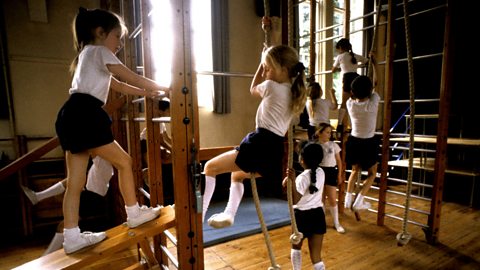
A person can prevent obesity by eating sensible amounts of nutritious food and exercising regularly. Most obese people can lose weight by eating less and exercising more.
Obesity quizTest your knowledge with this quick quiz.
Nutrition and food tests
There are different tests which can be used to detect carbohydrates, proteins and lipids.
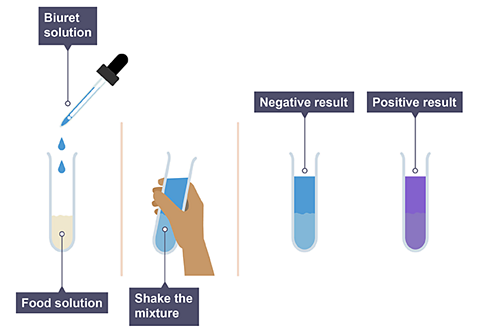
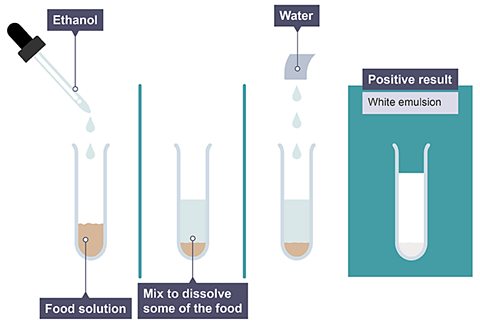
They involve adding a reagent to a food sample which changes colour depending on what biological molecules are present.
Sometimes it may be necessary to crush the food or add water to the food before adding the reagent.
| Types of food | Reagent | Method | Initial colour | Colour of positive result |
|---|---|---|---|---|
| Sugar such as glucose | Benedict’s | Add Benedict’s reagent to the food and boil in a water bath. | Blue | Brick red precipitate |
| Starch | Iodine | Add iodine reagent to the food. | Yellow-brown | Blue-black |
| Protein | Biuret (a mixture of sodium hydroxide and copper sulfate). | Add Biuret reagent to the food. | Blue | Lilac/purple |
| Fat | Ethanol | Add ethanol to the food to dissolve the fat then add water and shake gently. | Colourless | White |
Teeth
By the age of 12 to 14, most young people have lost all their baby teeth and have their adult teeth.
There are 32 adult teeth in total – 12 more than in the baby set. The last 4 of these, called wisdom teeth, usually emerge later than the others, generally between the ages of 17 and 21.
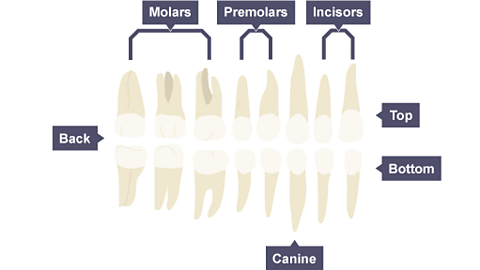
There are four types of teeth in your mouth, each with a different job to do.
| Job | Position in mouth | How many? | |
|---|---|---|---|
| Incisors | The teeth that you use to bite into your food | Front centre | Eight (four on both bottom and top) |
| Canines | For tearing apart food. Your sharpest teeth | Front middle behind the incisors | Four (two on both bottom and top) |
| Premolars | For tearing and crushing food | Behind the canines - back middle | Eight (four on both bottom and top) |
| Molars | To grind, tear, and crush food. Your largest teeth | Furthest to the back | Up to twelve (six on both bottom and top, which include four wisdom teeth) |
What are teeth made of?
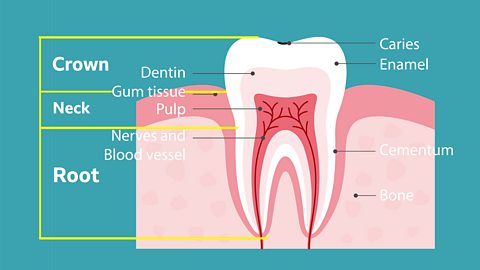
The part of the tooth that you can see above the gum is called the crown. This is covered in hard, shiny enamel. Enamel is the hardest substance in the body and protects the more sensitive inner parts of the tooth.
Underneath this is the dentine – a sensitive substance that makes up most of the tooth. Dentine is hard, though not quite as hard as enamel.
Dentine protects the inner part of the tooth, called the pulp. The pulp is where each tooth's blood supply and nerve endings are found. The blood supply is what keeps the teeth alive and healthy. The nerve endings send messages to the brain, such as whether you're eating something hot or cold, or if you have a decayed or damaged tooth.
Dental diseases
Most dental problems start because of plaque, a sticky layer of germs that grow on teeth.There are 2 main dental diseases:
- tooth decay
- gum disease
Gum disease
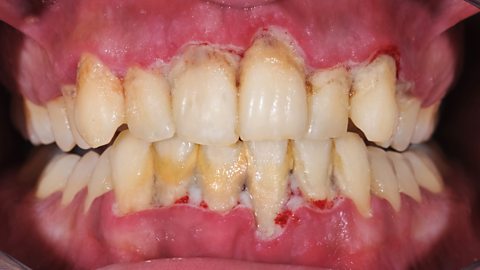
Gum disease occurs when germs in plaque infect the gums, causing them to become red and puffy and to bleed easily. The infection can spread to the supporting bone around the teeth and loosen them, and over time you may lose teeth.

Tooth decay
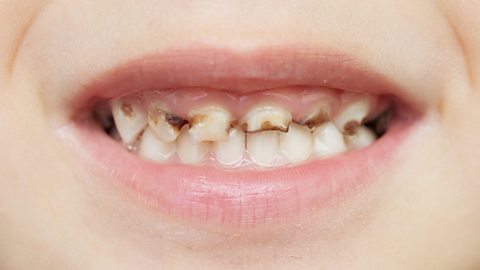
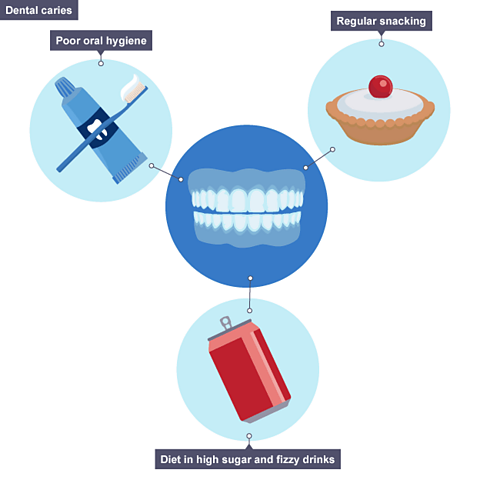
Tooth decay happens when the hard outer enamel of the tooth is damaged. This can happen when bacteria in the mouth convert sugars into acids that react with the enamel. If this happens often, the acid can make a hole in the tooth. Bacteria can then enter the softer dentine inside.
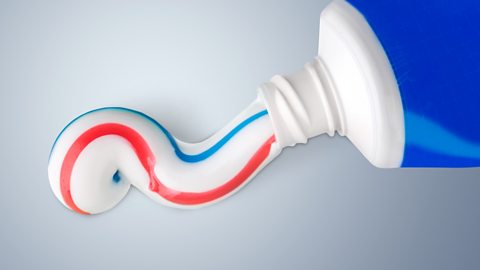
Tooth decay and gum disease can be prevented by:
- avoiding foods with a high sugar content
- using toothpaste and drinking water containing fluoride
- effective brushing of teeth and gums twice a day to prevent the build-up of plaque
Fluoride compounds may be added to toothpaste and public water supplies. Fluoride reduces tooth decay by:
- reducing the ability of bacteria on plaque to produce acid
- helping to replace calcium and phosphate lost by tooth enamel because of acid attack
However, there are arguments against fluoridation of drinking water. For example:
- some people say that they should not be forced to consume fluoride
- excessive fluoride can cause grey or brown spots on teeth
The decay or crumbling of a tooth is called dental caries.
More on Biology
Find out more by working through a topic
- count11 of 14

- count12 of 14
- count13 of 14
- count14 of 14