Key points
Overview
The poem is a short, powerful statement about staying strong and in control, even when life is painful or unfair. The speaker refuses to give in to fear, fate or suffering, showing unwavering inner strength and determination.
Main themes
The poem explores self-determination, courage and resilience. It highlights the human will to remain strong in the face of adversity and the belief that we can control our own fate, even when circumstances are harsh.
Tone and voice
The tone is bold, defiant and matter-of-fact. The speaker expresses determination and confidence, refusing to be broken by hardship or fear. The use of first person makes the message universal.
Context
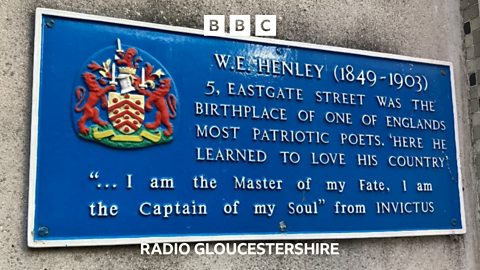
Henley wrote Invictus while recovering from a serious illness that led to the amputation of his leg. Despite physical suffering, he remained mentally strong. The poem reflects his belief in inner resilience and personal control over fate. The title, meaning "unconquered", was added later by an editor and gives the poem a sense of timelessness and status.
Form and structure
The poem is made up of four quatrains (four-line stanzas) with a regular rhyme scheme and steady rhythm in iambic tetrameter. Most lines are end-stopped, which adds to the sense of control and certainty in the speaker’s voice. The regular structure suggests steadiness and purpose.
Poetic devices to spot
- Metaphor – suffering is described as "night", "pit", or "shade", giving abstract pain a physical form.
- Allusion – the line "strait the gate" is a biblical reference, adding weight to the speaker’s journey.
- Personification – "chance" and "circumstance" are given human traits, making them feel like enemies to overcome.
- Alliteration – repeated ‘b’ and ‘p’ sounds add strength and emphasis to key lines.
- Asyndeton – leaving out conjunctions makes the lines more direct and forceful.
- Iambic tetrameter – provides a regular, heartbeat-like rhythm that reinforces the speaker’s steady resolve.
Invictus
by William Ernest Henley
Out of the night that covers me
Black as the Pit from pole to pole
I thank whatever gods may be
For my unconquerable soul.
In the fell clutch of circumstance,
I have not winced nor cried aloud.
Under the bludgeonings of chance,
My head is bloody, but unbowed.
Beyond this place of wrath and tears,
Looms but the Horror of the shade.
And yet the menace of the years
Finds, and shall find, me unafraid.
It matters not how strait the gate
How charged with punishments the scroll
I am the master of my fate:
I am the captain of my soul
The text of this poem is available in the CCEA Poetry Anthology, which can be downloaded from the CCEA website.
The BBC is not responsible for the contents of any other sites listed.
Summary
Henley’s best-known work, which he once described as “the idea that one's decisions and iron will to overcome life's obstacles, defines one's fate". Written in 1875 during a prolonged hospital stay.

- Title: The Latin term for “unconquered”; this both suggests the subject matter and also invokes a sense of timelessness and high status through its use of Latin, a classical language often associated with rank and prestige. The title was actually added later by an editor and not by the poet himself.
- Themes: Self-determination, resilience, courage, will vs. fate.
- Tone: Matter-of-fact, defiant, determined, resolved.
- Speaker: First person speaker; we know nothing of them personally save their unwavering resolve to persevere through challenges, allowing the poem some universal appeal to audiences.
Applicable context
- William Ernest Henley suffered from tuberculosis of the bone in his childhood, which caused him to need hugely painful medical procedures and meant he had to have his leg amputated when he was 16. He missed a lot of school, and his early attempts at a career in journalism were interrupted by long hospital stays. When his other foot became diseased, he submitted to three years in hospital to try new treatments to save it. During this trying time, he wrote Invictus as a testimony to the idea that mind can triumph over matter.
- Despite his physical difficulties in childhood, his younger brother remembered him always being cheerful, laughing and playing boisterously to mask or forget the intense pain he was in. This attitude continued into adulthood; his friend Robert Louis Stevenson used him as inspiration for the Treasure Island character Long John Silver, a one-legged pirate captain whose cleverness and courage made others fear him despite his physical disability. Stevenson's stepson said Henley had “unimaginable fire and vitality”.
- Invictus was published 20 years after Darwin's Origin of the Species and other scientific advancements had shaken society's faith in religion and the concept of God. Other societal norms, such as the role of the individual, were also being challenged and re-imagined. Some writers of this era, such as Oscar Wilde, embraced decadence and shallowness, focusing on appearances and pondering death; however Henley and his fellow writers like Stevenson believed in affirming life at all costs, promoting the human spirit and sense of adventure in their work.
Only a little context is needed for each poem; where used, it should be applied to the point you're making.
Form and structure
- The poem is set out in four regular A type of stanza - or a complete poem - consisting of four lines that have a rhyming scheme. (four-line stanzas) which give an impression of steadiness, solidity and purpose. Each A grouped set of lines within a poem. is end-stopped, so the speaker never sounds uncertain or out of control – he is steady and sure of his purpose throughout.
- The rhyme scheme of the poem is also regular and complete, alternating rhyming lines to give a similar sense of sureness and steadiness. This choice by the poet seems to suggest that, while life's challenges may be sudden and unbalanced, the speaker remains regular and firm when facing them.
- The The rhythm of a line of poetry based on how many syllables it has and where they are stressed or emphasised – likes beats in music. of Invictus is mostly based around Line of verse written in four pairs of syllables each made up by an unstressed syllable followed by a stressed syllable.. One 'iamb' is a two-beat combination: an unstressed syllable followed by a stressed (emphasised) syllable, making a 'da-DUM' pattern, like a heartbeat. Tetrameter means four of these two-beat units per line, making eight syllables altogether:
| I thank | what-ev- | -er Gods | may be |
|da-DUM | da-DUM | da-DUM |da-DUM|
This metre is fairly regular throughout, like someone marching forward consistently through adversity. However, a few lines (such as the first) slightly disrupt this regular rhythm with different stresses on the syllables, giving a sense that the speaker is a strong individual and will not always be constrained to the same beat.
Language and poetic methods
- Metaphor: Invictus employs many A metaphor is a word or a phrase used for dramatic effect, to describe something as if it were something else. throughout, referring figuratively to challenges rather than literally. This works as a way of effectively representing the many and various difficulties faced by different people in their lives in a way that almost everyone can relate to. The speaker compares suffering to “night” in line one, showing it feels dark and oppressive, and says it “covers” him like a metaphorical blanket, as though he feels smothered by it. The “pit” he refers to is likely to mean Hell, though he does not name it as such, instead evoking a sense of being trapped in a deep hole; it forms part of a simile, “black as the pit”, showing the darkness he faces is as terrible as Hell itself. The “Horror of the shade” in line 10 compares death to a shadowy place, lurking to take him after the miseries of “the place of wrath and tears”, a description of the world in which he currently lives. The “scroll” that is “charged with punishments” is like a grand document of judgement against him, decreeing he must be penalised without mentioning whether he has done anything to deserve this. In the end he states he is “captain of my soul”, as though his soul were a vessel he can command and steer in any way he chooses.
- Allusion: The line “It matters not how strait the gate” is a Biblical A quick reference - often to an image, character or place - from a work of literature or music or mythology.: in the New Testament, Jesus' sermon on the Mount contains the line “strait is the gate and narrow is the way”, where “strait” is used to mean tight and constricted, showing the difficulty of getting through. As noted in the context section, Invictus was written at a time when society's belief in religion had been shaken, and Henley notably puts his faith in himself and not God; however, this Biblical reference might have resonated with his readers anyway, especially those familiar with the Bible. Henley employs some subtle religious references (eg the “pit” as a metaphor for hell) but does not overtly show any religious belief in the poem; he mentions “whatever gods may be”, showing he does not put his faith in any one religion or deity, but in himself and his own choices and actions.
- Asyndeton: The use of The lack of conjunctions between phrases, like and, or, so, since, for, because, as, but, yet, still, while, as soon as, therefore etc, in which conjunctions like 'and' are left out between words and phrases they might usually connect, occurs in the final stanza. We could reasonably expect there to be a 'nor' used between the lines “It matters not how strait the gate, / How charged with punishments the scroll”, but Henley omits this conjunction, intensifying the things he lists and emphasising the hugeness of the challenges he will face down.
- Personification: Henley personifies both “circumstance” and “chance” in the poem; the former with its “clutch” suggests he is held trapped by his conditions, while the latter's “bludgeonings” are the metaphorical physical blows rained down on him. It's interesting to note that while he A type of imagery in which non-human objects, animals or ideas are given human characteristics. both conditions and luck in this way, he uses no capital letters for either – he gives them characteristics without making them into actual characters. This suggests he implicitly believes his difficult state is not something to be taken personally.
Under the bludgeonings of chance,
My head is bloody, but unbowed.
- Alliteration: The poet favours Marked by alliteration - the repetition of a sound at the beginning of consecutive words, such as ‘the big, bold, blue sea' of plosive sounds – 'p's and 'b's – in Invictus because they are abrupt, strong consonants that 'explode' from the lips, helping to emphasise the speaker's strength and defiance. The emphatic 'b' sounds in “bludgeonings” and “bloody” (as well as the 'b' in “unbowed”, which is consonance rather than alliteration but still works a sound repeated for emphasis) make the speaker sound deliberate and bold, while the pointed 'p' sounds repeated in “black as the pit from pole to pole” accentuate the difficulty of what he is facing.
Out of the night that covers me
Black as the Pit from pole to pole
This is not a list of every method or notable use of language and structure in Invictus.
Look at the poem again. Can you find any of the following?
Repetition
The most significant repetition in the poem is undoubtedly in the last two lines, which are often quoted in popular culture: “I am the master of my fate; / I am the captain of my soul.” These lines are stated as if they are facts, and the repetition of the phrasing with “I am” and “of my” accentuates the utter confidence and conviction of the speaker, and his faith in himself and his abilities.
A poetic device where a sentence continues beyond the end of the line or verse.
Often enjambment suggests looseness or even a loss of control by the speaker, but in this poem, it is used to set up a kind of cause-and-effect relationship between what the speaker suffers and how he carries on. In stanza two, for example, the speaker states “In the fell clutch of circumstance / I have not winced nor cried aloud” – the enjambment shows the direct connection between the difficulty suffered and the speaker’s behaviour, and creates a flow that encourages the reader to keep going, just as the speaker does.
What other poems could I compare with Invictus?
Prayer Before Birth – the uncertainty and fears of the unborn child speaker in the poem contrast with the determination and resilience of the speaker in Invictus.
Here – another first person speaker, but one who contrasts with the speaker in Invictus by questioning his place and purpose in an uncertain world.
Kid – a poem using pop culture references and humour to detail the experience of the speaker as he becomes stronger, more grown-up and more sure of himself.
Practice questions
Use these questions to hone your knowledge of Invictus, and to practise using your notes and analysis in organised paragraphs that focus on how particular themes or ideas are shown in the poem. There is an example answer in the following section to demonstrate how you can do this.
- How does Henley create a sense of universality in Invictus?
- What does Invictus show us about Henley's attitude to life?
- What poetic methods does Henley use to show a sense of self-determination in Invictus?
- How does Henley create a tone of strength and defiance in Invictus?
Example answer
Below is a demonstration of how to use the material in this section to answer an example essay question. The answer below is not a full essay, but only an extract of a longer answer showing some of the points that could be made.
Q: How does Henley create a sense of universality in Invictus?
A: Henley’s four quatrain poem Invictus was first written in 1875 but remains popular with readers today, appealing to many who find solace in its message about facing life’s challenges undaunted. The universality of its appeal can be noted even in the title, which is the Latin phrase for ‘unconquered’. This suggests the subject matter but also invokes a sense of timelessness through its use of Latin, a classical language; it is not widely used or studied today, but seems noble and ageless, and because of this the title does not age and remains accessible, giving a sense of universality for everyone. It’s notable that the title was not actually chosen by Henley himself but added later by an editor for publication; this detail further suggests the poem’s universality, since editors worked to create appeal for readers in a way writers would not have prioritised over their own vision and ideas.
The language of the poem is metaphorical but straightforward and easy to understand, while the regular metre and rhyme scheme make the poem catchy, memorable and attractive to even casual readers, creating universal appeal. The use of iambic tetrameter is mostly consistent, with a pleasing and regular beat, but occasionally Henley alters the metre (using a stressed syllable to start line one, for example) which gives a subtle sense of individuality, as though the speaker refuses to completely comply with the rules of rhythm. This sense of individual strength is something everyone wants to believe about themselves, and so the metre of the poem both pushes the reader forward through its daunting imagery but also gives small hints of individuality. This allows the reader to see themselves in the poem and creates a sense of universality.
This essay could go on to make the following points, backed up by evidence from the poem and detailed analysis of that evidence:
- Henley uses uncomplicated and easily understood metaphors rather than literal descriptions of challenges in his life, allowing readers to project their own troubles onto the poem and recognise their own struggles in it.
- Henley uses personification of both “circumstance” and “chance”, two aspects of life that apply to everyone, allowing readers to relate to and identify with the speaker and creating a sense of universality.
- Henley uses Biblical allusion and some subtle religious references, but these are not overt or preaching and do not put forward any one religion as a solution to life’s problems, therefore creating a universal appeal to readers of all beliefs.
Test your knowledge of Invictus
More William Ernest Henley
Invictus Games. video
Watch a host of athletes and celebrities recite William Ernest Henley's Invictus.

Celebrating William Ernest Henley's 175th anniversary. audio
Duncan Cook explores Henley's legacy at St Mary de Crypt.
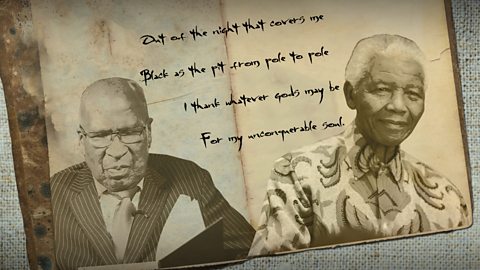
Nelson Mandela's cellmate reads Invictus. video
Nelson Mandela and fellow jailed anti-apartheid campaigner Andrew Mlangeni used to read the poem to each other in their Robben Island cell.
More on Anthology One: Identity
Find out more by working through a topic
- count4 of 11
- count5 of 11
- count6 of 11

- count7 of 11