Factorising quadratic expressions
Factorising an expression means finding the factors that multiply together to give that expression.
Useful topics:
Knowledge of how to factorise expressions of the form \(\mathbf{x^2 +bx +c}\) will help.
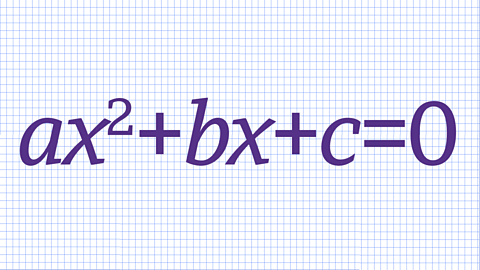
Factorising quadratic expressions of the form ax² + bx + c
How to factorise an expression with no number in front of the \(x^2\)
For \(\mathbf{x^2 + 5x + 6}\), the first step is to find two numbers whose sum is 5 and whose product is 6
\(\mathbf{x^2 + \color{green}5x + \color{red}6}\)
\(\text{Sum} = \color{green}5\quad= 2 + 3\)
\(\text{Product} = \color{red}6\quad = 2 \times 3\)
This gives the factors with no further working.
\(\mathbf{x^2 + 5x + 6 = (x + 2)(x + 3)}\)
This method for factorising \(x^2 + bx + c\) can be modified to factorise \(ax^2 + bx +c\)
Example
Factorise \(\mathbf{3x^2 + 11x + 10}\)
Solution
Write down the sum and product to help find the factors.
The sum is \(11\) but because there is a \(3\) in front of the \(x^2\), the product needed is \(3 \times 10\)
(Number in front of the \(x^2\) times the number at the end)
Find two numbers whose sum is \(11\) and whose product is \(3 \times 10 = 30\)
\(5 + 6 = 11\)
\(5 \times 6 = 30\)
Rewrite the equation splitting up the middle term
\(3x^2 + \color{blue}{5x + 6x}\color{black} + 10\)
Factorise the first two terms \(\color{purple}{3x^2 + 5x}\color{black} + 6x + 10\)
\(= \color{purple}{x(3x + 5)}\color{black} + 6x + 10\)
Factorise the last two terms to leave 3x + 5 in the bracket \(\color{purple}{ = x(3x + 5)}\color{black} + 2(3x + 5)\)
Write down the factors
\(= (3x + 5)(x + 2)\)
Answer:
\(\mathbf{3x^2+11x+10 = (3x+5)(x+2)}\)

In general
- Write down the sum and product
- Find the two numbers that add to give the sum and multiply to give the product
- Rewrite the expression splitting up the middle term
- Factorise in pairs - to give the same expression in both brackets
- Write down the factors
Example
Factorise
\(\mathbf{3x^2 - 5x - 2}\)
Solution:
Write down the sum and product
\(\text{Sum} = -5\)
\(\text{Product} = - 6\quad(3 x -2 = -6)\)
Find the two numbers that add to give the sum and multiply to give the product
\(-6 + 1 = -5\)
\(-6 \times 1 = -6\)
Rewrite the expression, splitting up the middle term
\(3x^2 \color{blue}-6x + x \color{black}-2\)
Factorise in pairs - to give the same expression in two brackets
\(= 3x \color{purple}(x - 2)\color{black} + 1 \color{purple}(x - 2)\)
Write down the factors
\(= (3x + 1)\color{purple}(x - 2)\)
Answer:
\(\mathbf{3x^2 – 5x - 2 = (3x + 1)(x - 2)}\)
Question
Factorise
\(2x^2 + x – 21\)
Solution:
Write down the sum and product \(\text{Sum} = +1\)
\(\text{Product } = -42\quad (2 \times -21 = -42)\)
Find the two numbers that add to give the sum and multiply to give the product
\(+7 - 6 = +1\)
\( +7 \times - 6 = -42\)
Rewrite the expression, splitting up the middle term
\(2x^2 \color{blue}+ 7x - 6x\color{black} -21\)
Factorise in pairs - to give the same expression in both brackets
\(=x\color{purple}{(2x + 7)}\color{black}-3\color{purple}(2x + 7)\)
Write down the factors
\(=\color{purple}{(2x + 7)}\color{black}(x-3)\)
Answer:
\(\mathbf{2x^2 + x - 21 = (2x + 7)(x - 3)}\)
Difference of two squares - factorising expressions like a²x²–b²
The expression \(9x^2 – 25\) can be factorised using the Difference Of Two Squares method. (DOTS)
In this expression,
\(9x^2 = (3x)^2\)
\(25 = 52\) and there is a minus sign in between
The difference of two squares.
\(9x^2 – 25 = (3x + 5)(3x – 5)\)
In general,
\(a^2x^2 – b^2\) can be factorised to give \(\mathbf{(ax + b) (ax – b)}\)
Example
Factorise
\(4x^2 - 100\)
Solution:
\(4x^2 = (2x)^2 \text{ and }100 = 10^2\) There is a \(–\) sign in between.
Use DOTS
The factors can be written down without any further working. \(4x^2 – 100 = (2x)^2 – 10^2\)
\(= (2x + 10)(2x – 10)\)
Question
Factorise
\(4x^2 - 49\)
Solution
\(4x^2 - 49 = (2x)^2 - 7^2\)
Use DOTS
\(\mathbf{4x^2 – 49 = (2x + 7)(2x – 7)}\)
Example
Factorise
\(9y^2 - 64x^2\)
Solution:
Use DOTS. \(9y^2 - 64x^2 = (3y)^2 – (8x)^2\)
Factors are
\((3y + 8x)(3y – 8x)\)
Answer
\(9y^2 - 64x^2 = (3y +8x)(3y - 8x)\)
Test yourself
More on M4: Number & Algebra
Find out more by working through a topic
- count2 of 4