Key points
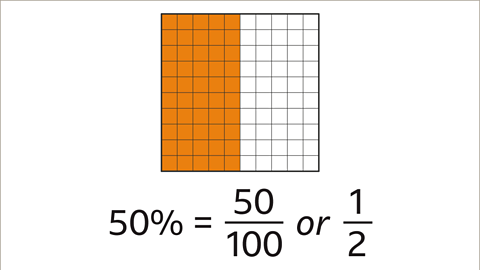
- Percentages represent an amount out of 100. This provides a consistent base to compare against when looking at fractional parts. For example, 50%, means 50 out of 100 or \( \frac{50}{100} \). 50% is the same as one half.
- Percentages are often used instead of fractions and decimals. This is because parts of 100 can be easier to understand.
What is a percentage?
- A percentage is a fraction that is parts out of 100
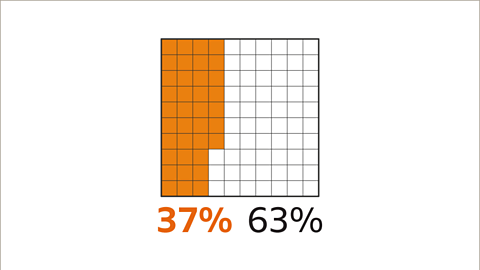
- A whole is 100%. The percentages that are part of a whole, The answer to an addition calculation to 100%
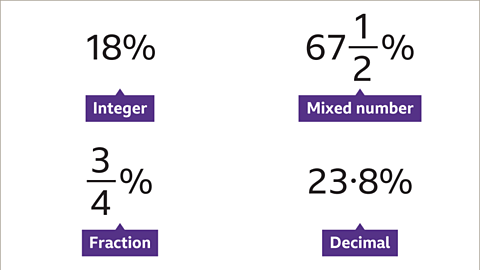
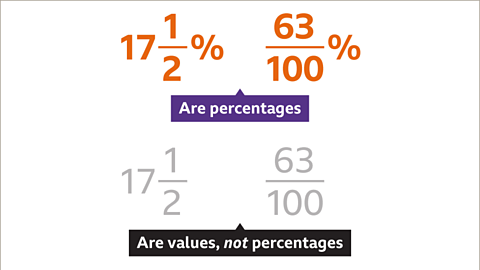
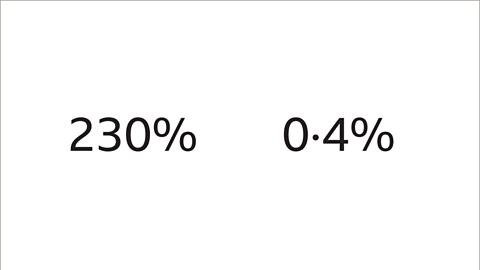
- A percentage is written as a number with the % symbol. The number can be an Integers are numbers with no fraction or decimal part. They can be positive, negative or zero. 42, 8, and 10000 are examples of integers., A number that is written using a whole number and a fraction, eg 3 4⁄5, fraction or a decimal.
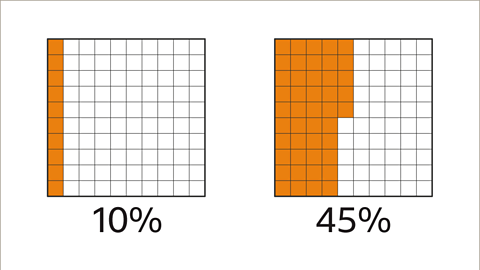
- A percentage can be represented by shading in a 100 square grid.
Examples
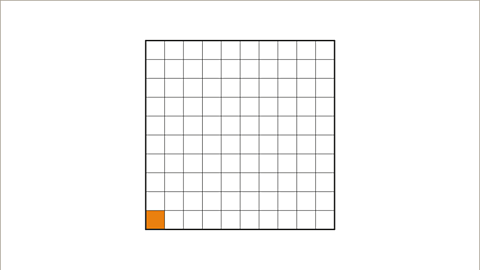
Image caption, What percentage of this grid is orange?
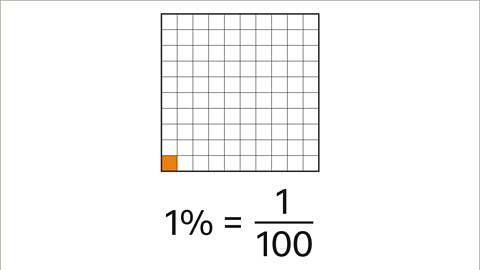
1 of 8
How to find a missing percentage
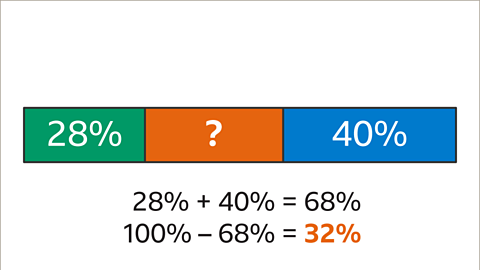
Add the given percentages.
Subtract the result from 100%
The difference between 100% and the total given percentage will be the missing percentage.
Remember that the whole is always 100%
Examples
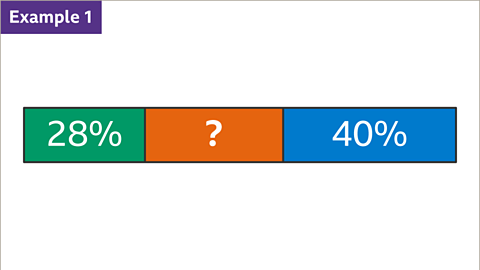
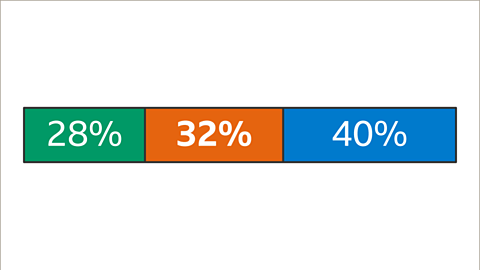
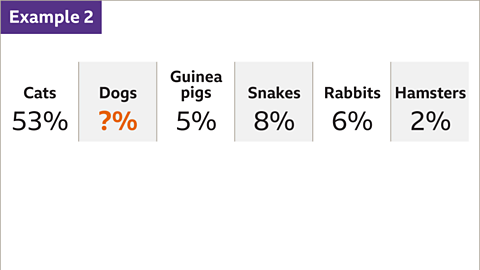
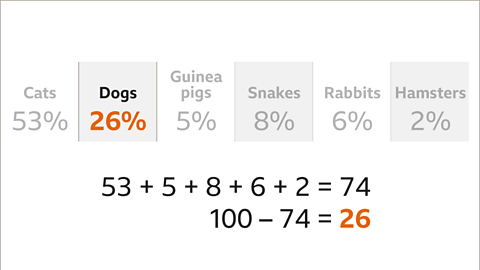
Image caption, Add the given percentages. 28% + 40% = 68%. Subtract the result (68%) from 100%. The difference between 100% and the total given percentage (68%) is the missing percentage. 100% – 68% = 32%
1 of 5
Question
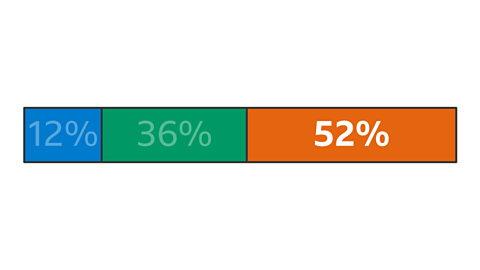
12% of the bar is blue. 36% of the bar is green. What % of the bar is orange?
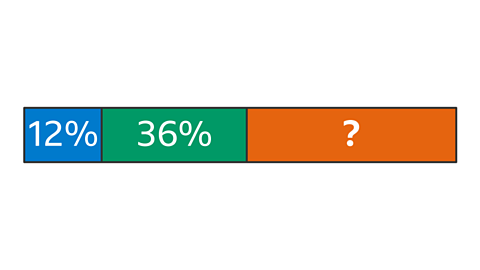
The whole bar is 100%
12 + 36 = 48
100 – 48 = 52
52% of the bar is orange.
A percentage as an operator
A percentage becomes an A mathematical action such as addition, subtraction, multiplication and division. when it represents a mathematical action.
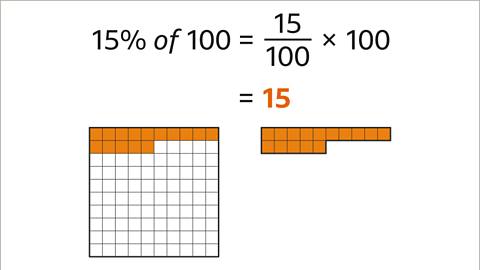
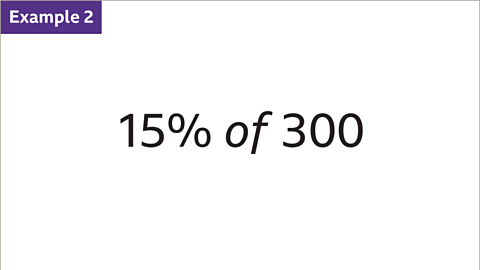
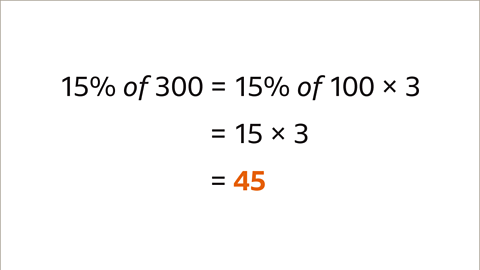
Finding a percentage of something is a mathematical action. The percentage is an operator. For example, 15% of 100 means work out 15 hundredths of 100
Examples
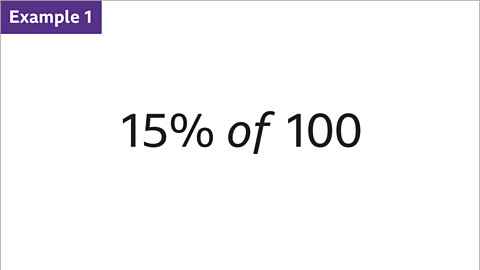
Image caption, 15% of 100 is an instruction to work out 15 hundredths of 100
1 of 4
Question
What percentages are represented in these 100-square grids?
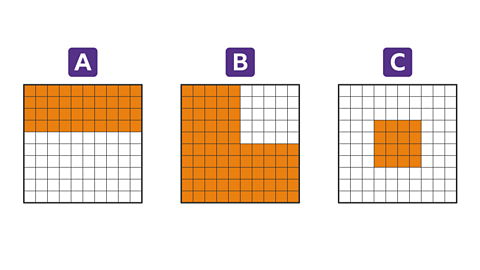
Count the shaded squares.
A 4 rows of 10 squares is 40%
B 5 rows of 5 squares is 25%. 5 rows of 10 squares is 50%. 25% + 50% = 75%
C 4 rows of 4 squares is 16%
Practise percentages
Try this quiz to practise percentages. You may need a pen and paper to help you answer the questions in this quiz.
Quiz
Real-world maths

A statistician is someone who works with data. They often use percentages in reports. To ensure accuracy, the total percentage is always 100%
Newspapers and magazines frequently present information in pie charts using percentages, as well as using them in headlines and reports to make a news story stand out. As a reader it is important to know what a percentage is in order to understand the information.
Play Sudoku with BBC Bitesize!
Every weekday we release brand new easy, medium and hard Sudoku puzzles. Perfect for testing your skill with numbers and logic.

More on Percentages
Find out more by working through a topic
- count2 of 7
- count4 of 7
- count5 of 7