Quick version
From the late 18th century onwards, thousands of Scots emigrated to Canada.
- some were escaping poverty and unemployment during the Agricultural Revolution
- some had been moved from their land during the Highland Clearances
- some volunteered to go to Canada for the opportunity of money and land
Scots played a prominent role in developing Canada:
- businessmen and entrepreneurs – such as Allan Gilmour
- politicians – such as Scotland-born Canadian Prime Minister, John Alexander McDonald
Scottish culture and traditions persisted in Canada - such as the Gaelic language, Highland Games, literature, and customs like Burns Night
Scots also played a part in the lasting damage to indigenous peoples, with Scottish politicians being key in drafting laws to control and oppress native peoples.
Video - Scots in Canada
This video explores the impact of legacy of Scots migrants in Canada.
From the 1830s onwards, emigration from Scotland surged, with millions boarding ships to start new lives - in Canada, the USA, Australia, New Zealand, and India.
As well as building new lives for themselves, they created lasting impacts on the places they settled. As an MP remarked in 1888:
“In British settlements, from Canada to Ceylon, from Dunedin to Bombay, for every Englishman that you meet who has worked himself up to wealth from small beginnings without external aid, you find ten Scotchmen.”
The Scots reputation for self-reliance often made them central figures in the development of countries across the British Empire – and Canada, with climate and landscapes similar to the Highlands, became a new Scots homeland.
Scots were heavily involved in key industries - the fur trade, farming, paper, steel, timber, and metalworks. By 1920, 25% of Canada’s business leaders were men who’d been born in Scotland.
And Scots took leading roles in creating Canada’s education system, banks, and legal system. Glasgow born John A MacDonald became the country’s first Prime Minister in 1867.
He was central to the development of the Transatlantic Canadian Pacific Railway, which linked Canada’s growing economic centre to locations across its vast territory.
But from the start, development also had a darker side…
Early Scots settlers formed links with indigenous communities – and learnt vital skills from them which enabled them to survive the winters.
But as settlers spread they began to interfere with traditional ways of life - particularly the bison-hunting cultures of the prairies.
When settlers fenced off land, conflicts increased, with indigenous people seen as a problem which the government needed to solve.John A. Macdonald masterminded the Indian Act, under which First Nation children were removed from their parents and brought into white Canadian culture .
All those who emigrated from Scotland had a huge impact on the Canadian development - and on the lives of the territory’s indigenous peoples.
Scottish enterprise and culture reshaped the vast expanse of Canada in the image of Scotland - in ways that are still felt today.
Learn in more depth
For many Scots, the promise of better housing, access to affordable land, and better-paid jobs was enough to entice them to cross the Atlantic to start a new life in Canada and North America.
Between 1763 and 1777, 50,000 Scots, mostly from the west of Scotland, settled in North America. (source: Oxford Companion to Scottish History.)
Many of these Scots were escaping poverty and hardships back in Scotland:
- the Agricultural Revolution saw the introduction of new farming machinery and methods. These led to a rise in rural unemployment
- the Highland Clearances saw hundreds of thousands of Highland Scots displaced from their homes – sometimes involuntarily. Many of these people emigrated.
Others welcomed a move to Canada seeing it as an opportunity to earn more money or secure access to land.
Scots in Canada
Many early Scottish emigrants came from farming communities. These migrants played a key role in the growth and development in Canadian farming and the early Canadian economy.
The principle attraction was the promise of land ownership. Many of the early Scots migrants would have been tenant farmers or labourers back in Scotland. They would have rented the land they worked on and they would have had little in the way of property rights.
However, for the first emigrants to Canada, a lot had to be done before any ‘farming’ could actually take place.
- Scots were responsible for clearing much of the land in Canada to create an economically viable farmland
- richer Scottish immigrants purchased “Crown Land” (government land) that was already cleared or partially clear.
For poorer migrants, life in Canada could be hard:
- clearing land was hard work
- not all the available land was suitable for farming
- Canadian winters could be very harsh
Scots and the Hudson Bay Company
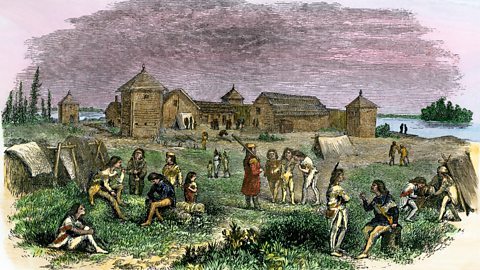 Image source, North Wind Picture Archives/ALAMY
The Hudson Bay Company owned the monopoly on hunting and trading in the Canadian territories under British control. Fur trading was immensely profitable, and Scots had a disproportionate involvement in the business.
Scots were actively recruited by the company and many Scots, keen to escape poverty or lack of opportunity in Scotland, signed up to work for the company in Canada.
- Orcadians provided a ready labour force. Ships sailing to Canada stopped at the Orkney Islands en route and Orcadian men were typically recruited
- Scots dominated in clerical and managerial posts in the company
Scots who settled in Canada often sent word back home for other family members and relatives to join them. The clan system of the Highlands and Islands was often replicated in Canada as extended Scots family groupings dominated trade in specific Canadian territories.
Image source, North Wind Picture Archives/ALAMYScots and the Canadian economy
As well as providing labour and expertise in turning Canada's wild areas into profitable farmland, Scots also earned a reputation as keen and industrious businessmen.
In the 1880s Scots migrants dominated Canadian textiles, paper, sugar, oil, iron and steel, the fur trade and bakery products. They were also incredibly influential in the development of transport links such as railways and shipping.
Scots were crucial in the development of Canada's banking and financial centres. Many of Canada's banks – such as the Bank of Upper Canada, formed by William Allen and John Strachan – were established by Scots.
Scots also played an important role in establishing many of Canada's schools, colleges, and universities. For example, McGill University was established with money from the estate of James McGill, a Glasgow emigrant.
Notable Scottish Canadians
George Stephen, 1829 - 1921
George Stephen emigrated from Dufftown, Banffshire to Canada in 1850.
Born to humble origins, Stephen went on to become President of the Bank of Montreal. He was the first Canadian to receive a peerage and became known as Baron Mount Stephen
He helped to establish and run the Canadian Pacific Railroad in the 1880s that ran across the entire breadth of Canada from the Pacific in the west to the Atlantic in the east.
Allan Gilmour, 1775 - 1849
Allan Gilmour emigrated from Glasgow to Canada in the early 1800s.
Gilmour built up a very successful business in Canada that included timber and ship yards. The large ships that he designed and built made his company a fortune in the 1830s and 1840s.
Scots and indigenous Canadians
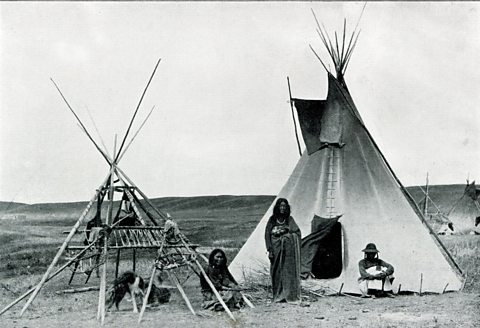 Image source, Chronicle/ALAMY
The arrival of Europeans in Canada brought these new arrivals into contact with indigenous native Americans.
The relationship was complex. While there was peaceful trading relations and intermarriage between the two groups, there was also a lasting legacy of persecution and oppression of native Canadians by European settlers.
Through farming, fur trapping, hunting, logging, and the development of industry, Europeans found themselves in competition and conflict with indigenous people for control of the land.
Over the years, intermarriage had created a significant number of people which a dual heritage – part European and part native Canadian. These people became known as the Métis.
In 1869 and 1885 the tensions between the competing interests of British settlers and indigenous Canadians exploded into violence as Métis people launched rebellions against the seizure of their land.
For many Europeans, the native Canadian people were seen as 'savages', and measures were made to 'civilise' and control them.
- Gradual Civilization Act 1857 – introduced a process where native males could lose their 'Indian status' and become British subjects
- Gradual Enfranchisement Act of 1869 – furthered the process of 1857. In order to own land in reservations, indigenous people had to adopt European names
- Indian Act of 1876 – granted rights to indigenous people but also introduced laws that governed their lives and freedoms, such as their ability to leave Indian reserve lands.
Image source, Chronicle/ALAMYThe role of Sir John Alexander Macdonald
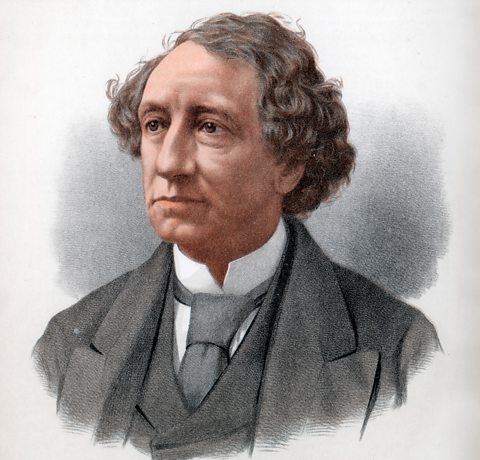 Image source, Getty / Print Collector
Born in Glasgow in 1815, Sir John Alexander Macdonald's family emigrated to Canada in 1820. From humble beginnings, he went on to become Canada's first Prime Minister from 1867 to 1873. He served again from 1878 to his death in 1891.
His leadership saw the development and expansion of the railway network that is often credited as helping to make Canada a nation rather than a collection of provinces.
While celebrated as one of Canada's most important politicians, there are lasting questions about his treatment of indigenous Canadians.
- Critics claimed that Macdonald deliberately starved native Canadians off their territories to clear land for the railways by denying them food aid during famines.
- Macdonald was responsible for the Residential Schools that removed indigenous children from their parents and tried to forcibly raise them as "civilised" Christians.
- Macdonald sanctioned the execution of Métis leader, Louis Riel, in 1885 and alienated and marginalised dual-heritage Canadians.
Image source, Getty / Print CollectorCultural legacy of Scots in Canada
 Image source, Autumn Sky Photography/ALAMY
Scottish migrants had a impact on Canada. Their legacy can be seen simply in the place names in the country.
Many Canadian places have names with links to the origins of Scottish settlers – such as Stornoway, Glasgow, Lanark, Stirling, Banff, Elgin and Aberdeen. The very province of Nova Scotia itself means New Scotland, highlighting the powerful cultural impact they had on the country.
The Highland emigrants continued to use Gaelic in Canada. It remained the main language in many communities, particularly Cape Breton and Nova Scotia, well into the 20th Century. Gaelic newspapers were even circulating in the 1930s, demonstrating the massive impact and cultural links between Scotland and Canada.
Much of the continued use of the language can be attributed to religion. Christianity was able to thrive through the Gaelic medium in these communities. Eventually they did become bi-lingual, but the Gaelic language was fundamental to the settlers, and as a result it continued into the modern day.
Scottish cultural traditions, such as music and dance, also persisted in Canada. To this day, many areas of Canada have pipe bands and practice Scottish dancing.
The emigrants also brought with them various sports activities. The Highland Games were first played in Canada in 1819, and the Canadian interest in curling and golf is often attributed to Scottish origins.
Image source, Autumn Sky Photography/ALAMYTest your knowledge
Quiz
Recap what you have learned
From the late 18th century onwards, thousands of Scots emigrated to Canada.
- some were escaping poverty and unemployment during the Agricultural Revolution
- some had been moved from their land during the Highland Clearances
- some volunteered to go to Canada for the opportunity of money and land
Scots businessmen, such as Allan Gilmour, and politicians, such as Scotland-born Canadian Prime Minister, John Alexander McDonald played a prominent role in developing Canada.
Scottish culture and traditions persisted in Canada through the Gaelic language, Highland Games, literature, and customs like Burns Night
Scots also played a part in the lasting damage to indigenous peoples, with Scottish politicians being key in drafting laws to control and oppress native peoples.
More on Migration and Empire
Find out more by working through a topic
- count12 of 13
- count13 of 13