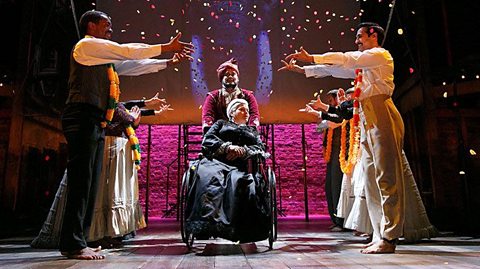
What are the key themes in The Empress?

The four main themes in The Empress are:
Class, power and responsibility
Racism and Empire
Relationships
Education

Remember
When writing an answer about theme, you should aim to:
Include evidence from the play (a quotation or key moment)
Explore how the historical setting might impact on the theme
Consider what the author Tanika Gupta's message might be.
Class and power
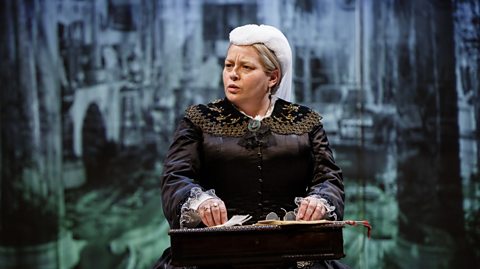
There is a A way of organising society in a triangular structure. There are fewer people higher up the triangle but they have more power, wealth or responsibility. of power in the play: the Queen is at the top of this social structure and Non-European sailors who worked on British ships trading in the Indian Empire. They were paid less than European sailors and worked in worse conditions. and Indian nursemaids who looked after European children, often on sea voyages to and from Britain. are at the bottom.
In the play white, British, wealthy characters are able to maintain authority over others due to their higher status in Victorian society. However, Gupta also shows how characters experiencing To be treated in a harsh and unfair way. fight back.
Through the themes of class and power, Gupta criticises social injustice in the Victorian era.
Gupta explores the themes of power and class in the play through:
- Victoria’s role as the Queen of England, Empress of India and ruler of the British Empire
- The harsh treatment of lower-class characters such as Rani and Hari and how they reclaim their power
- The changing power dynamic in Queen Victoria and Abdul Karim’s relationship
- Dadabhai’s role in Britain seeking to obtain political power
- Lady Sarah and Bertie’s increasing power over Queen Victoria throughout the play.
Interactive activity
Prejudice and racism
In The Empress, Gupta illustrates and explores racism, as a part of an overlooked period of British history. Many characters in the play face Unfair treatment of a person or a group of people because of their nationality, gender, religion or other reasons. and To romanticise or glamorise someone or something from a different country. due to their race.

Rani
Rani faces racial Treating someone differently based on something they cannot change like their race or gender. and discrimination at several points in the play.
- She is fired by Susan Matthews who has hired an English nanny to care for her children as soon as they arrive in England.
- While working for her next employer, Lord Oakham, Rani is exoticised as he demands that she dresses in traditional Indian clothing while serving him curry. He says:
I prefer to see you dressed as an Indian woman."
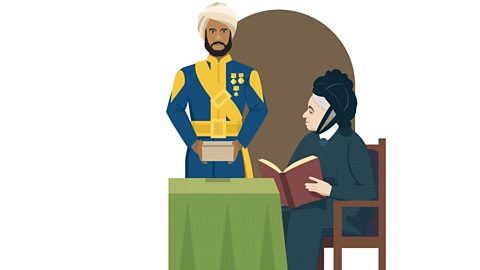
Abdul Karim
Abdul faces racial discrimination and exoticisation as soon as he arrives in England.
- When he is presented to the Queen as a gift for her Golden Jubilee, Lady Sarah doubts that Abdul can speak English and immediately makes plans to “send him back”.
- Victoria argues with Lady Sarah that he should be allowed to stay because his turban matches her eggcup. This implies that Victoria sees Abdul as a possession as opposed to an equal.
Hari says that Abdul:
Might be all dressed up like a fancy peacock but he is still a lackee to the white man."
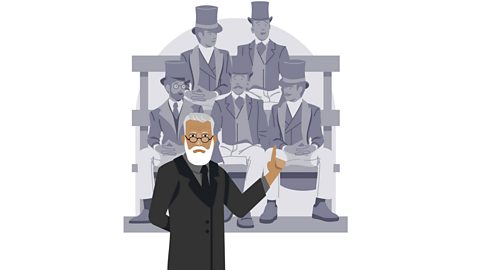
Dadabhai Naoroji
Dadabhai was an Indian politician who researched the devastating impact British rule had in India.
In the play, Gupta presents his successful campaign to be a Member of Parliament and society’s racist attitude towards him.
- In a parliamentary speech, Dadabhai criticises Queen Victoria and the expanding British Empire.
- By the end of the play, Dadabhai returns to India.
He feels he is not able to make a real difference in England due to the racist attitudes of fellow politicians and members of society.
When he is elected, a British politician speaks out against him and says:
Naoroji is an alien in race, in custom, in religion."
Relationships
In The Empress, Gupta presents friendships, romantic relationships and relationships between employees and employers. Some relationships are supportive, whereas some are abusive. Characters in The Empress rely on their friendships and learn from them.
Rani and Hari
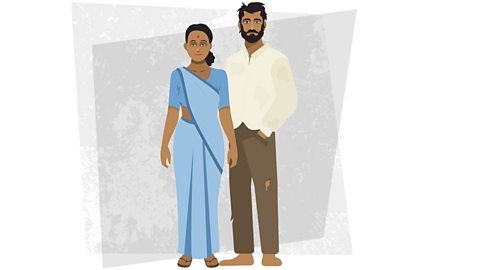
Rani and Hari’s friendship gets them through times of hardship and suffering. It also inspires them to improve themselves.
At the start of the play, Rani teaches Hari how to read and write. In his letter to Rani later in the play, Hari reveals that she has inspired him to continue learning.
When Rani is fired and left helpless at the docks, Hari helps her find somewhere to stay by taking her to Lascar Sally’s boarding house.
Their friendship develops into a romantic relationship by the end of the play when they declare their love for each other and kiss.
Firoza and Lascar Sally

Gupta highlights the importance of empowering and supportive female friendships through the characters of Firoza and Lascar Sally.
- Sally provides a room for Rani when she is stranded in London at the start of the play.
- When Rani is jobless and alone, Firoza gives her advice about finding a new job.
- Later in the play, when Rani considers abandoning her baby at the docks, Firoza and Lascar Sally give her emotional support.
They help her name her baby and take her to the Ayahs' Home – a refuge for abandoned and Extremely poor or without the means to look after oneself. ayahs.
Abdul and Queen Victoria
The friendship between Abdul and Victoria is presented as a close bond from which both benefit.
Abdul benefits from his relationship with Victoria as he is able to rise through the ranks of the royal household and extend his influence over the Queen.
Victoria benefits from the friendship as she learns Hindi, learns about the history of India and is provided with a companion in the final 14 years of her reign.
Gupta presents their relationship as flirtatious and romantic at times, which is looked down upon by members of the royal household.
Rani and Lord Oakham
Rani works for Lord Oakham’s family as an ayah and becomes pregnant with his child. Gupta presents Oakham as an aggressive and abusive employer who manipulates Rani into a sexual relationship. He denies fathering her child and throws her out into the street.
Gupta highlights the power imbalance in their relationship and reveals how ayahs were powerless and forced to endure abuse so they could make a living to support themselves and their family overseas.
Dadabhai and Rani
Gupta presents Dadabhai as Rani’s mentor. At the start of the play, they meet on the ship to England and Dadabhai offers her friendly advice about the importance of education.
Later in the play, Dadabhai helps to open the Ayahs' Home when Rani seeks refuge following her dismissal by Lord Oakham. When Dadabhai campaigns to be a Member of Parliament, Rani persuades him to let her work as his assistant.
He encourages Rani to stay in England to be with her daughter and friends and he also encourages her to listen to Hari.
Mini quiz
Education
Gupta shows the importance of education for all members of society regardless of their status and wealth.

Key moments
Rani teaches Hari to read and write on the ship at the start of the play. Hari is inspired by Rani to continue teaching himself once they are separated. Later in the play, Hari is able to use this education to write a list of demands for the captain.
The Ayahs' Home, set up by Dadabhai, is a place of refuge for Firoza and Rani. While there, ayahs are provided with education as well as shelter.
Abdul teaches Victoria Hindi and educates her about India and the Violent or cruel behaviour. of the British Empire’s rule in India. In The Empress, Victoria does not take proper responsibility for her actions as a leader. She does not understand the full extent of suffering that people who lived in nations When one country enforces political control over another. by the British had experienced.
Key quotes about education
| Quote | Who says this? | Analysis |
|---|---|---|
| "How does one say I love you in Hindi?" | Queen Victoria to Abdul Karim | Gupta shows the growing bond between Abdul and Victoria when he teaches her Hindi. This quote reveals Victoria no longer sees Abdul as a servant but a close friend. |
| "I was educated. Now I am a teacher and I am hoping to set up a school." | Rani | Rani takes Dadabhai’s advice on board and continues to educate herself throughout the play. Gupta highlights the importance of education through Rani and Hari, who both use it to become successful in Victorian society despite their unfair treatment. |
| "Education is the only path to freedom." | Dadabhai to Rani | Dadabhai gives this advice to Rani at the start of the play. Gupta uses Dadabhai’s character to explore the importance of education as he becomes an MP and tries to educate Victorian society about the negative impact of colonisation in India. |
| "Once you have had the ultimate student, where do you go?" | Abdul Karim to Rani | At the end of the play, Abdul and Rani are contemplating the future. There is a complex tone of hope and sorrow as Abdul comments that he ‘will have to find another occupation’ other than teaching, as he’s already had the ‘ultimate student’ in Queen Victoria. The adjective ‘ultimate’ highlights the Munshi’s appreciation of Queen Victoria’s desire to learn about India - the language and the culture, but without her and ’nothing to remember her by’, he ends the play with his father’s compass to help find his way again. |
| "I took your advice and am learning my letters in the hope of finishing off what you inspired me to do." | Hari to Rani | Hari's admiration for Ran is revealed in this quote. Rani teaches Hari how to read and write on the ship and this inspires him throughout the play. |
Gupta's message about education
Gupta encourages the audience to view education as a necessary and positive force which can benefit all characters, regardless of their position in society. Characters from the young, mistreated Hari to Queen Victoria, the Empress of India, are shown to require education is differing ways, and to benefit from educating themselves.
Gupta also highlights that there are differing attitudes to different types of information. For example, while Queen Victoria is willing to learn words of her choosing in Hindi, she is less willing to educate herself about the impact of imperialism on nations like India.
Question
Why is education important in The Empress?
Education is important as it allows mistreated characters to gain back their power and make successful lives for themselves.
Gupta wants to educate a modern audience about what life was like for Indians living in England during the Victorian era.
Quiz
Test your understanding of themes in The Empress by taking this multiple-choice quiz.
More on The Empress
Find out more by working through a topic
- count4 of 6
- count6 of 6

- count1 of 6