Introduction to missing angles
This page has been put together to help you practise and revisit some of the brilliant skills you’ve learned all through primary school.
It’s a great way to boost your confidence in Maths and get you ready for the exciting next step into Year 8!
Let's find the missing angles!
In this guide, you will learn:
- angles are measured in degrees (°)
- the key rules: angles on a straight line (180°) and angles around a point (360°)
- how to solve angle problems using these rules
- how to spot angles in real life (clocks, maps, and in the classroom)
Rule 1: angles on a straight line
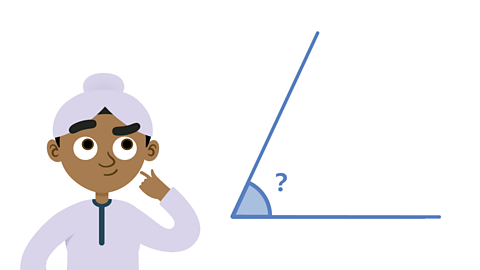
Finding missing angles is just a puzzle.
All you need to know are two key rules.
Angles on a straight line always add up to 180°
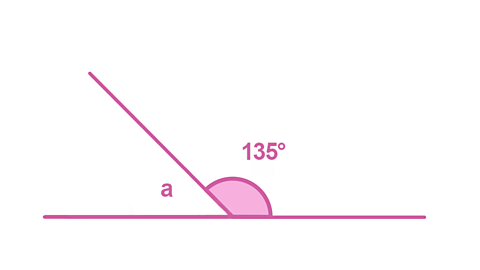
A straight line is a 'half-turn'. If you have two or more angles that make up a straight line, they must add up to 180°.
The problem: "An image shows a straight line. One angle is 135°. What is the missing angle 'a'?"
How to solve it (the method):
You know the total must be 180°.
You already have 135°.
Do the subtraction: 180° - 135° = 45°.
So, angle 'a' = 45°.
Rule 2: Angles around a point
Angles around a point always add up to 360°.
Rule 2: Angles around a point always add up to 360°.
A 'full-turn' (like a full spin or a complete circle) is always 360°. If you have several angles that meet at one central point, they must add up to 360°.
The problem: "An image shows angles around a point. You can see 90°, 70°, and 100°. What is the missing angle 'b'?"
How to solve it (the method):
You know the total must be 360°.
Add up the angles you already have: 90° + 70° + 100° = 260°.
Do the subtraction from 360°: 360° - 260° = 100°.
So, angle 'b' = 100°.
Find the missing angle
Angles in real life
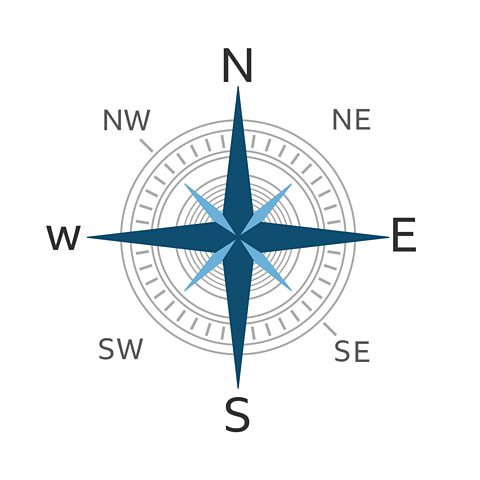
You can see these rules on compasses and clocks.
North (0°) to south (180°) is a straight line.
North (0°) to east (90°) is a right angle.
Turning from north to west (270°) and then back to north (360°) is a full circle.
Map directions
Summary

Great work! You have mastered the key angle rules.
You know that:
- angles on a straight line add up to 180°.
- angles around a point add up to 360°.
You can use these two rules to solve all sorts of angle puzzles on maps, clocks and in all sorts of maths problems.
Brain boost
Think about these questions to stretch your thinking and sharpen your skills!
What angle do the hands of a clock make at 9 o'clock? (Hint: It's a 90° angle, or 1/4 of a full turn).
What angle do the hands of a clock make at 6 o'clock? (Hint: It's a straight line!)
I am facing South-West. I turn 45° anti-clockwise. Which way am I facing now?
Have a chat about your answers with a parent, teacher or your class.
More on Practise and revise KS2 maths
Find out more by working through a topic
- count22 of 24
- count23 of 24
- count24 of 24
- count1 of 24