Introduction to place value grids
This page has been put together to help you practise and revisit some of the brilliant skills you’ve learned all through primary school.
It’s a great way to boost your confidence in Maths and get you ready for the exciting next step into Year 8!
Get ready to handle HUGE numbers!
In this guide, you will learn:
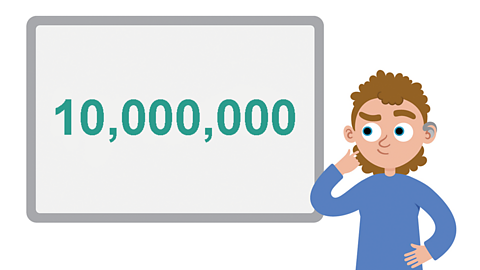
- how to read, write, and understand numbers up to 10,000,000 (ten million)
- how to use a place value grid to see the value of every single digit
- how to compare and order large numbers (eg house prices, populations)
- how to compare and order mixed numbers (eg 2 1/2 pizzas)
Understanding the place value grid
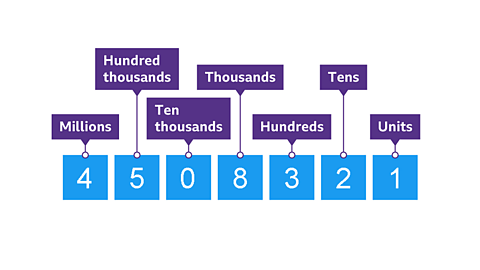
Place value helps us understand the value of a digit based on its position in a number. A '7' in the 'tens' column is 70, but a '7' in the 'millions' column is 7,000,000!
A place value grid is the best way to see this. Look at the number 4,508,321.
The 4 is in the millions column, so its value is 4,000,000.
The 5 is in the hundred thousands column, so its value is 500,000.
The 0 is a placeholder. Its value is zero, but it's essential! It keeps the '5' and '8' in their correct columns. Without it, the number would be 458,321, which is completely different.
Comparing large numbers
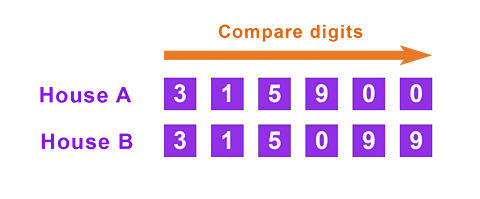
A maths question might ask you to compare large numbers to see which is biggest or smallest.
The Problem: "Which house is more expensive?
House A: £315,900
House B: £315,099
How to solve it (the method): Don't guess! The best method is to compare the digits from left to right.
Hundred thousands column: both have a 3. (It's a tie)
Ten thousands column: both have a 1. (It's a tie)
Thousands column: both have a 5. (It's a tie)
Hundreds column: house A has a 9 (value 900), but house B has a 0 (value 0).
Stop! The '9' is bigger than the '0'.
Therefore, house A (£315,900) is more expensive.
Comparing mixed numbers
What about comparing mixed numbers (a whole number and a fraction, like 2 1/2?
The problem: "Put these measurements in order, from smallest to largest: 2 3/4m, 3 1/4m, 2 1/2m"
How to solve it (the method):
Check the whole number first.
3 1/4 has a whole number of 3.
2 3/4 and 2 1/2 both have a whole number of 2.
This tells you 3 1/4 is the biggest.
Now, compare the fractions:
You just need to compare 2 3/4 and 2 1/2
Which is bigger, 3/4 or 1/2
Remember that 1/2 is the same as 2/4
So, you are comparing 3/4 and 2/4.
3/4 is bigger than 2/4.
Write the final order:
Smallest: 2 1/2 m (which is 2 2/4m)
Middle: 2 3/4m
Largest: 3 1/4m
Digit detective
Order it!
Summary

Great work! You now know how to read, write, and understand numbers all the way up to ten million.
You have learned the vital skills of comparing large numbers (start from the left!) and comparing mixed numbers (check the whole number first!).
This will help you solve all sorts of real-world problems.
Brain boost
Think about these questions to stretch your thinking and sharpen your skills!
What is the difference in value between the '6' in 6,400,000 and the '6' in 4,600,000?
How would you explain, step-by-step, which is bigger: £7,090,100 or £7,091,100?
Why is ½ bigger than 1/3? How would you draw this to prove it?
Have a chat about your answers with a parent, teacher or your class.
More on Practise and revise KS2 maths
Find out more by working through a topic
- count13 of 24
- count15 of 24
- count16 of 24