Introduction
This page has been put together to help you practise and revisit some of the brilliant skills you’ve learned all through primary school.
It’s a great way to boost your confidence in maths and get you ready for the exciting next step into Year 8!
Work your way through it to learn:
- how decimals are used for money (£), weight (kg) and measures (m, l)
- the "golden rule" you must always follow when adding or subtracting
- how to correctly add numbers with one or two decimal places (eg £1.50 + £0.85)
- how to subtract decimals, especially when finding change (eg £20.00 - £4.75)
- how to use placeholder zeros to make sums easier to solve (eg making 1.8m into 1.80m)
Adding with decimals
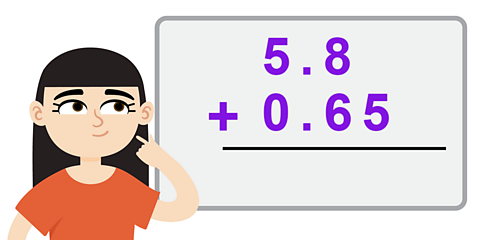
When you add numbers with decimal points, the most important job is to get the set-up right.
Imagine the decimal point is a button on a shirt.
You must line up all the buttons perfectly, one above the other.
This makes sure you are adding units to units, tenths to tenths and hundredths to hundredths.
A common question might ask you to add 5.8m and 0.65m.
How to solve 5.8m + 0.65m:
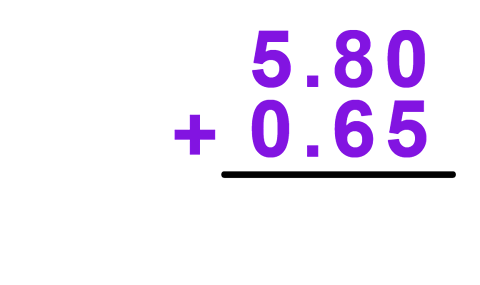
Look: Notice that 5.8 has one decimal place, but 0.65 has two.
Convert: Add a placeholder zero to 5.8 to make it 5.80. Now both numbers have two decimal places. This step is vital!
Line up: Write the sum with the decimal points lined up.
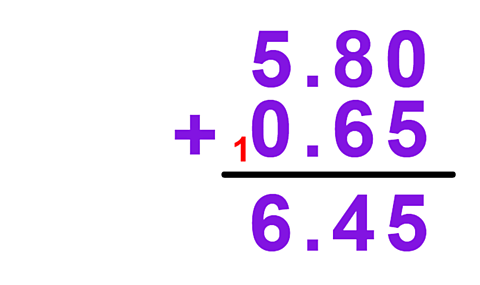
- Add: Add the columns, starting from the right (the hundredths).
Subtracting with decimals
Subtraction follows the exact same "golden rule" – line up the decimal points!
This is especially important when subtracting from a whole number, like finding change.
A question might be: ‘A shopkeeper has a 10kg bag of flour. He sells 3.45kg. How much is left?’
How to solve 10kg - 3.45kg:
Look: 10 is a whole number and 3.45 has two decimal places.
Convert: You must convert 10 by adding a decimal point and two placeholder zeros: 10.00. This is essential. Without the zeros, you can't subtract the 45 hundredths.
Line up: Write the sum with the decimal points lined up.

- Subtract: Subtract as normal. You will need to 'exchange' from the next column, just like in whole-number subtraction.
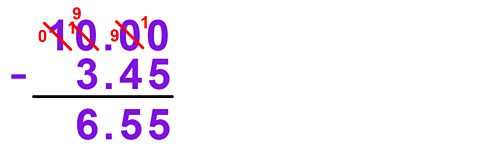
So, 10kg - 3.45kg = 6.55kg.
Top tip: the golden rule
Whether you are adding or subtracting, always line up the decimal points! Never line up the last digits (unless they happen to be the decimal points).
Solving two-step problems
Many questions are two-step problems. This means you need to do more than one calculation to find the final answer.
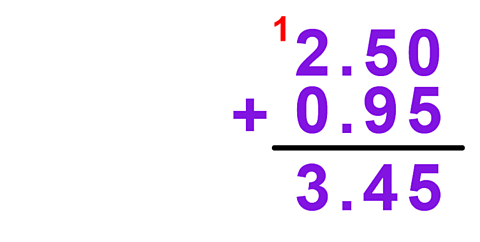
Example problem: ‘Niamh buys a magazine for £2.50 and a bar of chocolate for £0.95. She pays with a £5 note. How much change does she get?’
Solution:
Step 1 (Addition): First, add the cost of the items together.
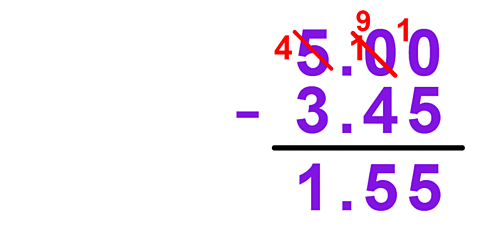
The total cost is £3.45.
Step 2 (Subtraction): Now, subtract the total cost from the £5 she paid with. Remember to convert £5 to £5.00!
Niamh gets £1.55 change.
Decimal Detective
The Change Challenge
Summary

Well done! You've revised how to add and subtract numbers with up to two decimal places.
You now know that the key to success is lining up the decimal points and using placeholder zeros to help convert numbers.
This skill is important for handling money, measurements and amounts in school work and in real life.
Brain boost
Think about these questions to stretch your thinking and sharpen your skills!
Why is it a bad idea to line up the last digits when subtracting 8.25m from 15.5m? What would your wrong answer be?
Can you think of three jobs, besides working in a shop, where adding or subtracting decimals accurately would be essential every day?
Describe the steps you would take to solve this problem: ‘Peter's bag weighs 1.4kg. Sarah's bag weighs 0.85kg more than Peter's. What is the total weight of both bags combined?’
Have a chat about your answers with a parent, teacher or your class.
More on Practise and revise KS2 maths
Find out more by working through a topic
- count2 of 24
- count3 of 24
- count4 of 24