Introduction to dividing decimals
This page has been put together to help you practise and revisit some of the brilliant skills you’ve learned all through primary school.
It’s a great way to boost your confidence in maths and get you ready for the exciting next step into Year 8!
Dividing a decimal by a whole number is a key skill especially for questions about money and measures.
Power through this page and you’ll learn:
- how to use the 'bus stop' method (short division) with decimal numbers
- the ‘golden rule’ for where to put your decimal point
- what to do when you have a remainder part-way through the sum
- how to use placeholder zeros to complete a division (eg turning 6.1 into 6.10)
What is the 'bus stop' method and its golden rule?
Dividing a decimal by a whole number uses the same 'bus stop' method you use for whole numbers.
There is just one "golden rule" you must follow.
Top tip: the golden rule
When you set up your 'bus stop' sum, the very first thing you should do is place the decimal point in your answer line, directly above the decimal point in the question.
This locks it in place, so you don't forget it later!
Once you've done that, you just divide as normal.
Example: £8.42 ÷ 2
Set up: write the sum in the 'bus stop'.
Golden rule: place the decimal point in the answer line.
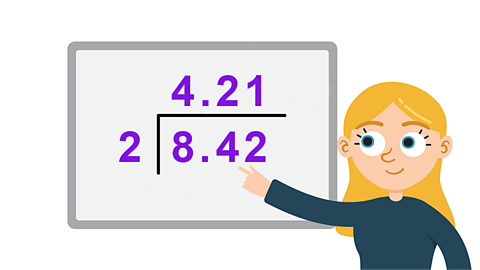
Divide:
8 ÷ 2 = 4
4 ÷ 2 = 2
2 ÷ 2 = 1
Answer = £4.21
Handling remainders inside the sum
The real challenge begins when you have remainders.
In the sum £7.50 ÷ 3:
Set up: write the sum and place the decimal point in the answer.
Divide the units: 7 ÷ 3 = 2, with a remainder of 1.
Carry the remainder: That remainder '1' is carried over and placed next to the '5', turning it into 15.
Divide the tenths: 15 ÷ 3 = 5.
Divide the hundredths: 0 ÷ 3 = 0.
Answer = £2.50
What is the placeholder zero trick (remainders at the end)?

Sometimes, you'll get a remainder on the very last number. For example, in 6.1 ÷ 5:
Set up: write 6.1 ÷ 5 and place the decimal point in the answer.

Divide the units: 6 ÷ 5 = 1, with a remainder of 1.
Carry the remainder: Carry the '1' over to the next digit, making the '1' into 11.
Divide the tenths: 11 ÷ 5 = 2, with a remainder of 1.
We have a remainder, but we are working with decimals, so we don't write 'r 1'. We must find an exact answer.
Convert with a placeholder zero: We convert 6.1 by adding a placeholder zero to the end, making it 6.10. This doesn't change its value (6.1 is the same as 6.10).

Carry the remainder: now we can carry our remainder '1' over to that new '0', making it 10.
Finish dividing: 10 ÷ 5 = 2.
The final answer is 1.22. This is a crucial skill for money or measurement problems. You can add as many zeros as you need (eg 6.10, 6.100) until the sum is complete.
Solving division problems
Some maths questions often have two or more steps. They test your ability to interpret the problem and see which skills to use.
Example problem: ‘A 4 pack of yoghurts costs £5.80. A single yoghurt costs £1.50. How much do you save per yoghurt by buying the 4 pack?’
Solution:
Step 1 (division): First, you must find the price of one yoghurt in the 4 pack. You need to calculate £5.80 ÷ 4.
5 ÷ 4 = 1 remainder 1
Carry the 1 to the 8, making 18.
18 ÷ 4 = 4 remainder 2
Carry the 2 to the 0, making 20.
20 ÷ 4 = 5
One yoghurt in the pack costs £1.45.
Step 2 (subtraction): Now, find the saving. The single yoghurt costs £1.50, and the pack yoghurt costs £1.45.
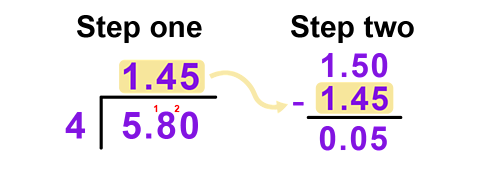
Remember to line up the decimal points for subtraction!
Answer: You save £0.05 (or 5p) per yoghurt.
Division steps activity
Decimal Detective
Summary

Great work! You now know how to divide a decimal number by a whole number.
You've learned to:
Use the "golden rule" to place your decimal point first.
Carry remainders over to the next digit.
Convert numbers by adding placeholder zeros to finish the sum when you have a remainder at the end.
This is vital for all sorts of measurement and money problems.
Brain boost
Think about these questions to stretch your thinking and sharpen your skills!
What is the very first step you should take after writing out a decimal division 'bus stop' sum? Why is it so important?
If you are solving £20.10 ÷ 6, what will you have to do at the end of the sum to get a final, accurate answer?
Describe the steps you would take to solve this problem: ‘A 5 metre plank of wood is cut into 8 equal pieces. How long is each piece in metres?’
Have a chat about your answers with a parent, teacher or your class.
More on Practise and revise KS2 maths
Find out more by working through a topic
- count3 of 24
- count4 of 24
- count6 of 24