Introduction to scaling and ratio problems

This page has been put together to help you practise and revisit some of the brilliant skills you’ve learned all through primary school.
It’s a great way to boost your confidence in Maths and get you ready for the exciting next step into Year 8!
These are skills you use all the time, maybe without even noticing.
In this guide, you will learn:
what scaling means (making something bigger or smaller by multiplying or dividing, like a recipe)
what ratio means (a way to compare amounts or share things out, eg 1:3)
how to read, write, and solve simple scaling and ratio problems
What is scaling?

Scaling is something you probably already do. It's when you change the size or amount of something by multiplying or dividing.
Think about a recipe. If a recipe for 4 people needs 100g of flour, how much flour would you need for 8 people?
You have scaled up the number of people.
You multiplied by 2 (because 4 x 2 = 8).
This 'x 2' is your scaling factor.
You must scale all the ingredients in the same way:
100g of flour x 2 = 200g of flour.
This is simple scaling. You find the scaling factor and apply it to everything else.
What about scaling down? If you wanted to make the same recipe for only 2 people, you would be scaling down.
You would divide by 2 (because 4 ÷ 2 = 2).
Your scaling factor would be '÷ 2' (or 'x 0.5').
100g of flour ÷ 2 = 50g of flour.
What is ratio?

Ratio is very similar to scaling. A ratio is used to compare amounts or to share things out.
If a bag of sweets has 1 red sweet for every 3 green sweets, we can write the ratio of red to green as: 1:3
This means for every 4 sweets in total (1 part + 3 parts), 1 part is red and 3 parts are green.
Maths questions could ask you to share a total amount using a ratio. This tests your ability to solve problems and interpret the numbers correctly.
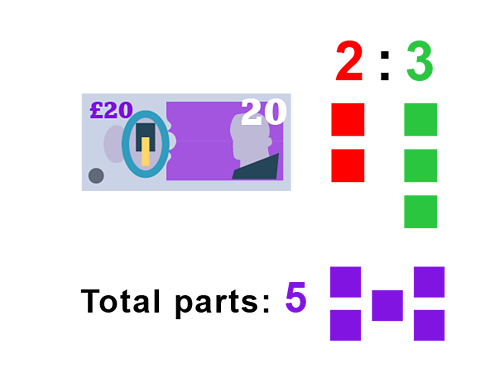
The problem: Share £20 between Ben and Sam in the ratio 2:3.
How to solve it (The 3 Steps):
Step 1: Find the total number of 'parts'.
The ratio is 2:3.
Total parts = 2 + 3 = 5 parts

Step 2: Find the value of one part.
Divide the total amount (£20) by the total number of parts (5).
£20 ÷ 5 = £4 per part
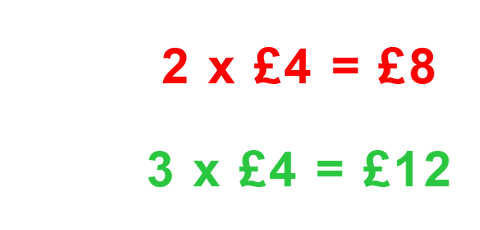
Step 3: Share the money.
Ben gets 2 parts: 2 x £4 = £8
Sam gets 3 parts: 3 x £4 = £12
Always check your answer at the end:
£8 + £12 = £20. It's correct!
Recipe Scaler
Share the treasure!
Summary

Well done! You can now scale recipes and amounts up and down by finding the multiplier or divider.
You can also share a total amount using a ratio by following the 3 key steps:
Add the parts
Divide the total
Multiply for each person
Brain boost
Think about these questions to stretch your thinking and sharpen your skills!
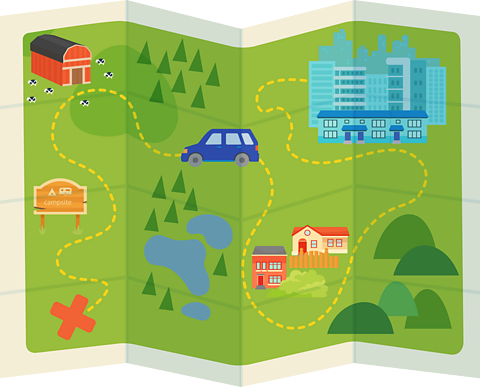
A map has a scale of 1cm = 5km. How would you write this as a ratio? (Hint: First, change the km into cm. 1km = 100,000cm)
Using the map from the first question, a town is 4cm away on paper. How far is it in real life?
What are the three steps you must follow to share 30 sweets between Bob and Jane in the ratio 2:1? How many sweets does each person get?
Have a chat about your answers with a parent, teacher or your class.
More on Practise and revise KS2 maths
Find out more by working through a topic
- count10 of 24

- count11 of 24

- count12 of 24
- count13 of 24