Introduction to bar models
This page has been put together to help you practise and revisit some of the brilliant skills you’ve learned all through primary school.
It’s a great way to boost your confidence in Maths and get you ready for the exciting next step into Year 8!
Let's draw our maths!
A bar model is a simple drawing that helps you see and understand a word problem.
In this guide, you will learn:
- what a bar model is
- how to use a part-part-whole bar model for addition and subtraction
- how to use an equal parts bar model for multiplication, division, fractions and ratio
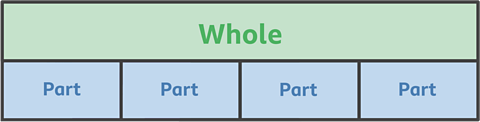
The part-part-whole model

A bar model helps you visualise a problem. Instead of just numbers, you draw bars (rectangles) to represent the amounts.
This model is perfect for addition and subtraction. It's called a part-part-whole model.
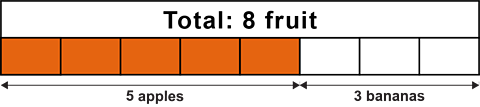
Example (Addition): 'Niamh has 5 apples and 3 bananas. How much fruit in total?'
You draw two small bars (the 'parts'): one for 5 and one for 3.
You draw one big 'total' bar underneath, which is what you need to find.
5 + 3 = 8. The total is 8.
Example (Subtraction): 'Niamh has 8 fruits in total. 5 are apples. How many are bananas?'
You draw the big 'total' bar at the top and label it 8.
You draw one 'part' bar underneath and label it 5.
The other 'part' bar is the unknown. You can label it with a ?.
8 - 5 = 3. The missing part is 3.
The equal parts model (for fractions and ratio)
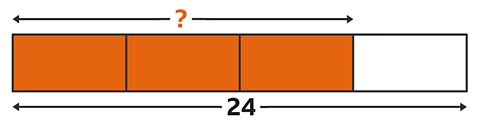
Bar models are really powerful for trickier problems involving multiplication, division, fractions and ratio.
For these, we draw a bar that is split into equal parts. This helps you interpret what the question is asking.
Example (fractions): 'Find 3/4 (three-quarters) of 24.'
Draw one long bar. This is the whole, so label it 24.
The fraction is 'quarters', so divide the bar into 4 equal boxes.
Find the value of one box (1/4) by dividing the whole by 4.
24 ÷ 4 = 6.
So, each box is worth 6.
The question asks for three quarters (3/4), so you need 3 boxes.
3 x 6 = 18.
3/4 of 24 is 18.
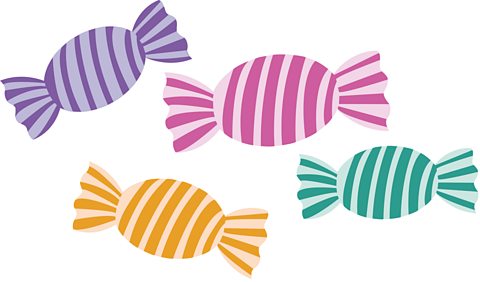
Example (ratio): 'Share 24 sweets in the ratio 1:3.'
This works just like the fractions example!
A ratio of 1:3 has 1 + 3 = 4 parts in total.
So, draw one long bar for the whole (24) and divide it into 4 equal boxes (4 parts).
Find the value of one box (one part).
24 ÷ 4 = 6.
Person A gets 1 part (1 box) = 6 sweets.
Person B gets 3 parts (3 boxes) = 3 x 6 = 18 sweets.
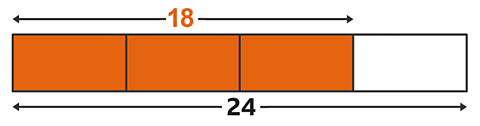
Label the bar model
Summary
Well done! You can now use bar models to turn complicated word problems into simple pictures.
You know how to draw:
- part-whole models for addition and subtraction
- equal parts models for multiplication, division, fractions and ratio
This is a brilliant tool for understanding a problem before you solve it.
Brain boost
Think about these questions to stretch your thinking and sharpen your skills!
How is the bar model for 'Find 1/5 of 40' similar to the bar model for 'Share 40 in the ratio 1:4'?
How would you start to draw a bar model for this problem: "I think of a number, I double it and I add 5. The answer is 25."
Do you always need to draw a bar model? When is it most useful to draw one?
Have a chat about your answers with a parent, teacher or your class.
More on Practise and revise KS2 maths
Find out more by working through a topic
- count11 of 24

- count12 of 24
- count13 of 24