What are factors and factor pairs?
This page has been put together to help you practise and revisit some of the brilliant skills you’ve learned all through primary school.
It’s a great way to boost your confidence in maths and get you ready for the exciting next step into Year 8!
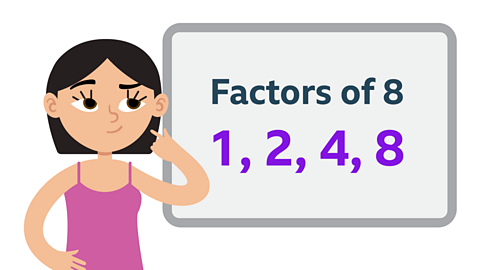
A factor is a number that divides into another number exactly, with no remainder.
A factor pair is a set of two numbers that, when multiplied together, give a specific number.
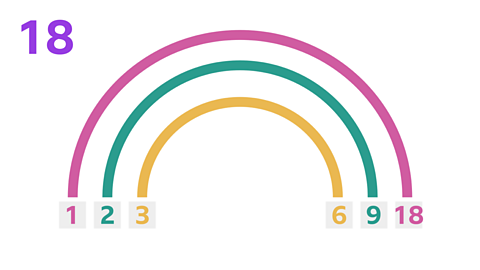
The factor pairs of 18 are:
1 x 18
2 x 9
3 x 6
We can use these pairs (like 2 & 9, or 3 & 6) to make division much easier.
What is the two-step division trick?
Instead of doing one hard division, you can break the divisor into a factor pair and do two easy divisions one after the other.
Example: Let's solve £360 ÷ 18. The divisor is 18. We can use the factor pair 3 x 6.
Step 1: Divide £360 by the first factor (3).
£360 ÷ 3 = £120
Step 2: Take your new answer (£120) and divide it by the second factor (6).
£120 ÷ 6 = £20
Answer: £20
It works with any factor pair! Let's try with 2 x 9:
Step 1: £360 ÷ 2 = £180
Step 2: £180 ÷ 9 = £20
The answer is the same. You just pick the factor pair that you find easiest.
Top tip: The golden rule
To divide by a large number (eg 24), you can instead divide by its factors one after the other (eg divide by 4, then divide the answer by 6).
Example problem
This skill is perfect for word problems where you have to divide by numbers like 15, 24, 18, or 30.
Example problem:
‘A school orders tickets for a concert. The total cost for all the tickets is £1050. If each ticket costs £15, how many tickets did the school buy?’
Solution:
The sum: The problem is 1050 ÷ 15.
The divisor: The divisor is 15.
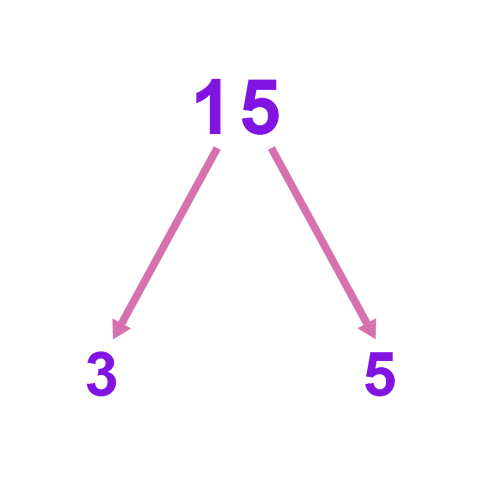
The factors: Find a factor pair for 15. The obvious choice is 3 x 5.
Step 1 (divide by 5): It's easy to divide by 5.
1,050 ÷ 5 = £210
Step 2 (divide by 3): Now divide your answer by 3.
210 ÷ 3 = 70
Answer: The school bought 70 tickets.
This is much faster than trying to set up a 'bus stop' sum for ÷ 15!
Factor Finder
The two-step challenge
Summary

Well done! You've learned a fantastic mental maths shortcut.
Instead of one hard division, you now know you can break the divisor into its factors and do two (or more) easy divisions.
Brain boost
Think about these questions to stretch your thinking and sharpen your skills!
Why can't you use the factors 4 and 5 to solve a sum like £192 ÷ 24? (What would your wrong answer be?)
What are all the factor pairs you could use to divide by 30 (not including 1x30)? Which pair do you think would be easiest to use, and why?
Describe, step-by-step, how you would mentally solve £1,500 ÷ 60 using this factor method. (Hint: you could use 10 x 6, or you could even use three factors: 2 x 3 x 10)
Have a chat about your answers with a parent, teacher or your class.
More on Practise and revise KS2 maths
Find out more by working through a topic
- count6 of 24
- count7 of 24

- count8 of 24