Introduction to rotational symmetry

This page has been put together to help you practise and revisit some of the brilliant skills you’ve learned all through primary school.
It’s a great way to boost your confidence in Maths and get you ready for the exciting next step into Year 8!
Let's go for a spin!
In this guide, you will learn:
- the two main types of symmetry: line symmetry (a fold) vs. rotational symmetry (a turn)
- what rotational symmetry is and how to find it
- what the 'order' of rotational symmetry means and how to count it
What is rotational symmetry?
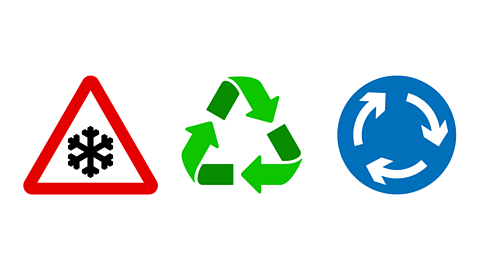
We already know that a shape has line symmetry if you can fold it in half with a 'mirror line' and both sides match perfectly.
But there is a second type of symmetry: rotational symmetry.
A shape has rotational symmetry if it looks exactly the same after being turned (rotated) around its centre point, before it gets back to the start.
The number of times a shape fits perfectly onto itself during one full 360° spin is called its order of rotational symmetry.
Example: A Square
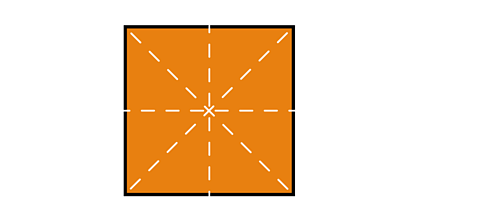
If you spin a square, it fits perfectly…
After 90°
After 180°
After 270°
After 360° (back at the start)
It fits 4 times. So, a square has rotational symmetry of order 4.
Example: A rectangle
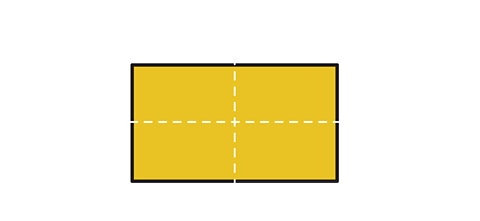
If you spin a rectangle, it only fits perfectly…
after 180° (it's upside down, but fits the space)
after 360° (back at the start)
It fits two times. So, a rectangle has rotational symmetry of order 2.
What about order 1? If a shape only fits onto itself after one full 360° turn (ie when it's back where it started), we say it has order 1. This means it has NO rotational symmetry. An irregular scalene triangle or a kite has order 1.

What's the order?
Summary

Spin-tastic! You now know what makes a shape symmetrical.
It can have:
- line Symmetry (a mirror fold)
- rotational Symmetry (a turn)
The order of rotational symmetry is the number of times a shape fits perfectly onto itself in one full 360° turn.
Brain boost
Think about these questions to stretch your thinking and sharpen your skills!
Can a shape have line symmetry but no rotational symmetry (order 1)? (Hint: Think of a kite or a capital 'A').
Can a shape have rotational symmetry but no line symmetry? (Hint: Think of a parallelogram).
What is the order of rotational symmetry for a perfect circle?
Have a chat about your answers with a parent, teacher or your class.
More on Practise and revise KS2 maths
Find out more by working through a topic
- count21 of 24
- count22 of 24
- count23 of 24
- count24 of 24