Introduction to perimeter of shapes

This page has been put together to help you practise and revisit some of the brilliant skills you’ve learned all through primary school.
It’s a great way to boost your confidence in Maths and get you ready for the exciting next step into Year 8!
Let's measure shapes!
In this guide, you will learn:
what perimeter is (the total distance around the outside of a shape)
what a compound shape is (a shape made of two or more simple shapes, like rectangles)
the key skill: how to find the missing side lengths before you add
how to spot a common error pupils make
What is perimeter?
The perimeter is the total length of the boundary of a shape. Imagine you are walking all the way around the outside of your school playground – the total distance you walk is the perimeter.
A compound shape (like an L-shape or a T-shape) is just two or more rectangles joined together.
To find the perimeter of any shape, you must add up the lengths of all the sides.
The key skill: finding missing sides
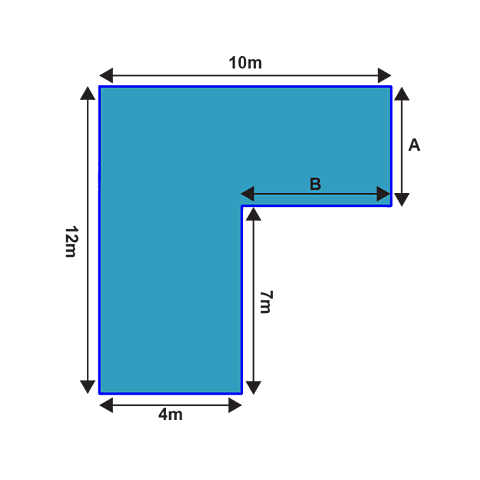
This is the most important part and a key problem-solving skill. Many compound shape problems won't give you all the side lengths. You have to find them!
The problem: Look at this L-shape. We need to find the missing lengths A and B before we can find the perimeter.
How to solve it (the method):
How to solve it (the method):
- Find the missing vertical side (A):
Look at all the vertical (up and down) sides.
The total height on the left is 12m.
The partial height on the right is 7m.
This means A + 7m must equal the total height of 12m.
So, A = 12m - 7m = 5m.
2. Find the missing horizontal side (B):
Look at all the horizontal (left to right) sides.
The total width at the top is 10m.
The partial width at the bottom is 4m.
This means B + 4m must equal the total width of 10m.
So, B = 10m - 4m = 6m.
3. Find the total perimeter:
Now you have all the side lengths, add them all up!
12 + 10 + 7 + 6 + 5 + 4 = 44m
The total perimeter is 44m.
Perimeter problems
Summary

Great work! You now know that perimeter is the total distance around the outside of a shape.
For compound shapes, you must:
find all the missing side lengths by looking at the other vertical and horizontal sides
add up every single side to find the final perimeter
Brain boost
Think about these questions to stretch your thinking and sharpen your skills!
Look at the L-shape from Activity 1. Can you explain why all the horizontal sides (10m) must add up to the same total as all the other horizontal sides (4m + 6m)?
What is the difference between perimeter and area?
How would you find the perimeter of a perfect square if you were only told that one side is 5cm long?
Have a chat about your answers with a parent, teacher or your class.
More on Practise and revise KS2 maths
Find out more by working through a topic
- count18 of 24

- count19 of 24

- count20 of 24
- count21 of 24