Introduction to remainders during division
This page has been put together to help you practise and revisit some of the brilliant skills you’ve learned all through primary school.
It’s a great way to boost your confidence in maths and get you ready for the exciting next step into Year 8!
What do you do with your leftovers?
When a number doesn't divide perfectly, you get a remainder.
The real challenge isn't just finding the remainder, it's knowing what to do with it.
In this guide, you will learn:
how to find a remainder using short division (eg 17 ÷ 4 = 4 r 1)
the three ways to handle a remainder in a word problem
Case 1: When you must round up.
Case 2: When you must round down.
Case 3: When the remainder is the answer.
How to find a remainder
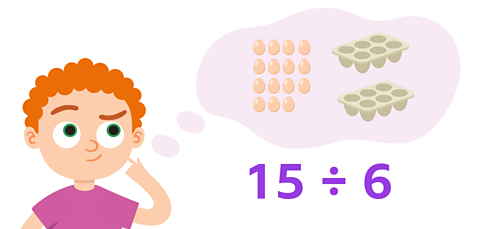
When you divide using the 'bus stop' method, the number left at the end that is too small to be divided is the remainder.
Example: 15 ÷ 6
1 ÷ 6 doesn't go.
Carry the 1 over to the 5, making 15.
How many 6s go into 15? 2 (because 2 x 6 = 12).
What is the 'leftover' amount? 15 - 12 = 3.
So, 15 ÷ 6 = 2 remainder 3.
But what does “2 r 3” mean? The answer could be 2, or 3. It all depends on the story.
Top tip: the golden rule
The calculation (eg 15 ÷ 6 = 2 r 3) is only the first step.
Before you answer, re-read the question and ask yourself:
Do I need another whole one to fit everyone/everything in? (Round up)
Does it ask for complete groups? (Round down)
Does it ask what is left over? (Remainder is the answer)
Case 1: You must round up
This happens when everyone or everything must be included.
Problem:‘A group of 40 pupils are going on a trip. A minibus can hold 6 pupils. How many minibuses are needed?’
Solution:
Sum: 40 ÷ 6 = 6 r 4
Thinking: 6 buses would only hold 36 pupils (6 x 6). You still have 4 pupils left on the pavement!
Context: To get all 40 pupils to the trip, you need another bus for those 4 leftovers.
Answer: You must round up. You need 7 minibuses.

Case 2: You must round down
This happens when the question asks for complete or full items.
Problem: ‘A teacher has 40 pupils. She wants to make complete teams of 6 for a game. How many full teams can she make?’
Solution:
Sum: 40 ÷ 6 = 6 r 4
Thinking: You can make 6 full teams (36 pupils). You have 4 pupils left over, which is not enough for another complete team.
Context: The question only wants to know about full teams. The remainder is ignored.
Answer: You must round down. She can make 6 full teams.

Case 3: The remainder is the answer

This happens when the question asks "how many are left?" or "how many are remaining?"
Problem: ‘A teacher has 40 sweets to share equally among 6 prize winners. How many sweets will be left over?’
Solution:
Sum: 40 ÷ 6 = 6 r 4
Thinking: Each pupil gets 6 sweets (6 x 6 = 36). The amount 'left over' is the remainder.
Context: The question is only asking about the leftover amount.
Answer: The remainder is the answer. There are 4 sweets left over.
Remainder Round-Up
Scenario Sorter
Summary
You are now a master of remainders!
You know that a calculation like 17 ÷ 5 = 3 r 2 is just the start.
You also know how to read the context to decide if the true answer is 3 (rounding down), 4 (rounding up), or 2 (the remainder itself).
This is a top-level problem-solving skill.
Brain boost
Think about these questions to stretch your thinking and sharpen your skills!
Describe a real-life situation where you would have to round up the answer to a division sum.
Describe a real-life situation where you would have to round down and ignore the remainder.
A school of 100 pupils is going to the cinema. The cinema seats are in rows of 8. A teacher says, "100 divided by 8 is 12 remainder 4." What three different questions could be asked that would give the answer 12, 13, or 4?
Have a chat about your answers with a parent, teacher or your class.
More on Practise and revise KS2 maths
Find out more by working through a topic
- count7 of 24

- count8 of 24

- count9 of 24

- count10 of 24