Introduction to percentages in calculations
This page has been put together to help you practise and revisit some of the brilliant skills you’ve learned all through primary school.
It’s a great way to boost your confidence in Maths and get you ready for the exciting next step into Year 8!
Let's master percentages!
'Per cent' literally means 'out of 100'.
In this guide, you will learn:
how to solve multi-step percentage problems (eg find a 25% discount, then find the new price)
how to find common percentages (50%, 25%, 10%, 1%) quickly
how to solve tricky reverse percentage problems (finding the original price)
how to use percentages in real-life shopping and data problems
Finding percentages (the basics)
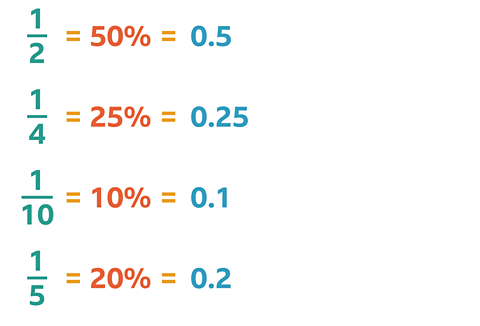
Finding a percentage is just finding a fraction of an amount. These are the key ones to know by heart:
50% = 1/2 (divide by 2)
25% = 1/4 (divide by 4)
10% = 1/10 (divide by 10)
1% = 1/100 (divide by 100)
From these, you can find anything!
To find 5%, you can find 10% and then halve it.
To find 20%, you can find 10% and then double it.
To find 75%, you can find 25% and multiply it by 3.
Multi-step percentage problems
In maths questions, you'll often have to do more than one step.
The Problem: "A jumper costs £60. It is in a 25% off sale. What is the new sale price?"
How to solve it (The 2 Steps):
Step 1: find the discount.
You need to find 25% of £60.
25% is the same as 1/4.
So, £60 ÷ 4 = £15.
The discount is £15.
Step 2: find the new price.
The sale price is the original price minus the discount.
£60 - £15 = £45.
The sale price is £45.
Reverse percentages (the tricky bit)
This is a very common maths problem that can catch people out. This is where you are given the final price and asked to find the original price.
The problem: "In a '50% off' sale, a coat's sale price is £40. What was the original price?"
The trap: Many people find 50% of £40 (which is £20) and add it on, getting £60. This is wrong! The 50% discount was taken from the original price, not the sale price.
The correct method (think backwards)
A 50% discount means 50% was taken off, so 50% is left.
This means the sale price (£40) is the 50% that is left.
So, if 50% = £40…
…then 100% (the original price) must be double that.
£40 x 2 = £80.
The original price was £80.
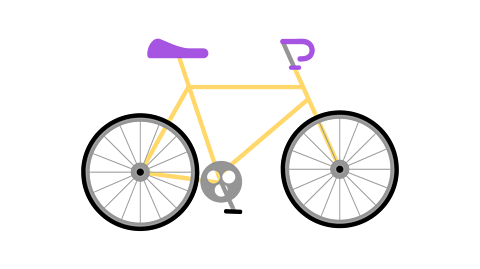
Challenge example: "A bike costs £30 in a '25% off' sale. What was the original price?"
100% - 25% (discount) = 75%.
So, the sale price (£30) is 75% of the original price.
75% is the same as 3/4.
So, 3/4 = £30.
To find 1/4 (one part), we do £30 ÷ 3 = £10.
To find 4/4 (the whole), we do £10 x 4 = £40.
The original price was £40.
The sale price challenge
Are percentages reversible?
Summary

Amazing work! You can now solve multi-step percentage problems by finding the values in order.
You also know the secret to reverse percentages: the sale price is the percentage left over, not 100%.
Brain boost
Think about these questions to stretch your thinking and sharpen your skills!
What is the fastest way to find 75% of £80?
What is the difference between 'finding 10% of £50' and 'finding what £10 is as a percentage of £50'?
If a shop has a '20% off' sale, what percentage of the original price do you actually pay? (Hint: 100% - 20%)
Have a chat about your answers with a parent, teacher or your class.
More on Practise and revise KS2 maths
Find out more by working through a topic
- count17 of 24
- count18 of 24
- count19 of 24
- count20 of 24