Introduction to reading and plotting co-ordinates
This page has been put together to help you practise and revisit some of the brilliant skills you’ve learned all through primary school.
It’s a great way to boost your confidence in Maths and get you ready for the exciting next step into Year 8!
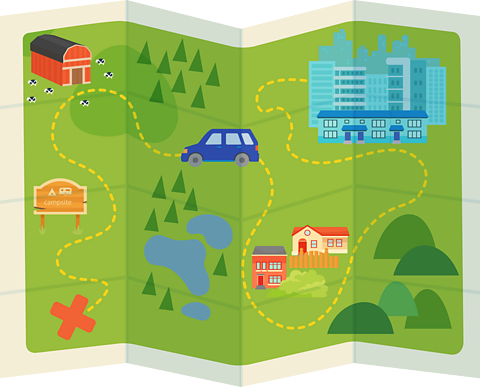
Let's find the treasure! Co-ordinates are like a map reference, they tell you an exact position on a grid.
In this guide, you will learn:
- how to read co-ordinates (x, y)
- the golden rule: "Along the corridor (x-axis), then up/down the stairs (y-axis)"
- how to plot points in all four quadrants using negative numbers
- how to read decimal co-ordinates eg (2.5, 4.5)
Reading co-ordinates (the x, y rule)
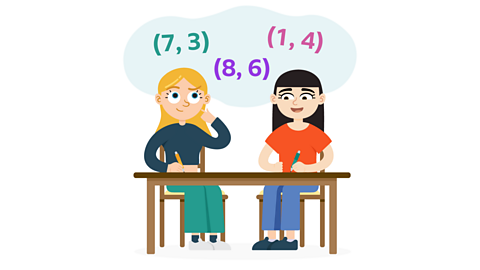
A co-ordinate is always a pair of numbers in brackets, like (4, 7).
The first number (x) tells you how far to go horizontally (left or right) along the x-axis.
The second number (y) tells you how far to go vertically (up or down) along the y-axis.
Remember the rule: Go along the corridor first, then up (or down) the stairs.
(4, 7) means go 4 along to the right, then 7 up.
A very common mistake is to mix them up and plot (7, 4) by mistake. Always do the x-axis first!
The four quadrants
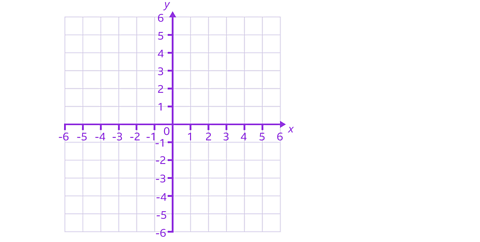
A co-ordinate grid is often split into four sections (quadrants) by the x-axis and y-axis. The centre point (0,0) is called the origin.
Top-right quadrant: all co-ordinates are positive eg (3, 5)
Top-left quadrant: the x-number is negative eg (-3, 5)
Bottom-left quadrant: both numbers are negative eg (-3, -5)
Bottom-right quadrant: the y-number is negative eg (3, -5)
Decimal co-ordinates
Sometimes, a point isn't on a main line.
You might have to read decimal co-ordinates, like (2.5, 4.5).
This just means it's halfway between 2 and 3 on the x-axis, and halfway between 4 and 5 on the y-axis.
Plot the points
Summary

You're now a co-ordinate expert!
You know how to plot points (x, y) in all four quadrants.
Most importantly, you know the golden rule: go along the x-axis first, then up or down the y-axis.
Brain boost
Think about these questions to stretch your thinking and sharpen your skills!
What is the co-ordinate for the origin (the very centre of the grid)?
If a point has 0 as its first number (e.g., (0, 5)), where is it?
I have plotted 3 corners of a square at (2, 2), (5, 2), and (5, 5). What is the co-ordinate of the fourth corner?
Have a chat about your answers with a parent, teacher or your class.
More on Practise and revise KS2 maths
Find out more by working through a topic
- count24 of 24
- count1 of 24
- count2 of 24
- count3 of 24