Introduction to properties of 3D shapes
This page has been put together to help you practise and revisit some of the brilliant skills you’ve learned all through primary school.
It’s a great way to boost your confidence in Maths and get you ready for the exciting next step into Year 8!
Let's move from flat 2D shapes to solid 3D shapes!
In this guide, you will learn:
- the properties of 3D shapes, including faces, edges, and vertices
- how to find the volume of cuboids using the formula length × width × height
- what a net is and how it folds up to make a 3D shape
- how to identify common 3D shapes like cuboids and tetrahedrons
Properties of 3D shapes
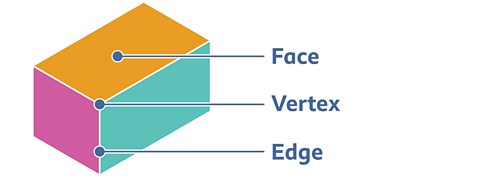
A 3D (three-dimensional) shape is a solid shape that you can hold. We can describe 3D shapes using three key properties.
Faces: the flat 2D surfaces of the shape. A cuboid's face is a rectangle.
Edges: the straight lines where two faces meet.
Vertices: the 'corners' where three or more edges meet. (The singular is 'vertex').
Let's look at a cuboid (like a cereal box or a book).
It has six faces (a top, bottom, front, back, and two sides).
It has 12 edges.
It has eight vertices (corners).
Volume of a cuboid
Volume is the amount of space inside a 3D shape. We measure it in cubic units, such as cubic centimetres (cm³).
To find the volume of a cuboid, you just need to know its length, width, and height.
Formula: volume = length × width × height
The problem: "A cereal box is 20cm long, 8cm wide, and 30cm high. What is its volume?"
How to solve it (the method):
Use the formula: V = L × W × H
Put the numbers in: V = 20cm × 8cm × 30cm
Solve it in steps:
20 × 8 = 160
160 × 30 = 4800
The volume is 4800 cm³.
Nets of 3D Shapes
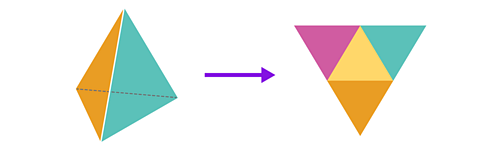
A net is a flat 2D pattern that can be folded up to make a 3D shape. Imagine unfolding a cardboard box so it's completely flat – that's its net!
The net of a cube is made of 6 squares.
The net of a tetrahedron (a triangular-based pyramid) is made of 4 triangles.
A tetrahedron is a special type of pyramid with a triangle for its base.
It has 4 triangular faces (all identical if it's a 'regular' tetrahedron).
It has 6 edges.
It has 4 vertices.
Match the shape with the description
Shape Inspector
Summary
You're a 3D expert! You can now identify the faces, edges and vertices on shapes like cuboids and tetrahedrons.
You also know that a net is the flat 2D pattern that folds into a 3D shape and you can find the volume of any cuboid using the formula: length × width × height.
Brain boost
Think about these questions to stretch your thinking and sharpen your skills!
What is the difference between a prism (like a cuboid or a Toblerone box) and a pyramid (like a tetrahedron or the Giza pyramids)?
A cuboid has a volume of 100 cm³. What could its length, width, and height be? (eg 10 x 5 x 2)
If a cube has one side length of 5cm, what is its total volume?
Have a chat about your answers with a parent, teacher or your class.
More on Practise and revise KS2 maths
Find out more by working through a topic
- count20 of 24
- count21 of 24
- count22 of 24
- count23 of 24