Introduction to problem solving in maths

This page has been put together to help you practise and revisit some of the brilliant skills you’ve learned all through primary school.
It’s a great way to boost your confidence in Maths and get you ready for the exciting next step into Year 8!
Let's put all your maths skills to the test!
In this guide, you will learn:
- that many maths problems are puzzles that mix different types of maths
- how to find the 'hidden' maths in a problem (eg is it algebra? shape? data?)
- how to use 'missing box' or simple algebra to find an unknown number
- how to solve problems using pie charts, bar charts, shape, and measure
What is a problem?

A 'problem' is just a question where the 'sum' is hidden in a story. Your job is to find it.
Many problems are secretly algebra or 'missing box' questions.
The problem

"I think of a number. I multiply it by 5 and add 3. My answer is 38. What was the number I first thought of?"
You can write this as a 'missing box' sum: (☐ x 5) + 3 = 38
How to solve it (the method): To find the number in the box, you must work backwards. This means you do the inverse (opposite) of each step, starting from the end.
Start with the answer: 38
The last step was 'add 3'. The inverse is subtract 3.
38 - 3 = 35
The first step was 'multiply by 5'. The inverse is divide by 5.
35 ÷ 5 = 7
The number in the box is 7.
Check your answer: (7 x 5) + 3 = 35 + 3 = 38. It's correct!
Problem solving: pie charts (data)
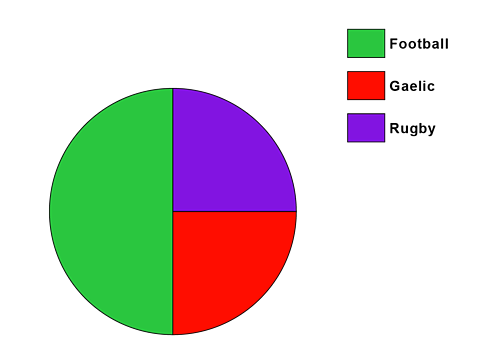
Another common maths problem mixes data handling with fractions and angles. You need to be able to read a pie chart and find the amounts.
The problem: "60 pupils were asked their favourite sport. This pie chart shows the results. How many pupils chose 'rugby'?"
How to solve it (the method): The whole pie chart represents all 60 pupils.
Read the chart: The 'rugby' section is 1/4 (one-quarter) of the whole pie. (You know this because it has a 90° angle, which is 1/4 of 360°).
Find the sum: The problem is "Find 1/4 of 60".
Solve it: To find 1/4 of a number, you divide by 4.
60 ÷ 4 = 15
The answer is 15 pupils chose rugby.
Football: This is 1/2 (half) of the chart. 60 ÷ 2 = 30 pupils.
Check: 30 (football) + 15 (gaelic) + 15 (rugby) = 60 pupils. Correct!
Data detective
Two-step money problem
Summary

Well done, problem solver! You now know that 'problem solving' just means finding the 'hidden' sum.
You can solve 'missing box' problems by working backwards (using inverse operations) and you can find amounts from pie charts by using your knowledge of fractions and angles.
You can also read and compare data from different charts.
Brain boost
Think about these questions to stretch your thinking and sharpen your skills!
What 'maths' can you see hidden in a recipe for 4 people that you need to make for 8 people? (eg scaling, multiplication).
What is the inverse (opposite) of 'multiplying by 10'?
What is the inverse of 'subtracting 7'?
A pie chart shows 100 pupils. How many pupils would be in a section with a 90-degree angle? How do you know?
Have a chat about your answers with a parent, teacher or your class.
More on Practise and revise KS2 maths
Find out more by working through a topic
- count15 of 24
- count16 of 24

- count17 of 24

- count18 of 24