Introduction to algebra problems
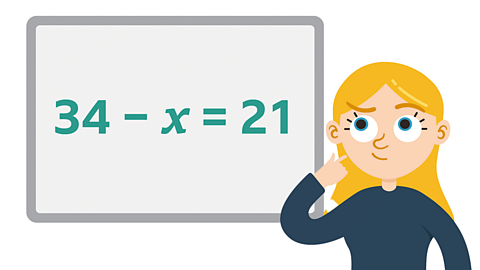
This page has been put together to help you practise and revisit some of the brilliant skills you’ve learned all through primary school.
It’s a great way to boost your confidence in Maths and get you ready for the exciting next step into Year 8!
Don't let the letters scare you! Algebra is just a special way of solving puzzles.
In this guide, you will learn:
that algebra is just using letters (like n or x) to stand for an unknown number
how to write an expression (a rule) for a real-life problem
how to solve an equation (a full sum) to find a missing value
how to solve algebra problems that use large numbers and decimals
What is an expression?

You use algebra all the time without even knowing it. An expression is just a set of rules or instructions.
Think about cooking a turkey. The instructions might be: "30 minutes per kg, plus 20 minutes at the end."
If we use the letter k to stand for the number of kilograms, we can write this as an algebraic expression: 30 k + 20
30 k means 30 x k (30 minutes times the number of kg)
20 means add 20 minutes at the end.
This is a rule. If your turkey is 2kg, you put '2' where k is: (30 x 2) + 20 = 60 + 20 = 80 minutes.
What is an equation? (A sum to solve)
An equation is when you have a full sum and you need to find the missing number. An equation always has an equals sign (=).
This is just like the 'missing box' problems you've seen before.
The problem: "Caoimhe buys 4 drinks and a newspaper that costs £2.50. The total bill is £12.50. What is the cost of one drink ( c )?"
We can write this as an equation: 4c + 2.50 = 12.50
How to solve it (the method): To find c, we must work backwards (use the inverse). We need to get the letter c all by itself.
Start with the total: 12.50
Undo the '+ 2.50': The inverse is subtract 2.50.
12.50 - 2.50 = 10.00
Now our equation is simpler: 4c = 10.00
Undo the '4 x c': The inverse is divide by 4.
10.00 ÷ 4 = 2.50
The answer: c = 2.50. One drink costs £2.50.
Solve the Shopping Problem
Summary

Well done! You've learned that algebra is just using letters to find missing numbers.
You now know how to:
write an expression (like 30k + 20) which is a rule.
solve an equation (like 4c + 2.50 = 12.50) by working backwards to find the unknown value.
Brain boost
Think about these questions to stretch your thinking and sharpen your skills!
What is the difference between an expression and an equation? (Hint: look for an equals sign!)
How would you write this as an expression: "A taxi costs £3.00, plus £2.00 for every mile (m)"?
How would you start to solve this equation: 2x - 10 = 40? What is the first inverse operation you would use?
Have a chat about your answers with a parent, teacher or your class.
More on Practise and revise KS2 maths
Find out more by working through a topic
- count16 of 24
- count17 of 24
- count18 of 24

- count19 of 24