The Cosmic Diary of a Future Space Explorer
The Cosmic Diary of a Future Space Explorer: The Next Step for Humankind, written by Tim Peake and Steve Cole and illustrated by Max Rambaldi, is the third title in the 2026 Blue Peter Book Club.
Watch the animation below to discover more about the book.
Tim Peake was the first British astronaut to visit the International Space Station.
His astronomical book looks at what space travel might be like in the future.
So pull on your spacesuit and prepare for an adventure across our solar system.
With the help of some robot adventurers, discover the incredible places we might visit.
Will we ever land on Venus?
Could we go to school on the moon?
It might seem out of this world, but anything is possible with space exploration.
Real-life astronaut Tim Peake is here to tell you what it’s like to blast off into space – and everywhere we might travel in the future!
Could we build a colony on Mars? Will we ever land on Venus? Can we play football on the Moon?
So pull on your spacesuit and join Tim (and a host of expert STEM characters) in this journey through space, time and the diary of one truly incredible space adventure.
With help from some robot adventurers, you’ll discover space missions of the past and present - and explore where we might travel in the future…
You can get a sneak peek of the book over on Blue Peter.
What is non-fiction writing?
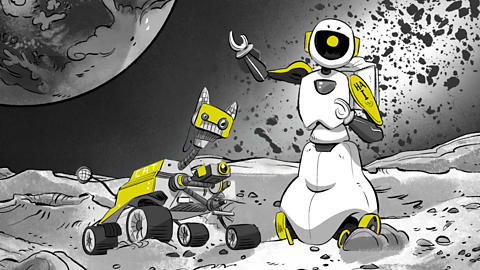
The Cosmic Diary of a Future Space Explorer keeps you intrigued by blending together non-fiction writing and imaginative ideas as you travel to new planets.
This book is a great example of a non-fiction text; however, parts of it sometimes feel like a story, especially because of characters such as ‘HALLEY’ and ‘CAT’.
Non-fiction writing is factual, whereas fiction is imaginative and made up.
You know that The Cosmic Diary of a Future Space Explorer is non-fiction because it uses facts to help you imagine how our lives in space could be in the future.
How do you switch between different forms of writing?
Did you notice how the book switches between different forms of writing?
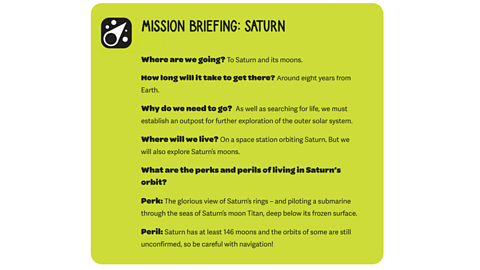
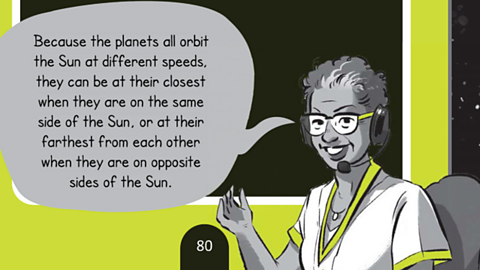
There are fact-files at the start of each mission, diary entries written by HALLEY, comic-style frames, speech bubbles, timelines, mission briefings, and even a quiz.
The authors have switched between writing styles to present the facts in a fun, exciting and creative way.
We’re sure you’d agree that this is much better than presenting information as a long, boring list of facts!
Switching between different forms of writing like this keeps you, the reader, more engaged in the book. It encourages you to keep reading and to think about how we could live in space one day.
What is the difference between fact and opinion?
Unlike many non-fiction books, The Cosmic Diary of a Future Space Explorer includes both facts and opinions.
Facts are things that are definitely true. Non-fiction books like this one are full of facts. For example,
“There are over a million asteroids in the asteroid belt.” (page 138)
On the other hand, opinions are how a person or character feels. People can have different opinions about the same thing.
HALLEY shares opinions throughout the book. For example:
“I feel a bit sorry for the astronauts stuck on the VSS for at least 19 months at a time.” (page 94)
Example 1
Take a look at this fact file about Jupiter.
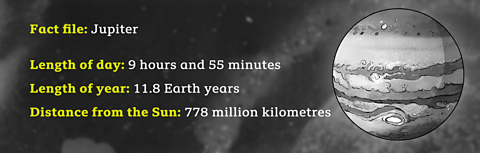
How does this fact file tell you that this book is a non-fiction text?
✓ Fact files are a form of non-fiction writing because they give real information.
They present facts clearly to help us learn about the topic. That's why this fact file shows that the book is non-fiction.
Example 2
Take a look at this slideshow that shows some different forms of writing from the book.
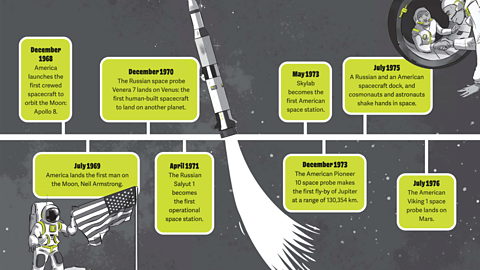
Image caption, Timeline of space exploration
1 of 3
Why have these different writing forms been used by the author?
✓ Using different forms of writing to share different facts can help keep readers engaged in the book.
Example 3
Finally, take a look at this extract.
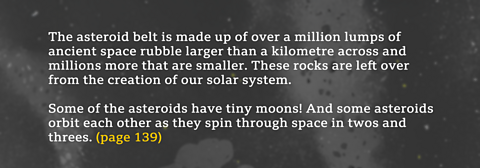
Can you decide if Tim is sharing facts or opinions?
✓ These are facts because they are definitely true (scientists have been studying space for many years).
Remember:
facts are things that are definitely true.
opinions are a person or character’s feelings.
Blue Peter Book Club
Watch as Abby and the Book Clubbers talk about their favourite parts of The Cosmic Diary of a Future Space Explorer with a very special guest!
You need to read this book.
This book is out of this world.
Do you want to be an astronaut?
Everything you need is in this book.
Blast of!
Calling all future astronauts.
Have you ever wondered what space travel will be like when you grow up?
Well, grab your helmets and check out the Cosmic Diary of a Future Space Explorer, our latest BP Book Club read.
Here to give us their stellar reviews are stargazers Shahid, Alexia, Blanca, and Balthazar.
And to host this space-themed book club, we're better than the space exhibition at the Science Museum in London, where we're helping create mini versions of the Mars rover.
While we get our rovers ready for orbit, I want to know what our beepy book clubers thought of the cosmic diary of a future astronaut.
My favourite part was when they were talking about all the different jobs that we could have on the moon, and they were so different to the jobs that we have here, so it was really interesting.
My favourite part was what would happen to your body if you went out in space without a suit on.
What would happen?
The water on your tongue and your eyes would boil.
Oh.
Why did you like that part of the book?
Cos it was gross.
What's been your favourite fact that you've learned?
Astronauts need to grow their own food.
If you put metal on Venus, it could melt.
Yeah.So, obviously this is a fact book, but they have characters as well.
Who's your favourite character?
I like HALLEY, but I also like CAT because in all of the emergency situations, she knew exactly what to do.
It'd be really cool to have just like a robot that'd be able to help you out all the time.I would probably get her to do my algebra.
And what do the book lovers think about the author being real-life astronaut Tim Peake?I think it's pretty cool.
Usually when famous people who have crazy jobs write books, they would be writing books for adults, but this is a children's book, so we can really understand what space is like.
Our rovers are looking mission ready.
Don't drop it, don't drop it.
Let's see how they fare on a red planet runway.
OK, should we give these a spin?
Yeah.
This is fun.
But things are about to get a whole lot more fun as a particular astronaut author is cleared to land.
Hi everyone, this looks like fun.
Houston, we have a real life space explorer.
Hello, hello, how are you doing? What are you up to?
Earth to Balthazar, come in, Balthazar.
This is the best morning ever.
These are fantastic, these are really good.
Tim is used to all sorts of space kit, so handling our rover should be easy, right?
Which one am I controlling, this 10 yeah, oh right, oh.
Oh oh, abort mission.
Let's hope our Mars rovers aren't crashing into each other for real.
How about we ask Tim some questions instead?
How do you get in and out of space?
So we travel into space on a rocket, but we're sat in a spacecraft that's on top of the rocket, and actually the spacecraft I was sat in was this, the Soyuz. And that took me and my two astronaut friends up to the International Space Station, and it stays attached to the space station for the whole time we're up there, it's like our lifeboat, and then we hop into it at the end of the mission and come back to Earth.
Do you believe that life is out there? Do you believe in aliens basically?What do you think?
Yeah, maybe.
I definitely believe in aliens.
I think the universe is teeming with life.
there are so many billions of stars in our own Milky Way galaxy, so many billions of galaxies in the universe, and we know that everything that we need for life is there in abundance out in space.
How do you go to the toilet in space?
Very important question.
So we have a tube, with a funnel on the top, that's what we pee into.And then we have a normal toilet for 2, we have, we've gotta have good aim, and then airflow keeps everything going in the right direction.
But here's the interesting bit, all of our pee gets turned back into drinking water in just, in just 6 hours.
So 6 hours later, when you go for your afternoon cup of tea, you're drinking your morning pee.
Oh Tim even has a gift for each of the book clubbers, and thankfully it's not a drink of space water.
This was flown in space with me for 6 months.
It did 3000 orbits of planet Earth at 25 times the speed of sound, so you now have something.
That was flown in space.
It's got a little rocket on it.
Space looks secured, and now with galaxies of space knowledge, who knows, this lot could be astronauts of the future.
If you've read the book, can you write about what you enjoyed the most? Think about the story, the facts and opinions.
Imagine a new planet has been discovered, can you write a mission briefing fact file?
Both of these will help you earn your Blue Peter Book Club badge, which you can read about here.
Quiz
Now put what you've learnt to the test with this quiz.
More on Blue Peter Book Club
Find out more by working through a topic
- count4 of 16
- count5 of 16

- count6 of 16