Key points
Overview
Sonnet 43 is about deep, spiritual love that lasts beyond life. The speaker expresses love as powerful, unconditional, and eternal.
Main themes
Love as pure and limitless.
Links to faith and morality.
Love as both emotional and spiritual.
Tone and voice
The tone is passionate, sincere and reverent. The speaker uses direct first-person address and repeated declarations to show unwavering devotion.
Context
Elizabeth Barrett Browning faced illness, a strict father, and a secret marriage to Robert Browning. Her love for him gave her freedom and happiness, which inspired this poem.
Form and structure
Petrarchan sonnet (14 lines).
Rhyme scheme: ABBA ABBA CDCDCD.
Written in iambic pentameter, like a heartbeat.
Poetic devices to spot
- Repetition – “I love thee” shows intensity and devotion.
- Metaphor – love compared to spiritual and moral ideals, like “being” and “grace”.
- Simile – love is “as men strive for Right,” linking it to justice and effort.
- Rhetorical question – “How do I love thee?” draws the reader in.
- Enjambment – lines flow into each other, showing love’s continuity.
- Caesura – pauses in lines create emphasis and reflection.
- Alliteration – adds musicality and reinforces key ideas.
- Tone – passionate, sincere, and reverent.
How Do I Love Thee? (Sonnet 43)
by Elizabeth Barrett Browning
How do I love thee? Let me count the ways.I love thee to the depth and breadth and height
My soul can reach, when feeling out of sight
For the ends of being and ideal grace.
I love thee to the level of every day’s
Most quiet need, by sun and candle-light.
I love thee freely, as men strive for right.
I love thee purely, as they turn from praise.
I love thee with the passion put to use
In my old griefs, and with my childhood’s faith.
I love thee with a love I seemed to lose
With my lost saints. I love thee with the breath,
Smiles, tears, of all my life; and, if God choose,
I shall but love thee better after death.
The text of this poem is available in the CCEA Poetry Anthology, which can be downloaded from the CCEA website.
The BBC is not responsible for the contents of any other sites listed.
Summary
A love poem detailing the speaker’s depth of feeling for her beloved, which she states will transcend this life and persist even more strongly in the afterlife if God allows. Sometimes also titled Sonnet 43, and written around 1845, the year Barrett Browning first met the man who would become her husband.

- Title: A rhetorical question which is then repeated in the first line of the poem; ‘thee’ is a familiar or intimate version of ‘you’, showing closeness to the subject.
How do I love thee? Let me count the ways.
Themes: Love, faith, spirituality, freedom, devotion.
Tone: Passionate, earnest, honest, sincere.
Speaker: A first person speaker, often assumed to be the poet herself addressing her husband, Robert Browning.
Applicable context
- Elizabeth Barrett (1806 – 1861) was born into a wealthy family whose fortune came from slave plantations. Despite this, she opposed slavery and wrote against it from a young age; this poem partly reflects her belief in personal and political freedom.
- She became ill in childhood and had poor health for the rest of her life, taking A liquid medicine made from alcohol and opium. People used it in the past to treat pain and help them sleep, but it was very addictive and could be dangerous. and morphine for her pain; her physical difficulties may partly explain her focus on feeling and spirituality in How Do I Love Thee?, as well as the reference to how she might “love thee better after death”, when ‘liberated’ from her painful body.
- Robert Browning, a fellow poet, wrote to express his admiration for her writing. He visited and wrote to her, and a romance slowly developed between them. For decades, Elizabeth’s life was greatly restricted by her illness and her controlling father; she and Browning married in secret, as Elizabeth knew her father would not approve.
The love she found with Browning freed her from being trapped at home, nurtured her talent and fulfilled her. The significance and positivity of their relationship could be illustrated in the devotion and attention to detail she shows in this poem, reflecting on how much love means to her.
Only a little context is needed for each poem; where used, it should be applied to the point you're making.
Form and structure
- How Do I Love Thee? is a Petrarchan sonnet (also known as an Italian sonnet), meaning that its rhyming structure is divided into an octet (eight lines which rhyme ABBA ABBA) and sestet (six lines with a rhyming pattern of alternating lines: CDCDCD).
- The poem is written in iambic pentameter, which was the traditional The rhythm of a line of poetry based on how many syllables it has and where they are stressed or emphasised – likes beats in music. used in most sonnets. One ‘iamb’ is a two-beat combination: an unstressed syllable followed by a stressed (emphasised) syllable, making a ‘da-DUM’ pattern, like a heartbeat. Pentameter means five of these two-beat units per line, making 10 syllables altogether:
| I love | thee with | a love | I seemed | to lose |
| da-DUM | da-DUM | da-DUM | da-DUM | da-DUM |
What is a sonnet? revision-guide
Learn about the conventions of a sonnet, Shakespearean sonnets and Petrarchan sonnets, iambic pentameter and rhyme in this KS3 English BBC Bitesize article.
- The use of these consistent rhymes and regular rhythm, as well as the sonnet being a traditional form for love poetry, helps to underscore the theme of love’s ability to create harmony, unity, and a sense of being complete and satisfied.
Language and poetic methods
Apostrophe: How Do I Love Thee? uses apostrophe – not the punctuation mark, but a figure of speech where the poet addresses someone directly. It is thought that Barrett Browning wrote this poem specifically to her husband. However, the use of ‘I’ and ‘thee’ throughout, the more abstract references to feelings, and the lack of names or details of any particular person, give this poem universality. It could be spoken by many people in both the context of romantic love and in other contexts – the love of a parent for their child, for example.
Rhetorical Question: the question asked about ‘how’ she loves the person to whom she is speaking is a A question asked in order to create a dramatic effect or to make a point, rather than to get an answer. used to set up an a rhetorical device where a writer pretends not to know something often so they can ask a question and then answer it themselves. in the rest of the poem. The question could show uncertainty, as if she does not know how much she loves them, and yet the fullness and detail of her following answer shows she is very sure of her feelings. This aporia (or rhetorical-question-and-answer) format allows her to clearly illustrate the extent of her love.
Repetition: The phrase “I love thee” is repeated throughout the poem, each time forming strands of an answer to the question (“How do I love thee?”) asked in the first line. The repetition of the phrase emphasises it, reminding the reader that her love is steady, strong, and enduring, as well as giving her a consistent platform from which to describe all the different forms and feelings her love takes on. “Thee” is a familiar and intimate form of “you”, showing her closeness to and fondness for the person she’s addressing.
Similes: In lines seven and eight, the poet uses A simile is a word or phrase used to make a comparison for dramatic effect, using 'like' or 'as'. to add positive associations to her uses of the adverbs “freely” and “purely”. “I love thee freely” is a significant line, since Barrett Browning was disowned by her father for marrying; her relationship with Browning freed her from a life ruled over by her father. As someone who was concerned with issues of freedom for all humanity, Barrett Browning would also have been aware that many women of this era had no choice at all in whom they had to marry; therefore her setting the term “freely” next to the simile “as men strive for right” creates a link between freedom, justice, and righteousness.
“As they turn from praise” in line eight similarly links the ‘purity’ of the love she feels with the idea of humility and being grounded; the Christian values of avoiding pride and not seeking attention are referenced when she mentions turning away from “praise”, imbuing the love she feels with an extra spiritual element that transcends human vanity.Metaphor: The poet’s references to “depth and breadth and height” are A metaphor is a word or a phrase used for dramatic effect, to describe something as if it were something else., because they suggest that the abstract concept of love could somehow have physical measurements. She offsets this attempt to give the reader a solid impression of her love’s size by adding a reference to her “soul” and the dimensions it can reach. This combination of physical dimensions and intangible spiritual references creates a sense of the love being so huge it is beyond full mortal comprehension – not only is it still “reaching” or expanding, but it is also “out of sight” of human eyes.
“The ends of Being and ideal Grace” are references to the end of humanity and the perfection of God; she implies that her love is huge enough to reach these figurative states of time and space, and that the love she feels brings her closer to Heaven.
This is not a list of every method or notable use of language and structure in How Do I Love Thee?.
Look at the poem again. Can you find any of the following?
A poetic device where a sentence continues beyond the end of the line or verse.
Enjambment occurs a few times in the poem. One such example is in lines two, three and four, when she refers to “the depth and breadth and height / My soul can reach when feeling out of sight / for the ends…” — it is as if the love she describes is so vast it cannot be neatly contained by the structure of the lines, instead bursting forth and spilling onto the next line.
A break in poetic rhythm in the middle of the line, a momentary pause.
Barrett Browning uses caesura in several places in How Do I Love Thee?, starting with the first line itself, which is divided by the question mark into a question and the start of its answer. She sometimes uses it to add more detail, such as the comma used in line nine, or to give a sense of pausing for breath and/or emphasis in lines 11 and 12. As if she has spoken so much about the extent of her love that she is running out of breath!
A sound feature; the repetition of the same sounds usually at the beginning of words.
Adding to the poem’s sense of harmony and peace, Barrett Browning sometimes uses alliteration to show cohesion or togetherness in the repeated sounds. An example of this is in lines 11 and 12, with “love… love… lose… lost” – the liquid ‘L’ sounds flow freely and create a lilting, graceful effect with their sound.
If you have found these methods, consider what you know about the poem and the poet already.
What effects do these methods create? Why has she used them?
What other poems could I compare with How Do I Love Thee?
i carry your heart – another poem in which the speaker directly addresses their beloved and considers how powerfully their love affects them.
Funeral Blues – an elegy meditating on the depth of loss felt when the poet’s loved one died.
Sonnet 130 – also a sonnet; the first person speaker in this poem also considers the object of his love and suggests how real his feelings for her are.
Practice questions
Use these questions to hone your knowledge of How Do I Love Thee?, and to practise using your notes and analysis in organised paragraphs that focus on how particular themes or ideas are shown in the poem.
- How does Barrett Browning show the extent of the love she feels in How Do I Love Thee?
- What does How Do I Love Thee? show us about Barrett Browning’s attitude to her relationship with the person to whom she addresses it?
- What imagery does Barrett Browning use to show her feelings about love in How Do I Love Thee?
- How does Barrett Browning create a tone of sincerity in How Do I Love Thee?
Example answer
Below is a demonstration of how to use the material in this section to answer an example essay question. The answer below is not a full essay, but only an extract of a longer answer, showing some of the points that could be made.
Q: How does Barrett Browning show the extent of the love she feels in How Do I Love Thee?
A: Barrett Browning uses a rhetorical question in both the title of her Petrarchan sonnetHow Do I Love Thee? and its opening line, setting up an aporia as though she might not remember or have thought about how much she loves the person she is addressing directly with the familiar and intimate term “thee”. By answering her own question in detail in the remainder of the poem, she uses the aporia effectively to show that she actually holds strong and true feelings of love and can list them off in great detail, showing the extent of the love she feels. She uses repetition of the phrase “I love thee” throughout the poem to emphasise this each time she gives an example of how much she loves them, further reinforcing her point.
The extent of the love Barrett Browning feels is further shown in the poet’s references to the “depth and breadth and height” of her lover, using a metaphor to give the feeling physical measurements. She offsets this attempt to give the reader a solid impression of her love’s size by adding a reference to her “soul” and the dimensions it can reach. This combination of physical measurements and intangible spiritual references creates a sense of the love being so huge it is beyond full mortal comprehension – not only is it still “reaching” or expanding, but it is also “out of sight” of human eyes. This shows the huge extent of her love, so big it cannot be fully seen or understood.
This essay could go on to make the following points, backed up by evidence from the poem and detailed analysis of that evidence:
- Barrett Browning uses similes to associate her love with qualities of goodness and purity.
- Barrett Browning uses alliteration to create a sense of cohesiveness and harmony among the language she chooses, showing the extent of her love is great enough to create peace and satisfaction.
- Barrett Browning uses caesura to give a sense of breathlessness, as if listing all the many ways she loves this person has made her out of breath because there are so many, showing the great extent of her love.
If you have found these methods, consider what you know about the poem and the poet already.
What effects do these methods create? Why has she used them?
Test your knowledge of How Do I Love Thee?
More Elizabeth Barrett Browning
In Our Time. audio
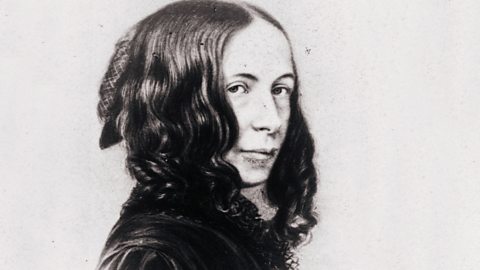
Melvyn Bragg and guests discuss Aurora Leigh, Elizabeth Barrett Browning's novel-poem published in 1856.
Words of Faith. audio
The poetry of Elizabeth Barrett Browning and her husband Robert. Presented by Reverend John Bowker.

Arts & Ideas. audio
Peggy Reynolds compares notes with Fiona Sampson on the writing of Elizabeth Barrett Browning.

More on Anthology Two: Relationships
Find out more by working through a topic
- count2 of 12

- count3 of 12

- count4 of 12

- count5 of 12