War Report
The ‘night-by-night’ coverage of the war proved to be a huge critical and popular success.


War Report was first broadcast on the BBC Home Service at 21.19, just after the main evening news and a speech from the King, on Tuesday 6 June 1944, D-Day. Its ‘night-by-night’ coverage of the war subsequently proved a huge critical and popular success. But, as newly-released accounts show, not everything ran smoothly behind-the-scenes.
War Report’s first edition was introduced on air by the BBC’s announcer, John Snagge:
Snagge’s opening words set out clearly the programme’s agenda: to provide listeners with a kaleidoscopic picture in sound of the whole, complex field of battle.
It was undoubtedly new and exciting. But War Report was not quite without precedent. Nor was it the only programme to feature the work of the BBC’s new War Reporting Unit. Listeners to the Allied Expeditionary Force’s programme, for example, could tune-in regularly to Combat Diary.
Listeners across the English-speaking world already had Radio Newsreel. Indeed, it was probably Radio Newsreel that provided the most obvious inspiration for War Report. For, as one of its own regular contributors, Audrey Russell, explained in her oral history interview, it offered a lively, flexible, and always-up-to-date pull-together of the day’s main events:
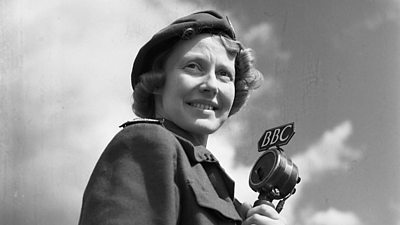
"Radio Newsreel was the classic news programme of the war… one of the programmes that made people realise that this was the BBC’s famous and most splendid hour… Everyone was liable to deputise for somebody else because in the war we were either bombed out or lost our windows or had to fetch a mother-in-law from hospital or something… you might go in and they would say, oh, somebody’s house had a hit, she’s all right but she can’t come in. And so you found yourself as a scriptwriter for one day for Radio Newsreel, or a producer for Radio Newsreel. My basic job was a broadcaster but I very often didn’t broadcast at all. There was an extraordinary mixture... an inflow of actors because we were always needing voices to read despatches when the recordings were not good enough to go through the static to get on the Overseas Service... then of course there were the professional broadcasters also working in Radio Newsreel... people like Colin Wills from Australia, Bing Whittaker from Canada, Ed Murrow USA, Stan Maxted… Chester Wilmot... the whole of this outfit was presided over by what was I think the ablest immediate boss that I was ever to know in the BBC, Peter Pooley... he had a complete grasp of what was almost any political or war situation... Of course, the conditions of work, especially for the scriptwriters and the producers was, well hectic is a mild word you see, because so often they were overtaken by events and we’d have a half hour programme ready to go on the air and suddenly the whole thing had to be scrapped... they were indeed at the mercy of events: a completely new script, new inserts, new everything had to be put together in as little as an hour and a half..."
What distinguished War Report was not just that it reached a Home Front audience, but that its launch coincided with a dramatic expansion in the BBC’s ability to provide up-to-date eye-witness accounts from the key battlefields. With some thirty or so correspondents and engineers in the field at any given moment – each embedded with a military unit, equipped with portable recording equipment, and each with reasonably quick access to transmitters – the programme could be built every night from a rich and seemingly unending stream of dispatches arriving at Broadcasting House.
Eisenhower’s words had been the first to be featured in the opening edition. But the programme then went on to include a translation of De Gaulle’s message, also broadcast earlier that day, before taking listeners ‘back into the darkness of the night before D Day’ with recordings from Robert Barr of para-troops getting ready at a British airfield and Richard Dimbleby describing parachutists taking off from another.
Listeners then heard the recorded words of Guy Byam, who was preparing to fly to Normandy by glider, followed by those of John Macadam, who was aboard when the glider landed.
There was a live interview with a naval commander. And then: the first actual description of the fighting on the beaches, which Snagge introduced with these words:
After Marshall’s gripping, unscripted account, War Report gave listeners another opportunity to hear the recording of Air Commodore Helmore in a Mitchell bomber broadcast earlier in the day, before Richard Dimbleby summed-up the latest situation on the ground in France, and the programme ended with a recording of General Bernard Montgomery speaking to his troops just before they set off at dawn.
‘To us is given the honour of striking a blow for freedom which will live in history’, he told them, ‘and in the better days that lie ahead, men will speak with pride of our doings.’
The script of this first ever edition is held in the BBC’s written archives, and can be downloaded in full below:
R28-684-1 - War Report Number One - The Story of D Day - 06-06-1944
Also held in the BBC’s written archives is a detailed, hour-by-hour list of all the other dispatches pouring-in to Broadcasting House throughout D-Day and the days that followed:
R28-282 - W Week - 01-06-1945
In this following recording for the BBC Oral History Collection, John Snagge was interviewed by John Lane, who had himself been involved in making War Report.
In talking together, the two men provide a fascinating reconstruction of what was involved in pulling-together each nightly edition at Broadcasting House:
Snagge describes his experience as an announcer on War Report as ‘exciting... fascinating’. But perhaps time had erased his darkest memories when he recorded this interview, since the BBC’s written archives happen to contain a one-page memo written by him early in August – two months into the series – which suggests the frenetic pace of production, with everything coming-in last-minute, was actually proving too much for him.
As an announcer with several years’ experience behind him, Snagge had got used to having plenty of time to read through and rehearse his scripts. Now, in War Report this was rarely possible:
R28-282 - War Report - 05-08-1944
There were signs that War Report was creating real stress in other parts of the BBC’s machine, too.
The Duplicating Section, for instance, was responsible for the typing and copying of every script. Given the extraordinary number of dispatches now arriving from every member of the War Reporting Unit, the scale of this job was evidently getting out of hand.
In her oral history interview, Mary Lewis, who was in day-to-day charge of the Section, described the impact:
The BBC’s war correspondents themselves also faced difficulties in the field. It was all highly dangerous of course: two members of the War Reporting Unit – Kent Stevenson and Guy Byam – were killed while accompanying bombing raids over Germany.
However, the correspondents also had to deal regularly with military commanders who would tune-in to hear their dispatches being broadcast and then harangue them for any perceived misreporting of events.
Reporters such as Frank Gillard reckoned that because the soldiers with whom he was embedded would hear everything he said on air, there was always an extra incentive for him to be accurate. But he was always at the mercy of generals, who could themselves be guilty of misreporting events.
And, as he reveals in this archive interview, it was on one such occasion that he was forced to leave the British Army – with consequences for the rest of his wartime broadcasting career.
"It was in the winter of the last year of the war when the Germans broke through in the Ardennes… When all that was over and the Germans had been mopped up and pushed back, Monty rather stupidly gave a press conference at which he claimed a lot of the credit for that… This caused such trouble with the Americans that Ike went to Churchill and said “Look, I’ve got three million American men under command in Europe. The only radio they can hear which they understand is the BBC’s. They can’t hear their home radio. If they hear the BBC reporting, even if it’s doing so in all innocence, that British forces won a battle when they know bloody well the Americans won the battle, this is not good for morale."
As a result of this row, Gillard was told he had to be detached from Montgomery’s British forces and be embedded instead with the troops under General Bradley’s command, to ensure the BBC provided better coverage of the American military successes.
"There I stayed until the end of the war. And this was fine for me… I had the capture of Cologne, the entry into Cologne, I had the taking of the one bridge over the Rhine that we were able to capture… the link up with the Russians at Torgau on the Elbe, And that of course really was the kind of crux of a career as a war correspondent that you might dream about, because that night, the night of the link up, the BBC 9 o’clock News – Big Ben sounded, the announcer, Stuart Hibberd said “Over to Frank Gillard in Germany”, and I did my piece about the link-up, and I was followed by Churchill, followed by Truman, and Truman was followed by Stalin. How’s that for a line-up of stars?"
This was not quite the climax of Gillard’s war reporting career, however. Because he was about to get a phone call from Montgomery himself, inviting him to be a witness to one final drama:
One frequently overlooked aspect of the War Reporting Unit’s work is the ongoing difficulty with recording equipment.
The BBC’s engineers had been immensely pleased that they’d developed new portable ‘midget’ disc recorders just in time for the D-Day landings. Wrapped in wooden cases, each one included batteries, a microphone on a clip which could be attached to anything such as a tree branch or the rim of a steel helmet, and a set of 12 double-sided 25-cm discs, each of which gave just under three-minutes recording time per side.
The whole package weighed no more than 18kg in total, and it seemed as if they could easily be operated by a reporter without any engineering support.
Yet by the bitterly cold winter of 1944-45, correspondents were increasingly finding that their attempts to record out in the open air were failing.
Audrey Russell, who had belatedly become a fully accredited war correspondent for the BBC, was based in Belgium when the worst of winter arrived, and in her oral history interview she described the unusual lengths she had to go to in order to get her own disc-recorder working:
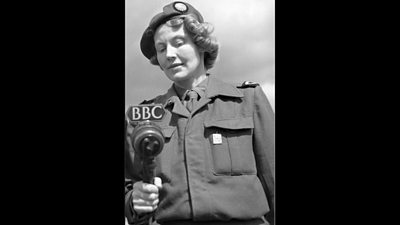
"In the cold weather this was almost impossible to do. For recording you must have a reasonable temperature… and I got a lot of teasing in the battery because the only way I could manage this in this appalling weather was to wear about 8 or 10 discs underneath the blouse in my battledress and I looked a very sort of curious square shape in front. But this was the only way to get the things cut you see. I went on and on trying and trying to make this thing work and it really was not very efficient. I didn’t know that all the men had rejected this really terrible bit of equipment and I struggled on."
Fortunately, Russell’s colleague Robert Reid had succeeded in getting his recorder to work back in August, when he had been covering the liberation of Paris. And the result was perhaps the single most gripping slice of reportage to be broadcast in the entire series of War Report.
French and American troops had only recently entered the city. Reid himself was just outside Notre Dame cathedral, where thousands of Parisians had assembled to await the arrival of General de Gaulle. Against a backdrop of intermittent machine-gun fire, he described the tanks heading towards him covered with people and the General himself entering the cathedral:
The broadcast was a sensation, a ‘real triumph’ of reportage, as one newspaper put it at the time: ‘There can never have been anything more dramatic’.
The final edition of War Report was broadcast on Saturday 5 May 1945, a day after the surrender of the German army at Lüneberg Heath. Over the previous months between 10 and 15 million Britons had tuned-in regularly, exhilarated by the sense of following the microphone to the places where things were happening.
The coverage of D-Day and its long aftermath made the BBC’s war correspondents famous and established the Corporation’s reputation for journalism. But none of this would have happened without a vast and often unacknowledged machinery of planning, training, engineering, logistics and administration, involving hundreds of BBC staff, at all levels, who had shared a vision of what broadcasting might achieve in times of crisis.
Intelligence Reports conducted by the Ministry of Information uncovered signs of at least some public disquiet with what they created: dispatches that were occasionally thought ‘too harrowing or gruesome’, especially for the families of those fighting, or reporters that sometimes sounded too much like football commentators.
However, John Snagge, who despite everything remained one of War Report’s regular announcers, rejected the idea that the series was in any way sensational. Or, to be more precise, he suggested that if it did occasionally sound enthusiastic, it was only reflecting the broader mood of the country as the war moved towards its climax:
Further reading:
- Desmond Hawkins (ed.), War Report: BBC Dispatches from the Front Line 1944-1945 (1994).
Search by Tag:
- Tagged with World War 2World War 2
- Tagged with News & Current AffairsNews & Current Affairs
- Tagged with 100 Voices100 Voices