Planting of new forest delayed for judicial review

 BBC
BBCThe creation of one of the largest new forests in decades has been delayed by a "costly and time-consuming legal battle", its developer has said.
Investment firm True North had planned to plant 600,000 trees in Lanchester, County Durham, as part of efforts to create a timber forest and holiday park.
But a legal challenge brought by local firm Lanchester Properties argued the Forestry Commission wrongly allowed the Greencroft Forest scheme to go ahead without a full Environmental Impact Assessment (EIA).
On 30 January, the High Court ruled a full substantive hearing of the details of the case should be held, forcing the afforestation scheme to halt.
Lanchester Properties company directory Caroline Cleary-MacArthur claimed "residents were not adequately informed" about the scheme's true nature.
She said people did not know the site would be dominated by "an industrial timber forest" made up predominately of Sitka spruce.
The company said Sitka spruce was a non-native, fast-growing conifer associated with "reduced biodiversity, monoculture landscapes and increased risks of flooding".
"People were led to believe this was a biodiversity project when the evidence shows otherwise," she said.
True North said the forest would be "diverse" and would include some broadleaf trees such as oak, birch, willow and hornbeam.
The company said its scheme would improve biodiversity and reduce flooding risks by planting a mix of trees on previously unobstructed farmland.
'Significant financial costs'
Lanchester Properties said it had "shouldered the cost" of the legal challenge after concerns about the scheme were raised by residents and landowners who could not afford to do so themselves.
The company, which is part of the Lanchester Group, also said the forest would cause turbulence, damaging three wind turbines at its nearby factory, and would "cause significant financial costs to the business", although True North disputes this.
In October, a High Court judge ruled the Forestry Commission had applied its environmental planning rules appropriately and rejected Lanchester Group's request for permission to apply for a judicial review of the body's decision.
He said the commission had given "consideration to all relevant issues of landscape, character, views and mitigation".
But the company applied for this ruling to be reconsidered and was successful, with the second judge ordering a hearing should be held focusing on whether a full EIA needed to be submitted with the planning application.
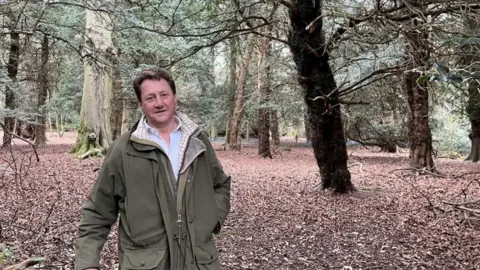
True North director Harry Humble said he was "disappointed" by the judge's decision, which had created a "costly delay".
"We won't be able to plant anything this spring, as the case will be locked up in the courts awaiting a decision while the legal bill for the taxpayer continues to mount," he said.
Humble said planting a new forest would help cut carbon and improve biodiversity.
"This is merely delaying the inevitable," he said.
"We are confident that the forest will be planted and that sense will prevail."