Noah Donohoe inquest told drain 'easy to get into'

 Pacemaker
The inquest into the death of Noah Donohoe has been told that the culvert in the area where he disappeared was "easy to get into".
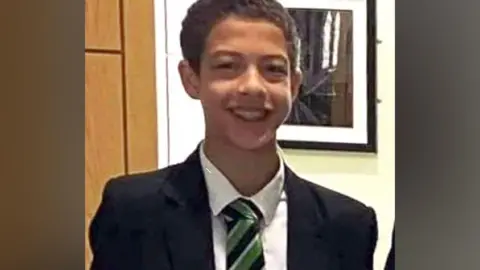
The body of the 14-year-old Belfast schoolboy was found in a water tunnel close to the M2 motorway almost a week after he disappeared in North Belfast in June 2020.
Appearing at the inquest into the boy's death, Sean McCarry from the Community Rescue Service said their volunteers went to the Northwood Road area after hearing that Noah's bicycle had been found.
He said they began searches in the general area, including behind local houses, where they discovered a culvert on waste ground.
The witness said the grille on top of the cover was "unlocked and could be easily opened".
He added that they realised that an adult could pass through the culvert.
He explained how their initial searches were focused on Cavehill, Noah's intended destination on the day of his disappearance.
He said their ongoing searches subsequently focused on many different areas.
Following the discovery of Noah's mobile phone at a play park in the area, the witness said they extended their searches to areas towards the city centre, Sailortown in the Docks, and the River Lagan.
He said their searches at Cavehill continued while other searches were in progress because they were aware that Noah could have accessed Cavehill from the North Belfast route he had taken on the day of his disappearance.
The witness said some of the grounds of Cavehill are "sometimes like a jungle".
Mr McCarry's evidence was preceded by a video of a BBC documentary, The Search, which showcased the voluntary work of the Community Rescue Service, with a particular focus on their volunteers during the searches for Noah, alongside hundreds of members of the public.
Appearing in the documentary, Fiona Donohoe, Noah's mother, described the Community Rescue volunteers as "a light in the darkness" and she also paid tribute to the members of the public for their role in trying to find Noah.
Where was Noah found?
McCarry said Noah's body was found "far beyond" where he would have expected a body to travel in an underground water tunnel.
McCarry explained how a trained CRS volunteer entered a culvert, at the tunnel inlet, during the early stages of the searches for Noah.
He said the volunteer was fitted in a harness and was attached to a line when he entered the culvert and travelled inwards a short distance before having to withdraw for safety reasons.
The witness also explained that during the brief underground operation, the CRS team used a camera and repeated a "call and wait" process during which they shouted down the tunnel and then paused to wait for a possible response.
Body was 'far beyond' expected in tunnel
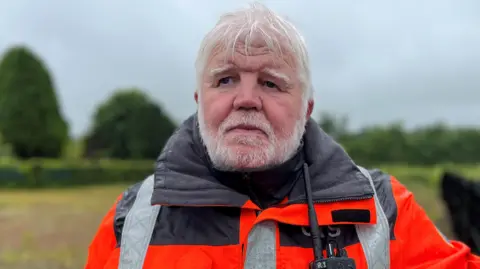
Asked by a barrister for the Department for Infrastructure if he thought that Noah's body would have been found so far down the tunnel, he replied, "definitely not" and it was "far beyond" what he would have expected.
He said: "It's a long way down that drain."
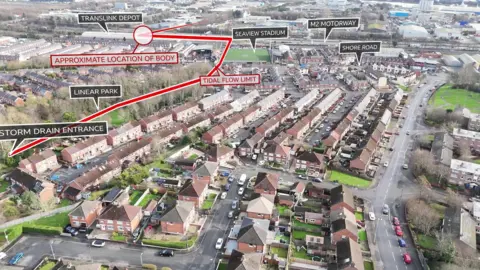
Noah's body was found 625 metres downstream from the inlet.
The tunnel runs downhill from Linear Park in North Belfast beyond the Seaview football stadium on the Shore Road and later changes direction to run alongside the M2.
His body was recovered close to a Translink depot beside the M2.
McCarry told the inquest that the CRS volunteers always hoped they would find Noah alive but ultimately, he was "extremely grateful" that Noah's body was brought back to the boy's family.
In his evidence to the inquest, Sean McCarry said Noah's aunt, Niamh, was their point of contact with the family during their searches and he wanted to "highly commend" her for how she conducted herself and how she represented the family.
He also explained how the Community Rescue searches were taking place in many areas above ground while other searches were being conducted by the police in underground water sources.
He said there was no indication that Noah had entered the culvert, and they remained hopeful during their searches that they would find him until the search team was informed that the boy's body was found close to the motorway six days after he went missing.
'Devastation' about what happened
The Community Rescue witness also gave details of the challenges their volunteers faced on waste ground close to where Noah disappeared.
He said the dense overgrowth suggested it was an area where "few people have been through" and it had to be "completely flattened" during their search.
Commenting on the involvement of a large number of members of the public during the initial stages of the search, the witness praised their role saying the members of the public were always "very cooperative and very supportive".
He said the Community Rescue volunteers "had nothing but full support" from the public and people were well-intentioned and very kind.
The witness also said the CRS volunteers feel "devastation" to this day about what happened to Noah.