O'Neill refuses to join second briefing on Middle East conflict

 PA Media
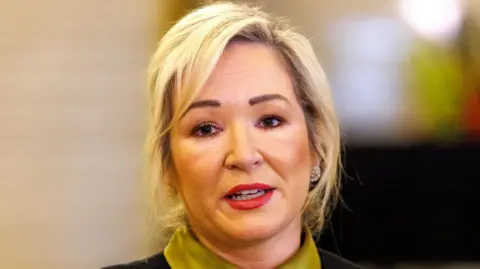
First Minister Michelle O'Neill refused to join another cabinet briefing on the ongoing conflict in the Middle East on Monday afternoon.
Deputy First Minister Emma Little-Pengelly said it was "genuinely disappointing".
O'Neill, who also failed to join a briefing on Saturday, has described the government's "direct involvement in the war as wrong".
Prime Minister Sir Keir Starmer agreed to a US request to use British military bases for "defensive" strikes on Iranian missile sites.
It came after Israel and the US struck Iran on Saturday, killing the country's Supreme Leader Ayatollah Ali Khamenei.
Iran has responded by launching missiles and drones across the region, targeting Israel, Bahrain, Kuwait, Qatar, the United Arab Emirates, Jordan, Saudi Arabia, Cyprus and ships passing through the Strait of Hormuz.
The cabinet briefing took place on Monday afternoon at Police Service of Northern Ireland (PSNI) headquarters in Belfast and Little-Pengelly was in attendance.
She said they were not being asked for their views on "military manoeuvres or tactics" in the virtual meetings with senior security and government officials.
"These briefings will give us an overview of what is happening in a military sense in the region to inform us about the impact of this conflict on the UK, on us here in Northern Ireland, but in particular, on those many thousands of people that are in the region who at the moment are very apprehensive," she said.
The deputy first minister added: "My primary concern in all of this is the safety of Northern Ireland people who are out in the region."
She added that she was not "engaging in a back and forth in relation to this issue with the first minister. My view is that we have a responsibility to be here".
Allow X content?
On a post on X, the first minister said that she would "not be part of any briefing by the British government on their military operations".
She said the war was "reckless and irresponsible," adding: "Further escalation, including the involvement of the British government, reflects a dangerous disregard for international law".
Speaking at Stormont earlier, O'Neill described the events over the weekend as a "spiralling conflict" and "deeply disturbing".
Little-Pengelly said it was "absolutely right" the UK government played its part "particularly in a defensive way to protect citizens and protect against escalation".
Irish passport holder concerns
Hamish Falconer, Parliamentary Under-Secretary of State for the Middle East, said the government would assist those who travelled to the Middle East from Northern Ireland with Irish passports.
"If you do not have a British passport but you want to register your presence then call our consular call centre," he told BBC Radio Ulster's Evening Extra programme.
"I was made aware of the issue and we have taken steps to rectify it.
"The reason people were finding it difficult is because our 'Register your Presence' document... does require a British passport number.
"But, if you are eligible for British nationality and are covered by the Good Friday Agreement for residency in Northern Ireland, call our consular call centre and we will make sure that you are included."
He made the comments after Little-Pengelly said that she had raised concerns that people from Northern Ireland who had travelled to the Middle East on Irish passports might not be able to register with the UK government for updates and advice.
She warned it could affect their inclusion in any future evacuation plans by the UK.
The Democratic Unionist Party (DUP) minister said she raised the issue during a Cabinet Office briefing on developments in Iran and the Middle East.
"Many people who hold Irish passports were born in Northern Ireland, they reside in Northern Ireland," she said.
"They are UK citizens and they are entitled to help and support.
"But of course the consular system does mean that if you travel on an Irish passport you will be directed to the Irish consular services."
 PA Media
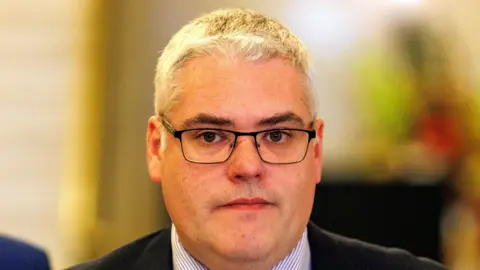
Earlier, DUP leader Gavin Robinson said he was pleased his party colleague was "prepared to step up" in her role as deputy first minister.
The East Belfast MP rejected suggestions of political point-scoring over the first minister's absence from the weekend security briefing.
"It's not a game. We have seen lives lost. We have seen service personnel deployed in the Middle East in the pursuit of democracy and against the evil regime that is Iran," he said.
"I play no games when saying I'm pleased that Emma Little-Pengelly was prepared to fulfil the responsibilities of her office."
Robinson described developments in the Middle East as "hugely concerning" but added "we shed no tears for the Ayatollah."
He said the Iranian regime has "sponsored terror" in the region and elsewhere, and in the past had "strong connections with terrorists that tried to destroy Northern Ireland".
'Supposed president of peace'
The escalating conflict in the Middle East was debated in the Northern Ireland Assembly following a request by Traditional Unionist Voice assembly member Timothy Gaston.
He said the first minister "couldn't find time to attend a security briefing on the situation, but could find time to tweet" her opposition to missile strikes.
Alliance Party deputy leader Eóin Tennyson called for a return to "diplomatic engagement" and said the future of Iran should be "grounded in democratic principles".
Ulster Unionist Party assembly member Doug Beattie expressed concern over US foreign policies but said Iran "should be stopped from having any form of nuclear weapons".
Social Democratic and Labour Party assembly member Matthew O'Toole said US President Donald Trump's government "does not care about stability, doesn't have a plan".
People Before Profit assembly member Gerry Carroll said the "supposed president of peace has once again launched a war" on people who "pose no threat to the citizens of the United States".