Irish government cuts excise duty on diesel and petrol

 Getty Images
Excise duty on petrol and diesel is being cut by the Irish government in a bid to help people with volatile prices caused by the war in the Middle East.
From midnight on Wednesday until the end of May, excise duty on diesel will be reduced by 20 cent per litre and petrol by 15 cent per litre.
The proposals, which were agreed at a leaders' meeting on Monday, were approved by the cabinet on Tuesday.
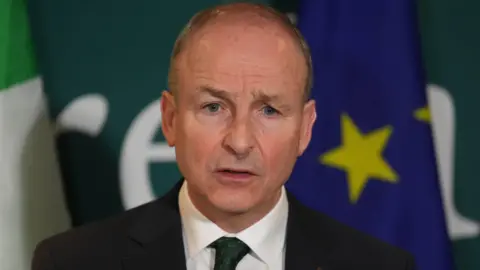
The Taoiseach (Irish PM) Micheál Martin said it will "help shield" homes and businesses from the recent hikes in fuel prices.
The Irish government has been under considerable pressure politically to tackle the rising costs of fuel since prices shot up nearly a month ago.
Diesel prices rose from about €1.80 (£1.56) per litre to between €2.20 and €2.30 at the weekend.
Petrol also rose steeply to about €2.
An increased diesel rebate scheme for hauliers and bus operators has also been announced, which will be backdated to 1 Jan 2026.
A pause on the National Oil Reserves Agency (NORA) levy will mean effective cuts of 22 cent and 17 cent on diesel and petrol.
The Irish government expects the cuts in excise duty and the levy to be "passed on" to consumers by retailers.
Excise duty is a flat charge applied per litre of petrol and diesel. It is one of the main taxes built into the price of fuel.
There was also good news for households struggling with home energy costs.
The Irish government also announced a four week extension to the fuel allowance season.
This means that the 470,000 households who get fuel allowance will receive additional support of €38 per week, totalling €152.
Will people travel across the border for fuel?
For people living in the border counties of the Republic of Ireland and Northern Ireland, the matter of where you buy your fuel has traditionally been important for household finances.
Before 2008, it was almost always cheaper to fill your car in Ireland but since then Northern Ireland has generally been the better option.
That is because fuel taxes in Ireland were raised sharply after the country's financial crisis and continue to rise due to an annual carbon tax escalator.
The UK is supposed to have a similar fuel duty escalator, but it has been effectively frozen for more than a decade.
The most recent figures suggest petrol and diesel are almost 30p a litre more expensive in Ireland. So even if the emergency tax cuts are fully passed through to consumers, Northern Ireland is likely to remain the cheaper option.
 PA Media
The measures will be in place for a defined period of time and the government said they will be adjusted "as circumstances evolve".
The Taoiseach (Irish PM) Micheál Martin said the government was "very mindful of the challenges being faced by increasing fuel costs and remain fully committed to supporting those most at risk".
"Today's measures will help shield households and businesses from the recent unprecedented hikes in fuel prices.
"We are making interventions to reduce the price at the pump for all, to protect our most vulnerable, and to support our haulage industry, as a critical enabler of our economy," he said.
A reputation for providing support
It is not the first time the Irish government has put in place packages of measures tailored to help with the cost of living outside of the usual annual budgetary process.
A package worth €500m in February 2022 included a very popular "energy credit" which gave every household in the country €200 off their electricity bills.
There was criticism within the Government that the measure wasn't targeted and to do so would take weeks, if not months, of work.
Despite being mooted as a "once off" measure to help households with high bills, the energy credit stuck around for several years and formed part of several annual Budgets.
Excise duty was also cut in 2022 after Russia invaded Ukraine and inflation surged.
The issue for the Irish government is that it now has a reputation of providing support for the public during difficult times and comes under pressure to reach into the State coffers whenever there is a crisis.
However, the excise fuel cuts have the same issue as the energy credits as they are also not targeted and anybody can benefit from them.
Excise duty cuts are to remain until the end of May - provided the Irish government doesn't need to extend it.
No doubt it will come under significant pressure to do so.