Resident doctors strike amid 'difficult' flu surge

 BBC
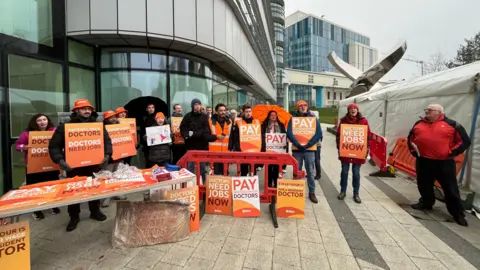
BBCResident doctors across the West Midlands have begun their five-day walkout over pay.
The strike went ahead despite last-minute talks between the British Medical Association (BMA) and the government on Tuesday.
Dr Jessica Sokolov, Midlands medical director for NHS England, said there were 3,360 flu patients in acute and community hospitals in the region, which was "more than we would normally expect at this time of year".
Trusts in Birmingham, Coventry and Warwickshire, Herefordshire and Worcestershire, Staffordshire, Shropshire and Wolverhampton urged patients to attend appointments if they have not been cancelled, and to use NHS 111, pharmacies and minor injuries units if appropriate.
'Heartless and selfish'
NHS England figures show a 69% increase in flu cases across the West Midlands.
In the region, there are picket lines at the Queen Elizabeth (QE) hospital in Birmingham, and at the Royal Stoke University Hospital.
At Russells Hall Hospital in Dudley, senior staff have covered for the striking workers.
Chief of surgery Babar Elahi said: "We are in the middle of this flu surge at the moment, so when you have flu and these combine, it does make it difficult, but I'm really proud of all the team here.
"Everybody has come in, our senior medics, to chip in and help with the shifts."
Cataract patient Andrew Taylor said he did not agree with the strike.
"It's a bit heartless and selfish," he said.
"There's a flu pandemic going round at the moment. Obviously staff will be off sick as well with flu, and there will be an uptake in patients needing care."
Dr Di Adamson, chief medical officer at the University Hospitals of North Midlands NHS Trust, said its priority was patient safety, and it was working to ensure essential services continued to operate safely.
"I would encourage the public to look after themselves, loved ones and check in on vulnerable family members and neighbours during this period," she said.
University Hospitals Birmingham said the trust had well-rehearsed plans to provide safe and effective care.
A hospital spokesperson said it was treating more than 240 patients with flu, and its urgent and emergency care services remained extremely busy.
Dr Brian McKaig, chief medical officer at Royal Wolverhampton NHS Trust, said: "We've had to cancel procedures, whether or not that's outpatient procedures or operations. Fortunately, the numbers are relatively small.
"At Wolverhampton, it's less than 2% and at Walsall it's around 7%, but those patients will all be getting new appointments and rescheduling appointments in the near future."
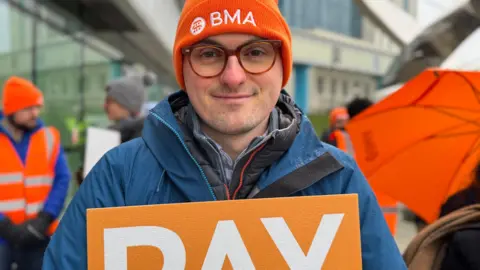
This is the 14th walkout by resident doctors, the new name for junior doctors, in the long-running pay dispute.
"All these patients are now being looked after by consultants and specialist doctors who are the most senior trained doctors within the hospital," said Dr Peter Fahey, co-chair of the BMA West Midlands Resident Doctor Committee, who is on the picket line in Birmingham.
"There is some element of elective care that has been stood down to allow that safety to be maintained for those patients, but I don't think anyone should be concerned about there being a significant risk."

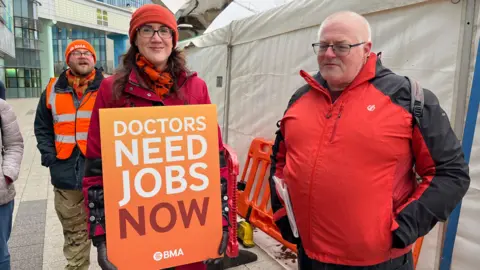
The doctors' union also wants the guarantee of new training places for qualified doctors.
Resident doctors move into these in their third year of training.
In 2025, there were more than 30,000 applicants for 10,000 of these jobs - some from abroad.
"Because there's an inadequate number of training posts it means that lots of doctors are not able to get into training, and that's me, I'm stuck," said Liam Miller, a doctor on the picket line outside the Royal Stoke Hospital.
"As a result of that, I'm not able to progress in my career.... We need the jobs so we can progress, so we can have that security, but patients need these jobs to come through as well, so that we can have the service we need."
The government's latest offer promised to accelerate the expansion of specialist training posts.
The government said it would increase the number of posts by 4,000 by 2028 – with the first 1,000 available from 2026.
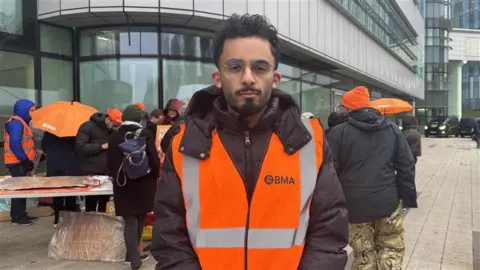
"I'm sorry that it has fallen during this period where the NHS is struggling with flu," said Dr Ossama Elshukri in Birmingham.
He said doctors did not want to strike, but did so because the government was not providing a "credible offer".
Health Secretary Wes Streeting said resident doctors had received the largest pay rises of any public sector employees over the last three years - totalling nearly 30%.
Follow BBC Birmingham on BBC Sounds, Facebook, X and Instagram.