'Cost to supply potatoes has risen 40%'

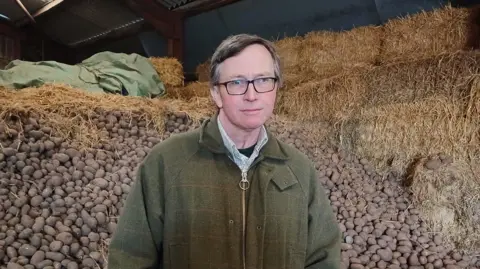 Paul Brown
A farmer has warned that it is "inevitable" that the cost of potatoes in shops will increase as producers grapple to cope with the impact of the conflict in the Middle East.
Paul Brown, who farms potatoes near Eccleshall, Staffordshire, has said the cost to buy new supply has risen by up to 40%, casting doubt on upcoming yields.
Iran's continued blockade of the Strait of Hormuz has led to higher costs for fuel and fertiliser, both crucial elements of food production.
"We've taken a lot of hits over the last two or three years and we simply can't absorb many more of these [financial] hits," Brown told BBC Radio Stoke.
A significant portion of the world's natural gas, crude oil and fertiliser normally passes through the Strait of Hormuz, which has now been effectively closed for more than three weeks.
According to the United Nations around a third of the world's fertilisers - such as urea, potash, ammonia and phosphates - normally pass through the Hormuz Strait.
The National Farmers Union (NFU) president, Tom Bradshaw, told the BBC that the price of cucumbers and tomatoes could rise over the next six weeks, with the cost of other crops and milk increasing in the next three to six months.
Brown, who is also the NFU Staffordshire representative said: "I am short of supply for the whole of the season, so I am definitely going to have to buy some in at inflated prices and we're seeing quotes of 30% to 40% increase if not more.
"Farmers have been under pressure for several seasons now with very variable weather.
 Getty Images
"We've seen increases in things like National Insurance for employees and despite some concessions by the Government, there are still quite a large amount of farmers who are going to be impacted by the impending inheritance tax increase.
"The implication is some farmers are going to think about what they're producing, how much and whether they're going to cut back, because we can't keep effectively borrowing money to pump into food crops just to lose money."
It is not yet clear what increases shoppers could face, as farmers sell produce to retailers such as supermarkets, which in turn set prices for consumers.
Farming minister Angela Eagle said she was "monitoring the developments in the Middle East and the impacts for our food and farming sectors".
Food inflation concerns
Charles Goadby, who farms near Nuneaton in Warwickshire, told the BBC Politics Midlands programme that he bought fertiliser at £325 a tonne last June, but had to pay £480 last week.
He said prices had risen further since then, to about £540 a tonne, if it was even available at all.
Goadby said a third of farmers failed to make a profit last year, forcing them into difficult decisions.
"Do we cut back on fertiliser and cut back on yield potential?" he asked.
With farmers due to go out to fertilise crops at this time of year "it couldn't have happened at a worse time for us," he said.
Goadby believes food prices would eventually go up as a result and it would be "the poorest in society that get hit the hardest".
Dr Alison Gardener, the Labour MP for Stoke-on-Trent South, said fuel price rises were a "real concern" for the government.
She said it was looking at regulation to prevent profiteering and to reduce EU tariffs.
But she added: "If anything, this conflict has shown us that we have to get control of our sovereign energy and really focus in on renewables, so that we are not at the whim of these fossil fuel wars."
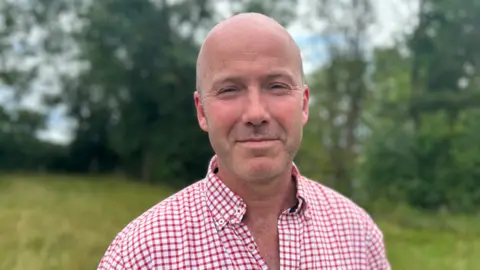
Helen Morgan, the Liberal Democrat MP for North Shropshire, said food inflation was inevitable.
"There's no way you can ask farmers to absorb those additional costs, because they're not making any money really in the first place," she said.
She also said: "The war was reckless, it was illegal, we should be putting a lot of pressure on Donald Trump to end it before we see even more economic chaos."
Jo Barker, a Conservative councillor sitting on Warkwickshire County council, said the best thing the government could do would be to "remove the extra duties and taxes at the moment".
She said it was a measure which would mean "meaningful amounts of money" for farmers.
Follow BBC Stoke & Staffordshire on BBC Sounds, Facebook, X and Instagram.