Plans for huge wind farm paused over 'unfair' grid charges

 BBC
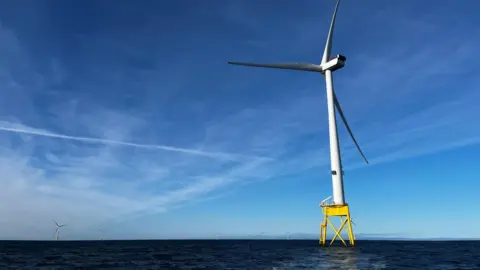
BBCA huge wind farm planned off the north coast of Scotland will not be built unless "unfair" transmission charges are overhauled, the developer has warned.
The 125-turbine West of Orkney wind farm had planned to generate enough electricity to power two million homes by 2029.
But the consortium behind the project says the cost of connecting to the electricity network – which is highest in Argyll and the north of Scotland - makes it impossible to compete against projects proposed in England.
The UK government said it is considering the charges as part of a wider review.
Transmission charges are imposed on power generators to build and maintain the network of pylons and underground cables which carry high-voltage electricity around Great Britain.
The charges for connecting to the grid were designed to encourage generators to build power stations close to where it is consumed.
It means they are the lowest around London and the south of England, where the electricity travels the shortest distance to reach the most densely populated group of consumers.
Some regions even receive payment subsidies to connect their projects to the transmission network.
But with the switch from fossil fuels to renewable generation, the prevalence of wind is now considered the most important factor in selecting a location to build a wind farm.
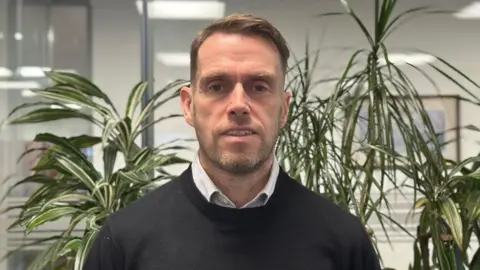
The West of Orkney development's project director, Stuart McAuley, said it is "an unfair system" for projects located in the north of Scotland.
"That is where the highest wind speeds are, and therefore the highest resource for renewable energy," he added.
"However, with the existing system we are penalised for that."
He said the transmission charge can increase costs by up to 30%, which makes the project uncompetitive when bidding for government contracts against renewables developments further south which do not have the same burden.
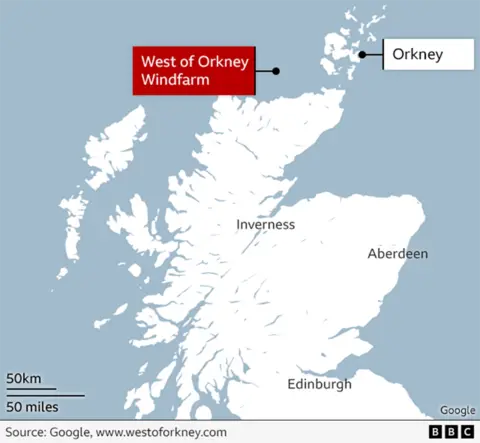
McAuley said £100m has already been spent on the two gigawatt wind farm, which would be located west of the Orkney mainland and north of the Sutherland coast.
Cables on pylons would carry the electricity from Caithness to Peterhead in Aberdeenshire, where it will link to a planned subsea cable running to Lincolnshire in the East Midlands.
At its peak, 80 people were working on the project – but that has been cut to a handful of skeleton staff until the transmission charging issue is resolved.
He added: "At the moment, the investment has to stop, into the project, until we can see a clear route to market."
West of Orkney is being developed by a consortium involving Corio Generation, TotalEnergies and Renewables Infrastructure Development Group.
The project is about half the size of the proposed development at Berwick Bank, off East Lothian, which could become the world's largest offshore wind farm.
Last week the UK government announced that it had guaranteed a minimum price for electricity supplied from Berwick Bank.
It was one of two offshore wind projects in Scotland to be awarded a Contract for Difference, along with the smaller Pentland floating offshore wind farm off Dounreay.
However, industry body Scottish Renewables has warned that transmission charges make it too expensive for most new projects to be built in Scotland.
It said the problem is most acute in the north of Scotland because it is furthest away from the UK's biggest population centre around London and the south of England.
West of Orkney is the first project to explicitly say that development has stalled because of transmission charges.
But Scottish Renewables CEO Claire Mack said: "If we look at the economics around that project versus some others, we can see there are many in the same boat.
"That's deeply worrying for me because I want to see Scotland being at the heart of the energy mix."
Projects like Berwick Bank and West of Orkney will play a significant part in the UK government's clean energy commitments.
Its Clean Power 2030 plan is for 95% of the UK's electricity to come from low carbon generation by the end of the decade.
Announcing backing for the Berwick Bank project last week, UK Energy Minister Michael Shanks insisted the government was looking at transmission charges as part of a review of electricity markets.
But he said there needed to be a more strategic approach to planning the country's energy system.
He added: "At the moment it is market signals that drive this.
"We actually think we should take a much more holistic, strategic approach and say: 'Where do we want power, where does it benefit the system'."
The Scottish government expressed its disappointment that only two projects were awarded contracts in the latest allocation round.
Its draft energy strategy describes the transmission charges as "counter-productive", while the Just Transition Commission said the system inflates costs and needs urgent reform.