Stately home's roof 'not fit for today's weather'

 Callum Thompson/National Trust
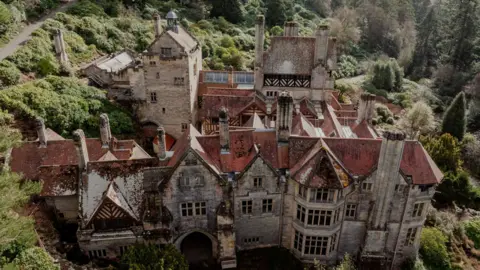
A stately home's Victorian-era roof and plumbing is not fit for today's weather patterns, the National Trust said.
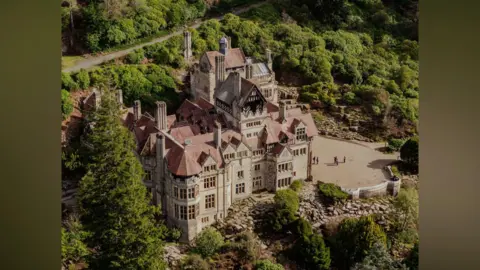
An "enormous scaffold" will be erected across the front face of Cragside house in Northumberland later, as part of a £1.8m conservation project to repair and renovate the roof.
Citing the effects of climate change, property curator Clara Woolford said it was not designed for today's "very different" weather patterns with longer, damper winters and more frequent sudden events like storms.
The project, which is expected to last two years, will use free-standing scaffolding and will pause during Cragside's bat breeding season.
The house was built in 1863 by engineer and inventor Lord William Armstrong.
It is thought to be the first in the world to be lit by hydro-electricity, the National Trust said.
Scaffolding will go up to the roof, which at its tallest point is 85ft (26m) high.
New areas revealed
Woolford said its roof was "really vulnerable" to wind damage and heavy rainfall.
"We've got Victorian-size gutters and we're now getting more water than those gutters can take," she said.
"When we get a heavy downpour, the gutters get overwhelmed."
She said water that was not diverted ends up seeping into the building, which then "becomes a problem for our historic interiors and the collection".
"As climate change continues to create more extreme weather patterns, we're having to adapt the house to be able to make sure that it can survive for another 150 years," Woolford said.
 Callum Thompson/National Trust
Woolford said she was excited for new parts of the estate to be revealed by works.
"I spend my working life in and out of this house, but I have never been to parts of its roof," she said.
During works last year, they found graffiti with the names of its original joiners, who they were able to trace through census records.
"Having that real connection to people who have built the house was fantastic," Woolford said.
"I'm intrigued to see if we find anything else like that."
The house will remain open to visitors during works, which are being funded by the National Trust and grants from the Wolfson Foundation and Sylvia Waddilove Charitable Trust.