Police face 'blue light' driving restrictions under training rules

 Getty Images
About 4,000 Police Scotland officers have had restrictions placed on their driving while on duty, until they undergo training to comply with regulations that came into force three years ago.
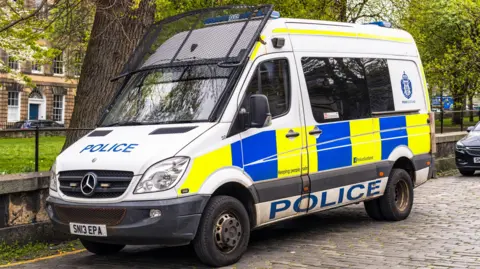
Police Scotland has rescinded authorisation for some officers to provide a blue light response to emergencies when they are driving police vans, while others will not be allowed to take part in the initial phase of a pursuit.
The restrictions were imposed with immediate effect on Tuesday and will remain in place until the officers - roughly a quarter of the force - have taken part in training programmes.
Senior officers said the move would improve safety and would not hamper frontline policing.
The regulations came into force in November 2022 when the Police, Courts, Sentencing and Crime Act amended the Road Traffic Act of 1988.
Why did the law change?
The law introduced a new legal standard for police drivers, which means courts will judge their driving against that of similarly-trained colleagues rather than holding them to same legal tests as ordinary motorists.
In other words, it allows the level of skill achieved through advanced training to be taken into account when considering whether driving is careless or dangerous.
The new test only applies if the officers were driving for police purposes and have received the appropriate training.
Police Scotland said 10,500 of its officers are trained to respond to emergency calls in a vehicle, and of those, 4,000 have been prioritised to take part in a rolling training programme which started this week.
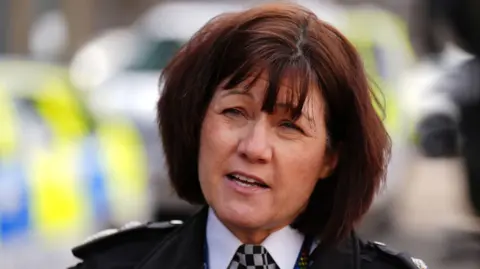
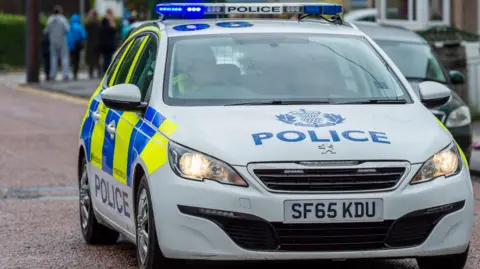
Assistant Chief Constable Lynn Ratcliff said all officers driving police cars will still be able to provide a blue light response to emergency calls.
Asked why Police Scotland had taken three years to respond to the new regulations, she said: "The regulations are UK-wide. They are comprehensive. They are complex.
"We deliver a wide range of driver training in Police Scotland and we have had to review thoroughly every one of those courses to understand what those regulations mean for us."
 Getty Images
Some officers will undergo a one-day course in responding to emergency calls in police vans, while others will spend three days being shown how to drive at the start of a pursuit.
Restrictions have also been placed on some officers who carry out security escort driving and escort abnormal loads, until they have undergone new training.
Will it have an impact on policing?
Ratcliff said blue light police pursuits were rare and there were plenty of trained officers able to carry out emergency responses while the training is rolled out.
"We're enhancing the training to make sure we align with the regulations and also provide that greater level of legal protection to our officers," she said.
"The public can still expect to see police vans on the road, they can still expect police vans to respond to emergency calls because we already have officers who are trained to do that and we're just enhancing that capability within the force.
"The instances where police have to pursue suspects or offenders in a vehicle are very rare. There are fewer than three of those types of calls a day across the country.
"We have a significant number of officers who are trained to undertake those pursuits. They do so on a daily basis and they will continue to do so."
The Scottish Police Federation - which represents officers up to the rank of chief inspector - has welcomed the training but it believes the restrictions will have a significant, temporary impact.
Brian Jones, the vice-chair of the Scottish Federation, said: "We applaud the force executive for doing this and it's a huge step for Police Scotland.
"It will have a huge abstraction on operational abilities but it's something we've been asking the force to do for the last 10 to 12 years.
"It not only protects our officers and our members but it also protects the public we serve and gives them confidence that the officers who are attending incidents are suitably trained."