Minister rules out national security status for new fisheries ships

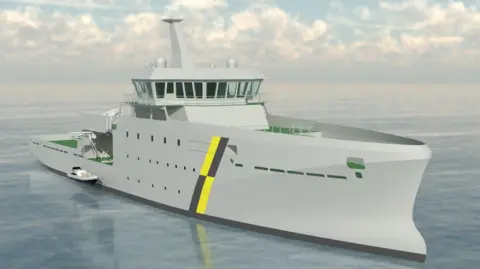 Scottish government
A call to designate two planned Scottish fisheries ships as vital to national security, boosting the chances of them being built in the UK, has been rejected.
Rural Affairs Secretary Mairi Gougeon said the ships would have no military capability and did not qualify for competition law exemptions for defence vessels.
The ships they are replacing were both built by the Ferguson shipyard and there have been suggestions the orders could provide new work for the state-owned firm.
One of the ships would be a patrol vessel to enforce fishing regulations, while the other would be a research ship.
The timetable for ordering the new ships is vague with the Scottish government only saying it will happen in the "coming years" but last week it released images and concept design information.
Previously it had suggested the procurement process might begin in late 2025, but information on the Public Contracts Scotland website has since been amended, according to online publication UK Defence Journal.
One of the ships would replace the marine protection vessel Minna, built by Ferguson's in 2002, and be equipped with three boarding craft for inspection roles.
The second would replace the fisheries research ship Scotia, also built by Ferguson's in 1998, and would be fitted with advanced sonar and other monitoring equipment.
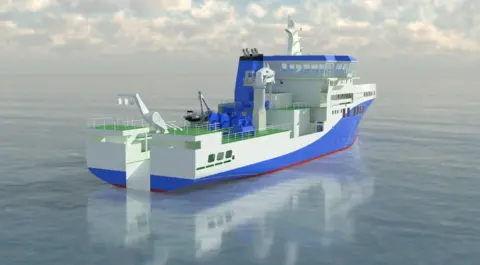 Scottish government
MSP Paul Sweeney, who leads Holyrood's cross-party shipbuilding group, asked in a written question whether the ship orders could be directly awarded or the bidding restricted to UK-based shipyards.
Sweeney suggested they might qualify for a "section 45" exemption from the UK's Subsidy Control Act in view of the role they would play in national security.
However, in her reply, Gougeon said defence was a reserved matter and Scotland did not commission independent naval vessels.
She added that the design of the ships "does not include warship specifications or military capability, which could misrepresent their authority at sea".
She said they were "merchant- class vessels" and any direct award of a contract would have to comply with both procurement and subsidy control legislation.
Echoes of an earlier debate
The debate over whether such vessels can be classed as defence-related "grey ships" mirrors a political row almost 20 years ago.
In 2007, Ferguson's, the Clyde's last commercial shipyard, was struggling in the face of competition from Poland, which had recently joined the EU, with claims that overseas yards were getting unfair state subsidies.
There were suggestions that by making a planned fisheries patrol vessel "lightly armoured" it could be classed as a warship, allowing an exemption from EU procurement rules.
At the time, the opposition SNP's deputy leader Nicola Sturgeon said: "Before the contract for a new fisheries protection vessel is put out to contract it should be reclassified as a 'grey ship' in order that the work can simply be given to a Scottish yard.
"It's time for action now to save jobs and protect our shipyards."
But the Labour/LibDem coalition in power at Holyrood insisted that redesignating the ship was not an option.
The patrol vessel was never built as the fleet renewal programme was reviewed after the SNP came to power later in 2007, and it decided not to proceed with the order.
Changed geopolitical climate
The chief executive of Scottish Engineering, Paul Sheerin, recently suggested the heightened level of threat since Russia's invasion of Ukraine meant it was time to look again at what was considered a military vessel.
Writing in the Herald, he said: "There is a valid argument that given the current precarious geopolitical climate, we should consider the potential dual use of publicly procured ships in terms of what role they could play in the event of the UK being pulled into conflict and so review their build in terms of sovereign capability."
The Ministry Defence (MoD) has traditionally restricted bidding for "complex warships" such as frigates and aircraft carriers to UK firms but does not extend the practice to support vessels.
In recent months, the MoD has faced criticism after it emerged that 24 tugs and other small support vessels for Royal Navy bases at Faslane and Portsmouth will be built overseas.
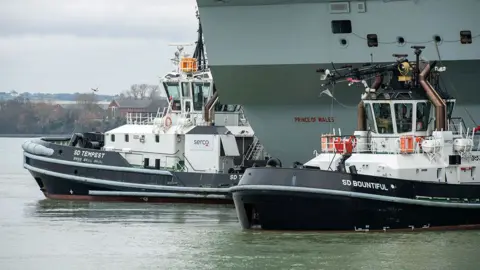 Serco
SercoThe £850m maritime service contract was awarded to UK-based Serco but the deal left it free to place the shipbuilding order with Damen, a Dutch firm which is currently contesting allegations that it breached sanctions on Russia.
The Ferguson shipyard, which was nationalised in 2019, is currently completing MV Glen Rosa, the second of two dual-fuel CalMac ferries which have been blighted by design challenges and disputes over costs.
The Port Glasgow firm, which employs about 300 workers including 50 apprentices, has no more orders on its books, having been undercut last year by a Polish rival in its bid to build seven simpler and smaller CalMac vessels.
Unions and representatives from the local community have asked the Scottish government to directly award it the contract for a replacement for another ferry, MV Lord of the Isles, to allow it to move on from the ferries controversy.
Ministers are still weighing up if that would be legal under procurement and subsidy control law.