Woman, 81, loses another home to coastal erosion

 Edd Smith/BBC
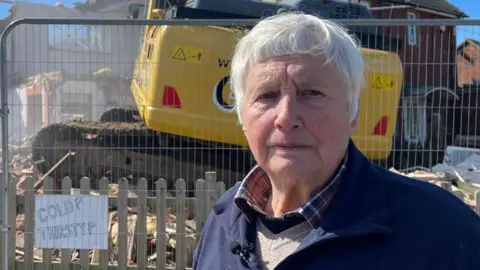
An 81-year-old woman who is losing a second home to coastal erosion has explained why she has continued to live near her village's crumbling cliffs.
In 2013, Bryony Nierop-Reading's home in Happisburgh, Norfolk, collapsed into the sea after it was teetering on the cliff edge. Now the home she moved into eight years ago is one of three properties due to be demolished.
North Norfolk District Council has worked with owners to provide a range of options, including financial support of £40,000-£100,000.
"I always knew it would go; I was never in any doubt about that; it was just about how long; it happened quicker than I thought it would, which is a pity," she said.
In 2009, Nierop-Reading bought a bungalow metres away from the cliff edge, however, this was lost to the sea following a storm.
She had been offered £53,000, and moved into a second property in the village.
Nierop-Reading said the money enabled her to use a consultant to secure planning permission to live in a static unit in her new garden.
She said: "Before I bought the house I had to consider the fact that I would ultimately lose it. My reason for staying is that the further away you are from the coast, the less concerned you are about coastal erosion."
 Edd Smith/BBC
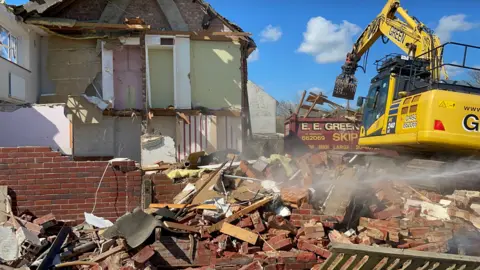
While she started campaigning to save the village a "long time ago" that had been put on pause while she watched the demolition of her second property.
She said that once the roof had fallen in it was "no longer a home" and was rapidly turning into a pile of rubble.
"The demolition people started stripping out the interior at the end of last week... I have been up in the night a lot looking at the window of the house and thinking I'm not going to be able to see that tomorrow," she said.
"The lighthouse light reflects off the house — it did — now the house is barely there, it is not going to reflect anymore. I will miss that."
 Edd Smith/BBC
Demolition work started on Tuesday and was expected to take up to two weeks.
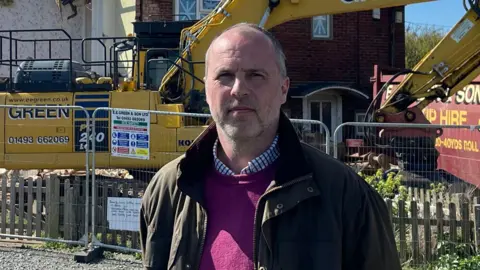
Rob Goodliffe, coastal manager at the council, said: "We have managed to work with the property owners and we have prepared for this; we have planned for this; we have provided some additional options that wouldn't otherwise be available."
He said the council had also offered to buy properties from the owners and give professional service support.
He said: "You can't get insurance for coastal erosion. Many properties have been bought without potentially knowing the full risk... our coast is changing, perhaps faster in some locations."
While defences have been in place since the 1960s, he said they were meant to slow down erosion not stop it entirely.
"These houses don't look too dissimilar to my own house," he said.
"It's heartbreaking for those people involved which is why for many, many years, North Norfolk District Council has sought to support communities."
Do you have a story suggestion for Norfolk? Contact us below.
Follow Norfolk news on BBC Sounds, Facebook, Instagram and X.