Rare Anglo-Saxon sibling burial proven by DNA test

 Neil Emmanuel
DNA analysis has revealed that two children buried together in an Anglo-Saxon grave at Cherington, Gloucestershire, were brother and sister.
Archaeologists say it is rare in Anglo-Saxon cemeteries to find that two people were buried together in the same grave at the same time.
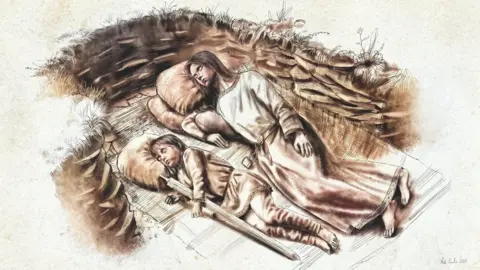
The arrangement of the grave appeared to reflect a close and caring relationship between the two children, according to Cotswold Archaeology, who completed the excavation.
Testing then carried out by the Francis Crick Institute proved the familial link between the siblings, whose remains were uncovered in 2024.
The grave contained a young boy buried with a sword and an older girl buried with a workbox. Both children had been placed on their side, with the older girl facing the younger boy.
Archaeologists say the positioning of their bodies indicates they were buried at the same time, which is rare, and may also suggest death from a fast-acting infectious disease.
Matt Nichol, senior project officer at Cotswold Archaeology and lead archaeologist on site, said it "really brings the human side of our Anglo-Saxon past much closer".
He added: "It becomes more poignant, in a way we very rarely experience."
 Cotswold Archaeology
An Anglo-Saxon sword was found at the site in Cherington, near Tetbury, in 2016.
Subsequent excavation in 2019 revealed a "princely burial" of a young boy buried with elaborate grave goods.
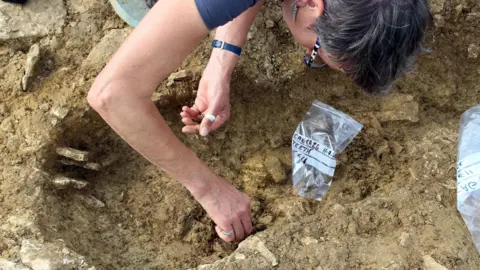
In 2024, further excavation showed the cemetery extended beyond the previously investigated area, and the discovery of a second sword burial led to the uncovering of the double grave.
Archaeologists worked alongside volunteers from Operation Nightingale, an initiative which assists the recovery of wounded, injured and sick military personnel and veterans by getting them involved in archaeological investigations.
Richard Osgood MBE, senior archaeologist for the Ministry of Defence and founder of Operation Nightingale, said: "The results show how important scientific advances have been for archaeology.
"The work has revealed an astonishing, if tragic family story."
Follow BBC Gloucestershire on Facebook, X and Instagram. Send your story ideas to us on email or via WhatsApp on 0800 313 4630.